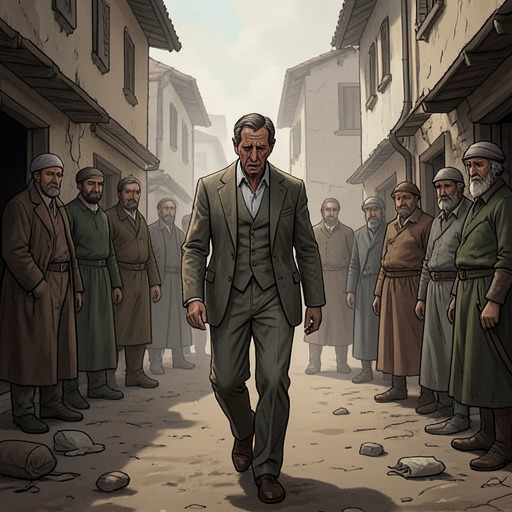
Abdellah interrogates Ismael about Driss’s death
The ForgivenAbdellah’s interrogation of Ismael follows Driss’s burial and shifts the question of responsibility from the fatal encounter itself to the testimony of the one other person who was there. Abdellah is grieving, suspicious of Ismael, and uncertain what he will do to David. What he needs first is an account of Driss’s death; the interview ends not with certainty or revenge, but with Ismael placed under an unsettled obligation to the bereaved father.
The Need to Know
The scene begins after the funeral, when Abdellah waits at the edge of the village for Anouar, who is returning on foot from Tabrikt. Driss’s body has been buried, and Abdellah has already spent the journey from Azna considering what to do about David. Yet he has not settled on a course of action. The question that governs his next decision is whether David will tell him truthfully how Driss died. Abdellah regards an accident and a lie as morally different: an accident is not, in his view, a deliberate choice, whereas lying would be a specific act of a person’s will. He therefore makes truthfulness a condition of what may follow, and regards deception as harder to forgive than the original death.
Anouar arrives with Ismael, who is wrapped in black rags to conceal his identity. The disguise, Ismael’s nervousness, and his evident wish to make himself inconspicuous set the tone for the questioning. Abdellah knows him as a boy who has been in his house often and who had at times seemed inseparable from Driss. He tells Ismael that he is not the one who has done anything wrong, while also insisting that he needs to know everything. The reassurance does not remove the pressure: Ismael is being asked to account for the last journey he and Driss made together, and Abdellah’s decision about David still depends on learning what happened.
Ismael’s Account
Anouar helps make the questioning possible by urging Ismael to explain what happened. He distributes and lights cigarettes, and the three wait for the moon to appear above the Jbel Issomour massif. The pause gradually makes the gathering more composed and conversational, but it does not resolve the uncertainty about Ismael’s honesty. Ismael first asks about the funeral and apologizes for not attending. He then says that he and Driss left together carrying Psychopyge trilobite specimens wrapped in paper, intending to sell them in Midelt. He identifies a German dealer there as a possible buyer.
Abdellah’s questions draw out the circumstances on the road. He says that the foreigners drove up and asks what happened next; Ismael reports that he and Driss ran toward the car and that its occupants slowed down. Anouar objects that this account seems impossible, and Abdellah presses Ismael about what followed. Ismael finally admits that he ran because he was frightened. He says Driss was already dead and that he saw the man turn him over. The admission establishes that Ismael was present when David reached Driss, but it also exposes Ismael’s own abandonment of his companion at the scene.
The account remains limited by the witness giving it. Abdellah considers Ismael a habitual liar and suspects him of petty theft, including digging in the fossil trenches at night. Ismael’s silence when Abdellah asks whether they were waiting for cars adds to the father’s mistrust. Abdellah also doubts whether the two boys were on the road only to sell fossils, and cannot treat Ismael’s word as conclusive. The interview supplies a crucial account of Driss’s final moments while leaving Abdellah uncertain about the witness’s reliability and the pair’s full purpose.
Anger and Obligation
After hearing that Ismael fled, Abdellah circles the crouching boy. He wants to kill him, yet recognizes that Ismael acted out of self-preservation. The narrative holds these responses together rather than presenting the boy as either innocent or wholly culpable: he abandoned Driss, but he did so out of fear, and Abdellah himself cannot be sure what the two had been doing. Anouar and Abdellah respond to the image of David running after Ismael with a pained, uneasy laugh. The moment offers no light relief; it underlines the strange and painful sequence of actions Ismael has described.
Abdellah then strikes Ismael, but the account emphasizes that the violence is halfhearted. His hands do not fully connect, his anger appears partly feigned, and Ismael turns away without reacting strongly. Abdellah’s outburst is therefore not a decisive act of vengeance. He curses the boy and asks what Ismael will do for him when the time comes. Ismael promises he will do anything. Abdellah answers that he has not asked for anything yet, but that Ismael owes him. The exchange turns the interrogation into a demand that may extend beyond the immediate questioning: Abdellah does not specify the future service, and the scene does not establish what it will be.
An Unsettled Ending
Afterward, the three fall silent as the moon rises and the man-made caves in the mountain become visible. Ismael furtively looks back down the dried oued, thinking of running away to Casablanca; he and Driss had spoken often about leaving for the city. He does not move. Abdellah, meanwhile, stops watching him and looks toward ladders suspended across the cliff face. The physical distance between the men remains, but Abdellah’s anger has begun to dissipate, and he lets Ismael cover his face again.
The scene ends without a final judgment on Ismael or a settled response to David. Abdellah’s expectation that fate will take over contrasts with the deliberate moral test he set for David: the truth still matters, but Abdellah has not yet decided what to do with what he has learned from Ismael. The interrogation consequently reveals both the limits of testimony and the uneasy passage from grief toward action. Ismael’s admission gives Abdellah a witness to Driss’s death, while his acknowledged flight and uncertain credibility leave the account incomplete. The debt Abdellah imposes is the scene’s unresolved consequence.