Anouar
The ForgivenAnouar is a member of the Aït Kebbash community and Abdellah’s son, a courteous and observant guide who helps David navigate the people and customs of the desert. His role is practical but also interpretive: he explains local boundaries, carries messages, and offers David a route back to Azna. At the same time, his own plans point away from Tafal’aalt, toward a future in France that he describes as a matter of survival.
Identity and First Encounters
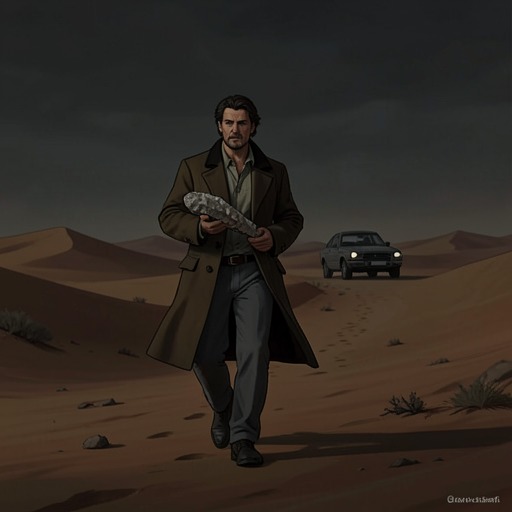
Anouar first appears beside David during the drive away from the community. Tall and fluent in French, he speaks with conspicuous politeness and offers David a cigarette for the road. David reluctantly accepts the crumpled Gitane, and Anouar lights it for him. Their meeting is marked by a small easing of tension: they look at one another without turning the encounter into a contest. Anouar’s manner is courteous and calm, with a boyish quality that makes him an unexpectedly approachable presence among the men accompanying David.
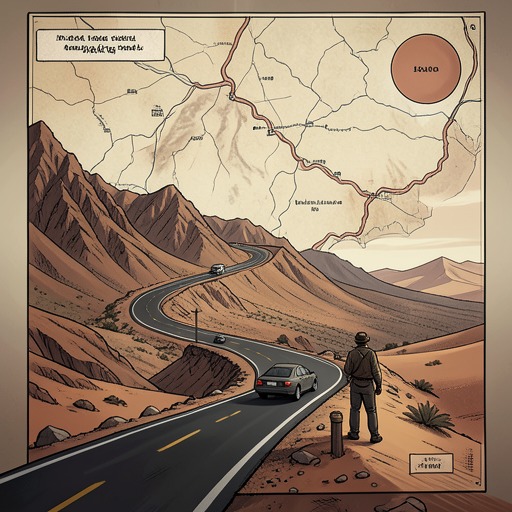
He also speaks plainly about David’s wife, Jo, remarking that she is very pretty and expressing the hope that he might one day have a gazelle like her. The comment is both a compliment and a glimpse of Anouar’s light, teasing manner. On the drive, he is the one who leans close to David to explain the immediate plan: they will continue through the night, stop in Erfoud to see people, have a drink, and sleep. While Abdellah concentrates on the road and avoids looking at David, Anouar supplies the quiet information that makes the journey legible to him.
Guide to Local Boundaries
On the road toward Merzouga, Anouar explains the difference between the men of Tafal’aalt and the Aït Atta, whom he describes as prospecting for aquifers and crinoids. The Tafal’aalt men, by contrast, deal in trilobites. He presents this division with a mixture of local pride and dismissiveness toward the neighboring group, then explains the commercial value of the fossils: traders from Germany, France, and the United States pay substantial sums for well-preserved Comura specimens dug from the Jbel Issomour massif, and some sell for hundreds of euros. His account links the region’s social distinctions to a livelihood shaped by fossil extraction and distant buyers.
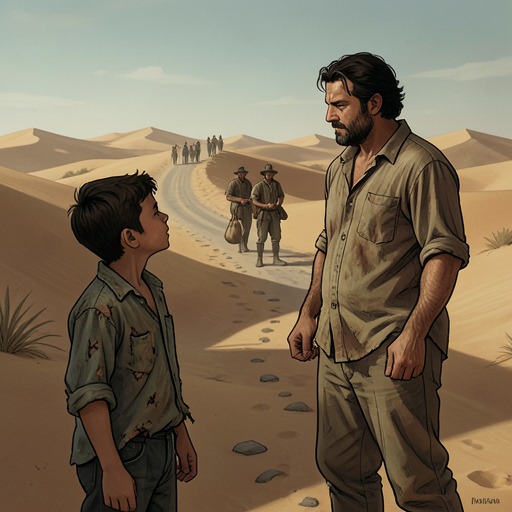
At the Mirzan quarry, David buys a small fossil from a girl who identifies herself as Tuda. Anouar gently draws him away from the group gathered around the tea. He then privately explains Abdellah’s rule: David must not drink from the same cup or eat from the same plate as the others, and even their shadows must not cross. Anouar does not present the restriction as his own; he clarifies that it is Abdellah’s prohibition and tells David in a low voice, away from the others. The moment shows his particular position between David and his father: he can make a rule understood without challenging it openly.
Anouar also acts as a messenger within the family and community. When Abdellah asks about Ismael, Anouar reports that he is hiding with his father in Tabrikt. Abdellah instructs him to tell Ismael that he wants to speak with him that afternoon and expects him to respect the request, while acknowledging that Ismael will not attend the burial. Anouar answers that Ismael is afraid. His brief report conveys both the practical limits of Abdellah’s authority and the apprehension surrounding Driss’s death.
Family, Care, and Departure
Anouar’s relationship with Abdellah is affectionate neither in display nor in easy agreement, but his filial position is clear. He carries out his father’s instructions, including the order to drive David straight back to Azna, while also finding room for small acts of choice. At one point he brings David a large metal dish of goat tagine. David opens the door quickly and says he is starving; Anouar checks whether everything is all right. The exchange is simple, but it places food and attention alongside the more formal duties Anouar performs for his father.
His own future is unsettled. On the way to Alnif, Anouar tells David that he plans to emigrate to France the following year. A cousin who owns a restaurant in Rennes may give him a place to work, though Anouar expects the move to be difficult. He has discussed it with Abdellah, who cannot prevent him. Anouar describes leaving as nearly a matter of life and death, a stark judgment that sets his hopes against the poverty and limited prospects associated with Tafal’aalt. His plan is not presented as a completed escape: it remains a difficult intention, dependent on the possibility of making a living elsewhere.
After Abdellah has judged David sincere, Anouar carries out his father’s final instruction concerning the return journey. At a café in Alnif, he tells David that he is to drive him straight back to Azna without stopping. Yet he immediately offers a limited exception: if David wants to buy fossils, they could spend an hour in Rissani, where Anouar knows a good seller. The offer makes his practical loyalty visible without reducing him to a simple instrument of Abdellah’s orders. David declines and asks only to be taken back to Jo, then wonders whether Abdellah has found it in himself to forgive him.
The Gift and Narrative Significance
During a later stop, Anouar goes into a small store to fill the water container. David, thinking of Anouar’s plan to emigrate, has decided that two thousand euros could help him reach Paris and live there for a few weeks. He imagines the money as a gesture that might materially change someone’s life. When Anouar returns with a heated croissant and offers it to David, David laughs, takes it, and turns the bag toward Anouar, saying that it is for him. Anouar asks whether it is truly for him, and David confirms the gift. The scene gives their exchange a quiet reciprocity: Anouar provides immediate care, while David attempts to offer resources toward the future Anouar has described. The evidence establishes the offer, not what Anouar ultimately does with the money.
Across these encounters, Anouar is neither a detached observer nor a spokesman for every person around him. He conveys local rules and economic realities in his own voice, carries out Abdellah’s requests, and quietly reveals that he intends to leave. His careful explanations make him an intermediary between David and the community, while his emigration plan shows that he, too, is negotiating the constraints of life in Tafal’aalt. The journey back therefore ends not with a settled resolution for Anouar, but with a concrete possibility placed in his hands.