Bereavement
The ForgivenAbdellah’s bereavement is the novel’s account of a father confronting the death of his only son, Driss, and of grief becoming an ethical claim upon the person responsible. At first Abdellah can only look at the body; later, his grief sharpens into the question of where the killers are. His eventual request that David return with Driss’s body to Tafal’aalt connects loss to burial, custom, and an obligation that wealth and police leniency have not erased.
The Father and His Only Son
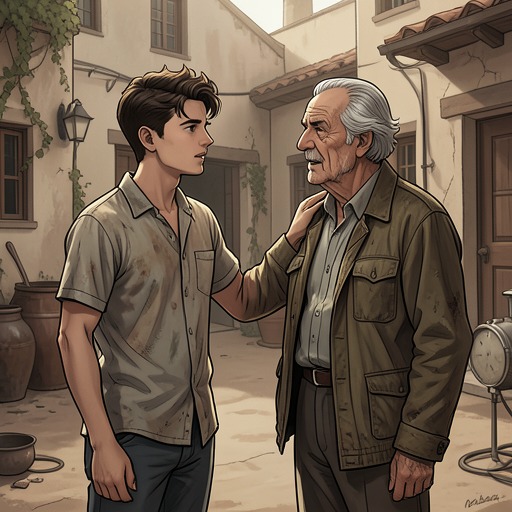
When Hamid expresses sympathy and asks the dead boy’s name, Abdellah answers that Driss was his only son. The brief exchange establishes the relationship at the center of the scene: this is not simply a community receiving a body, but a father meeting the death of his sole child. Abdellah’s response to the condolences is restrained. He does not elaborate on his loss, and the account does not offer a consoling explanation for it. The fact of his only son’s death stands plainly, before the reader, as the defining circumstance of his grief.
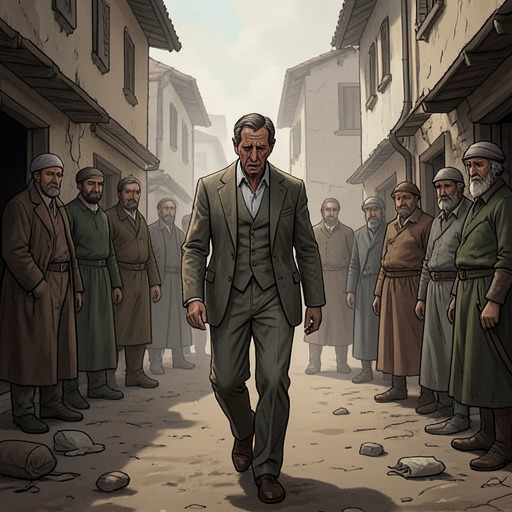
The setting makes the distance between home and loss tangible. Driss’s body has arrived at a village of about one hundred people on the far side of the Tafilalet, beyond Alnif, near the advancing desert edge and the quarries around Jbel Issomour where the community makes its living. This is where the body must be received and buried, far from the circumstances in which Driss died. Abdellah’s grief is rooted in this particular community and its obligations, even as the death has brought him into contact with visitors from elsewhere.
Encounter with the Body
Inside the room, attention briefly turns to its crowded, stable-like appearance. That ordinary observation gives way when the onlookers’ thoughts return to Driss, laid out in the center. Abdellah is permitted to approach his son alone. The staff watch from a distance, sharing in the scene as witnesses: they understand the death as an injustice and register that the responsible visitors have not come before the community to explain themselves or apologize. The account further emphasizes the disparity between the bereaved family and those visitors, who have been released by the police without a serious reprimand. Money appears to have insulated them from consequences and sharpened the anger of those watching.
Abdellah’s own response is not an outward display of anger. His face and bearing convey stupefaction; he does not blink or speak as he looks at the body. The narration slows the encounter into a sustained act of looking. For Abdellah, the living son he knew has become a physical presence that he cannot readily comprehend or accept. The account describes him as absorbing the sight until he can take in no more, then presents grief not as a release but as an emptying. His hands hang at his sides, and his mind seems to withdraw. The stillness is not evidence that the loss has left him untouched; it marks the extent to which he has been overwhelmed.
Grief Turns Toward Accountability
Eventually Abdellah’s lips begin to move, although no words emerge. The silence around him becomes uneasy, and the onlookers grow suspicious and restless. His attention has turned inward: the words of the Prophet and the remembered words of his own father gather in his mind, while his perception of the room becomes indistinct. The narrative gives no complete account of what those words say or how Abdellah interprets them. Instead, it follows the movement from disorientation to a single urgent concern: the killers are absent, and Abdellah wants to know where they are.
That question makes grief inseparable from the circumstances of Driss’s death. The bereavement belongs to Abdellah, but the scene also places it before the staff and connects it to the visitors’ failure to appear and the police’s unequal treatment. Their quiet anger cannot restore Driss or supply the apology that has not been offered. The account does not reduce Abdellah’s response to a settled plan for revenge; what it establishes is that his grief has made the absence of the responsible person impossible to overlook.
The Burial Request and Its Significance
Abdellah’s later conversation with Hamid converts that demand for acknowledgment into a concrete request. He wants David to return with the family to Tafal’aalt to bury Driss, on the grounds that the man responsible for the death should accompany him. Hamid presents the request as customary and proper, while also conveying uncertainty about how the Europeans will receive it. Abdellah speaks with measured insistence; David and Richard are excluded from the conversation between him and Hamid until the proposal is explained to them.
The request gives Abdellah’s bereavement a public consequence. David’s presence at the burial cannot undo the death, but the custom makes him travel with the body and face an obligation that cannot be dismissed as a private feeling. In this way, the grief of a father becomes a demand for the person responsible to enter the community and participate in the return of his son. Abdellah’s restraint and his insistence belong together: the scene first shows a father almost unable to respond to the body, then shows him acting within the conventions available to him. The novel thus presents bereavement not as a completed passage toward acceptance, but as a continuing loss bound to memory, burial, and responsibility.