Dally Margolis
The ForgivenDally Margolis is a wealthy American businessman whose extravagant hospitality helps make Azna Estate a destination for foreign guests, while his influence and sexuality become subjects of local gossip. He presents the restored ksour as a place of welcome and cultivated pleasure, but the discovery of a dead boy in the garages exposes a sharp contrast between his gift for orchestrating appearances and his unease when events threaten to escape his control.
Identity and Public Reputation
Among the older residents of Azna Estate, Dally and his partner, Richard Galloway, are known as wealthy foreigners with strange customs and tastes. The residents disapprove of the couple’s homosexuality, yet their judgment is mixed with admiration: the visitors bring lavish spending, generous wages, and visible improvements to the ksour. Their prosperity is tangible in the imported oranges, Parisian butter, and drinking water shipped from Meknes. Dally’s sexuality is thus discussed within a community that condemns aspects of his life while benefiting from the money and employment his household brings.
The same mixture of fascination and suspicion shapes local accounts of the visitors’ private world. Rumors describe Dally as the submissive partner and Richard as the more dominant one; stories about jinn angered by the presence of infidels turn unexplained kitchen noises into signs of supernatural outrage. The residents’ talk of scandal inside the main house intensifies because no one claims to have seen it until the morning after. These are reports circulating around Dally, not a direct account of what happened inside the house, and they show how his reputation is made partly from observation and partly from rumor.
The Making of a Social World
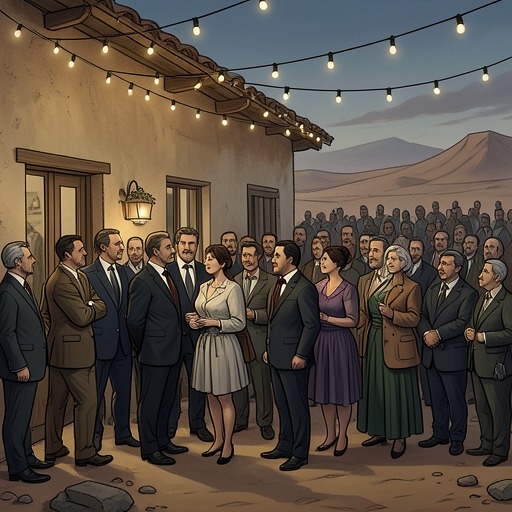
Dally’s public role is that of an exacting host and organizer. He and Richard expect about forty people for a weekend, and the small houses fill with guests. In the courtyard, tables are laid with fruit punch and iced rose water, while figs are split and arranged for serving; a Gnawa group arrives to perform. The old observer watching the preparations sees the weekend not as an ordinary gathering but as something designed to become memorable. Dally appears to him as a man of meticulous inner workings, combining clocklike precision with theatrical movement and a talent for orchestration.
His business helps explain the resources behind this display. Dally runs several e-commerce sites in the United States specializing in European fashion, one of the few areas of the economy said to have avoided the latest difficulties. At the gathering, he makes toasts while drunk and describes the long work involved in shaping the ksour to what he calls their vision of paradise: a place to receive the people they love. He credits the project’s success to the help of Moroccan friends. An Irish guest makes a cynical aside suggesting that connections in the Ministry of the Interior may also have mattered, but the remark is an insinuation, not confirmation of how the project was secured.
Hosting, Taste, and Control
Dally’s hosting depends on carefully arranged contrasts: an old ksar becomes a polished setting for international guests, local foods and music meet imported habits, and the staff’s work supports a show of relaxed abundance. The residents notice both the extravagance and its economic effects. A later celebration brings floodlights to the lacework facade; staff carry refreshments, the tamarisk trees are illuminated, and servants applaud themselves while quietly eating oranges. Dally and Richard’s visitors spill into the courtyard among bowls of fruit punch, iced rose water, and plates of figs. The spectacle makes the estate’s transformation visible, but also reveals the labor that sustains it.
Dally’s idea of paradise is therefore not detached from management. The weekend has a guest list, accommodations, food, entertainment, and a setting arranged for reception. Even the local observer who finds the visiting guests alienating recognizes Dally’s talent for turning a potentially forgettable weekend into an event. That appraisal sits beside the residents’ unease about the visitors’ habits and their stories of scandal. Dally’s social success does not dissolve the distance between guests and community; it gives that distance a lavish stage.
The Body in the Garage
That cultivated control is tested when a boy’s mangled body is laid out on a worktable in the garages, converted from former stables into space for five cars. Three oil lamps stand around the corpse after the staff turn off the overhead neon light, disturbed by the sight and unsure what to think. Dally paces without looking at the body and repeatedly asks Hamid when the police will arrive. When Hamid answers that they will arrive when they arrive, Dally curses and calls the situation a disaster. His agitation contrasts with the composed organizer associated with the weekend festivities.
Richard walks around the table and regards the boy’s appearance with an airy, aestheticized sadness, while Dally takes Richard’s arm and speaks rapidly in English so the staff cannot understand them. Visibly upset, he asks what they are going to do now that Richard has called the police and warns that the arrival will turn the situation into a circus. When Richard asks what he suggests, Dally proposes settling it that night by paying. The exchange establishes his immediate response as an attempt to contain the crisis through private arrangement. It does not establish that he caused the boy’s death or that any payment was made.
Character and Narrative Significance
Dally is presented through a tension between orchestration and vulnerability. In public, he can coordinate a large weekend and turn a restored ksar into a carefully staged retreat; at the garage, he paces, curses, and tries to prevent the police response from becoming a spectacle. The contrast does not erase his organizing ability so much as reveal its limits: a well-managed setting cannot guarantee control over what happens within it.
His characterization also depends on conflicting viewpoints. The local residents’ account combines material gratitude with moral disapproval, while the observer at the party admires Dally’s skill even as he finds the visiting guests’ fashionable detachment alienating. Richard’s private assessment of the corpse and Dally’s alarm offer another contrast between the partners. Through these shifting judgments, Dally’s wealth and hospitality remain both real sources of influence and conspicuous signs of social separation; when a body appears, the carefully arranged image of welcome gives way to an urgent effort to manage consequences.