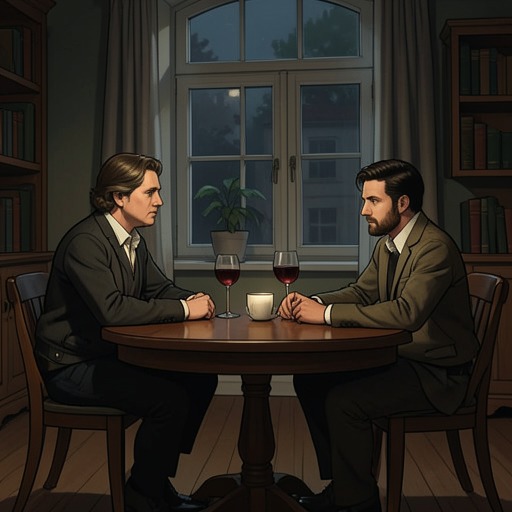
David Henniger and Jo Henniger
The ForgivenDavid Henniger and Jo Henniger’s marriage is presented as an established but combative partnership, shaped by years of mutual reproach and a basic disagreement over freedom, responsibility, and whose judgment should prevail. Their trip to Morocco brings that pattern into sharper focus: David treats Jo’s reluctance as a rigidity to be overcome, while Jo’s interventions register to him as attempts to contain the pleasures he associates with being a man. After a fatal road accident, their conflict acquires a moral weight that neither can easily resolve. Jo names what happened; David insists on his innocence even as the facts trouble that belief.
A long-standing contest
The narrator describes eleven years of this kind of contest between them. Jo is characterized as exact and fastidious, while David is bad-tempered and inclined to think that women seek to suppress the small transgressions that make life worthwhile. This is David’s resentful interpretation, not a shared account of their marriage: it turns Jo’s corrections into an attack on his freedom and gives his irritation a gendered rationale.
The age difference is also made explicit. Jo is ten years younger than David and forty-one, yet David regards her manner as that of an old-fashioned nanny. The contrast conveys more than their ages: he experiences her as someone who reproves and restrains him, while he casts himself as the adventurous party. His imagined adventures, however, are described as minor and unlikely to have serious consequences. That qualification complicates his complaint. The conflict is not simply over a demonstrated danger but over Jo’s authority to object and David’s conviction that she should let him test the limits for himself.
Their disagreements have become familiar enough to form a recurring marital ritual. Jo reproves; David interprets the reproof as suppression. His inward assurance that he would never let an adventure go too far shows how confidently he separates his intentions from the risks Jo may perceive. The passage does not establish that her caution is always right or that his self-assurance is always false. It does show that each approaches the dispute from a different account of what counts as harmless and who gets to decide.
The journey and its imbalance
On the walk back to the Salam, David takes Jo’s hand, a gesture of closeness set against his private misgivings about the trip. He wonders whether the sudden departure and expense were worthwhile, given that they came for amusement, friendship, and three days under a fiercer sun. He knows Jo had not wanted to come. The journey therefore exposes an asymmetry: David recognizes her reluctance but proceeds to treat the trip as his choice to impose.
He does not understand this pressure only as selfishness. In his own account, he enjoys provoking people when he believes their irritation comes from rigidity and hypocrisy. He imagines himself as a force that cleanses other people of prejudice and is certain Jo will be better off in the long run. That self-description reveals the gap between his benevolent explanation and the imbalance he acknowledges: he takes pleasure in overriding her preference, then recasts the act as something done for her benefit. His tenderness toward her is real in the scene, but the narration presents it as entangled with pity and with no clear practical purpose for his wife.
The dogs in the gorge make it difficult for David to relax as they walk, and his thoughts continue to turn. The scene does not resolve whether the trip has brought them closer. His hand-holding and his private doubts coexist with his satisfaction at having pressed Jo into an experience she did not choose. Their intimacy is thus neither absent nor straightforward: physical closeness does not erase the question of whether he has listened to her.
The accident and competing accounts
At dinner, Jo states that they had an accident on the way and killed a Moroccan man. Her disclosure makes the journey’s earlier disagreements newly consequential. What David had treated as a contest over small pleasures and restrictions is now joined to an event with an irreversible outcome. The available account does not make the couple’s positions identical: Jo brings the death into the open, while David asks why she did so and wonders whether the disclosure was meant to humiliate him.
David’s response is part of a broader difficulty with culpability. During the argument heard from the open doorway of their accommodation, Jo begins to sob. David is confused and indignant, and remains sure the accident was not his fault; the narration stresses that he cannot talk himself out of his innocence even when he is truthful. This distinction matters. The passage does not establish that he is lying about what happened, but it shows that factual truth does not by itself make him feel responsible. His conviction of innocence persists alongside the couple’s grief and their dispute over Jo’s decision to tell the others.
Intimacy without resolution
After the disclosure, David asks Jo whether she acted to humiliate him. The question turns attention from the death and its consequences to the injury he feels in being exposed. Jo, in turn, tells him they should go to sleep. Her practical insistence closes the immediate exchange without answering his accusation or settling their disagreement. The scene offers no basis for treating this as reconciliation: rest is proposed, but the underlying conflict remains.
Across these episodes, their marriage holds together contrasting signs of attachment and antagonism. David takes Jo’s hand; Jo challenges his conduct and speaks openly about the accident; David both imagines himself acting for her good and resents what he sees as her control. Neither a final separation nor a repaired partnership is established in this material. What emerges instead is a relationship in which the two can remain physically close while dividing sharply over choice, disclosure, and responsibility. The fatal accident does not create their pattern of contest, but it exposes the limits of the stories they tell themselves about one another—and about David’s own innocence.