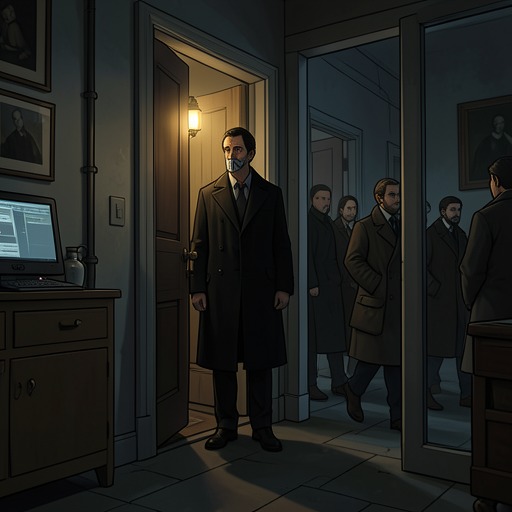
David agrees to go to Tafal’aalt for atonement
The ForgivenDavid’s agreement to go to Tafal’aalt for atonement turns a request to accompany Driss’s body into a moral test. Abdellah presents the journey as what is proper for the man responsible for his son’s death, while Hamid makes clear that David is not entirely free to refuse. David consents under pressure, but also because he hopes that facing the bereaved father may offer a form of forgiveness that official treatment of the death cannot provide.
The Request and Its Terms
Abdellah first addresses Hamid, speaking with measured insistence while the Europeans remain excluded from the conversation. Hamid then explains that Abdellah wants David to return with them to Tafal’aalt to bury Driss. The request rests on a direct moral claim: the man responsible for Driss’s death should accompany him home. Hamid describes this as customary and proper, though his uncertainty suggests that the arrangement is not a simple rule whose meaning everyone accepts without question.
The distinction between a request and a demand quickly becomes important. Hamid says Abdellah is being polite but will insist. David initially rejects the plan as absurd: he has not agreed to travel to an unfamiliar village, and he objects to being treated as though the decision has already been made. Yet the respectful form of Abdellah’s appeal gives the pressure a particular force. It is framed not as a transaction imposed by strangers, but as a father’s appeal to the person responsible for his son’s death.
Resistance and Consent
David’s first reaction is suspicion. He expects that the family will hold him in the village until he gives them money, and he interprets their position through a hostile stereotype of extortion and hostility toward outsiders. The narrative also shows that he has anticipated a demand of some kind all along. His immediate rejection therefore sits beside a recognition that resistance is unlikely to change the outcome.
Hamid’s warning, and David’s expectation that Richard will urge him to comply, narrow the available choices. David is tired and believes that he will give in. That anticipated surrender brings an unexpected relief: if others already regard him as guilty, he would rather seek forgiveness than remain marked by an unresolved accusation. His eventual agreement is hesitant rather than enthusiastic. When Hamid presses him for an answer, David says he supposes he will go, then asks how much money to take. Consent thus marks a real change in his course, but not a clean release from the pressure under which the decision is made.
Money, Responsibility, and Forgiveness
The question of money exposes the practical uncertainty surrounding the journey. Hamid tells David that he cannot ask him for a precise amount and that David must simply take a certain amount with him. Once David agrees, Hamid advises him to take everything he has and present it as all he can give, adding that the family is poorer than David can imagine. The suggested payment is not specified, and David’s private thought that poverty makes people greedy shows how readily he falls back on resentment even as he prepares to comply.
For David, however, money is not the central issue. He understands the proposed payment and the journey as different from legal exoneration: neither can simply substitute for the other. He believes that no authority can give the forgiveness he seeks, because only Abdellah, as Driss’s father, can do that. This makes the agreement an attempted act of moral repair, but not proof that repair has been achieved. David accepts the obligation before knowing its full cost or whether Abdellah will forgive him.
The Journey as a Test
The later course of the story gives the agreement a condition that David cannot settle merely by travelling or paying. After Driss is buried and Abdellah has spoken with Ismael, Abdellah waits to hear David’s account of how Driss died. He considers David’s truthfulness decisive: an accident and a deliberate lie are not morally equivalent to him. In his view, a lie would be a chosen act and harder to forgive than the original accident. The journey therefore places David before a test of candour as well as an obligation to accompany the dead.
During their later encounter, Abdellah shows David the fossil Driss had been carrying when the car struck him, recovered by the police. The object makes the fatal meeting concrete without resolving the question of what David has admitted or what Abdellah has decided. Near the end of the journey, David asks Hamid whether Abdellah found it in himself to forgive him. Hamid is certain that he did, reasoning that otherwise David and Hamid would not be drinking coffee in Alnif. The assurance is indirect: it comes from Hamid’s reading of what has happened, not from a reported declaration by Abdellah.
Significance of the Agreement
The decision joins outward compliance to an inward hope for absolution, while keeping the two distinct. David’s agreement answers Abdellah’s request and brings him into the family’s mourning, but it does not itself establish the truth of his account, determine the amount of any payment, or settle the question of forgiveness. Those uncertainties are essential to the event’s significance.
The episode also unsettles David’s assumption that he can understand the family’s actions in advance. He initially casts their demand as predictable extortion; the request’s language of burial, paternal loss, and responsibility confronts him with a moral claim that his usual objections cannot easily dismiss. His assent remains compromised by pressure and suspicion, yet it is also the first step toward facing the consequences he has tried to interpret from a distance. The agreement opens the possibility of atonement without making it automatic.