David and Jo’s marriage
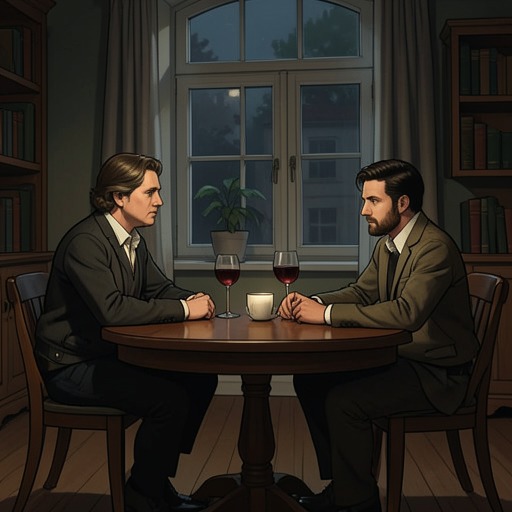
The ForgivenDavid and Jo’s marriage reaches a point of crisis where guilt, silence, and a newly disclosed betrayal become inseparable. Their estrangement predates Jo’s affair with Day: they have slept apart for two years, and Jo describes David as a husband who was often absent even when he was not physically away. After the fatal collision with Driss, their shared responsibility deepens that distance. When they draw close again, they recognize what has happened to each other, but recognition does not restore the marriage to its former condition.
Estrangement and the marriage before the crisis
Jo’s account of her fidelity makes the length of their alienation plain. She says that throughout the years of their marriage she had never been unfaithful, and that even after they began sleeping separately, the prospect of other men had not entered her mind. Her image of venturing into that world as someone who could only wave and drown conveys a habitual retreat from intimacy rather than a considered wish to leave David. The affair therefore arrives not as the fulfillment of a long-standing plan, but as a break with the identity she had maintained within the marriage.
Yet Jo’s sense of the marriage is already troubled. In trying to understand why she slept with Day, she recalls her rage against the husband who was not there and, in many ways, had never been there. She does not present that absence as an adequate excuse for betrayal; she recognizes that it is a poor argument, and says she did not need persuasion. The distinction matters: the marriage’s distance helps explain the circumstances of the affair without absolving her of responsibility for it.
Shared guilt after Driss’s death
Jo also carries knowledge of the couple’s role in Driss’s death. In speaking to Richard, she names alcohol as part of the cause: both she and David drink, she says, and David was so intoxicated that he drove badly. She insists that Driss had done nothing wrong beyond stepping into the road and trying to make them slow down. Her admission is not a report to the police, but a confession made because she believes Richard will keep it from them. She acknowledges that the confession may change nothing, yet feels compelled to say that the collision was entirely their fault.
The admission places the marriage inside a shared moral secret, though the spouses do not process it in the same way in these scenes. Jo speaks explicitly about their responsibility to Richard; the available exchange does not show her making the same confession directly to David. Later, she reflects that David had made her lie, and that in one sense they were even. The remark links their private life to the concealment surrounding the collision: their connection is sustained not only by affection or habit, but by a lie each must live with.
Their return toward the collision site makes that burden tangible. David drives down the Tafnet road recklessly until Jo holds his arm and makes him slow down. When the familiar whitewashed posts and abandoned buildings reappear, she asks him to stop and pay their respects at the place where they hit Driss. The request interrupts his urgency to get there quickly. In the car, Jo acts as the one who checks his speed and directs attention back toward the dead person at the center of their guilt; the moment suggests an effort to acknowledge what their marriage has otherwise struggled to face.
Infidelity and mutual recognition
Jo’s affair with Day breaks the fidelity she had preserved even through years of sleeping apart from David. On waking in Day’s arms, she feels panic, leaves the bed, and looks at herself in a mirror covered with fingerprints. She cannot clearly remember the lovemaking and does not know whether she enjoyed it. What she does understand is that the encounter has become a secret she must carry: even as a fragmentary memory, it changes what she knows about herself and about her marriage.
Jo connects the affair to several immediate circumstances rather than to a single cause: a bottle of wine, Day’s attentions, a moment of recklessness, and anger at David’s absence. She had set out for the weekend wanting the party’s release from ordinary life, but the escape produces a consequence she cannot simply leave behind. Her first impulse the next morning is to flee. The desire to get away, and her later uncertainty about whether she could ever tell David what happened, show that the affair creates a new secrecy alongside the couple’s existing silence about Driss.
When David and Jo are together again, the affair is not discussed openly. Jo lowers her head and wonders whether her skin still smells of Day; she reads David’s response as proof that he has understood what she did while he was away. She, in turn, understands what he has done. The text presents their knowledge as mutual but deliberately unspoken: neither can raise the subject again, yet neither can forget it. This silence is not reconciliation through innocence. It is an acknowledgment that both have crossed into experiences the other can sense, and that these experiences have permanently altered their relation.
Reunion without restoration
Jo calls David Stumblebum and tells him that they can go home, adding that it is all over. David echoes the word home, but the scene does not establish that their difficulties are resolved. They sit together in the early-afternoon sun as the atmosphere of Azna resumes around them, with guests and vehicles preparing to depart. The surrounding bustle offers no private answer to what their marriage will become. At the pool, the departing guests leave the Hennigers alone; Jo thinks they have become pariahs, though no one has consciously decided to treat them that way. Their isolation reflects the social aftertaste of the accident as well as their own separation from the weekend’s celebratory world.
Later, Jo watches David sleep beside the pool. His nightmares trouble him, but she has never been curious about them; his sleeping face seems to open onto an inner world she cannot enter, starved of beauty despite the lush, sunlit setting around them. She wonders whether she might one day use the affair against him in a bitter argument, then considers that his having made her lie leaves them quits. The thought balances retaliation against mutual culpability without settling either. Her hand passes over his closed eyes, a gesture that momentarily makes him seem dead, while her own heart fills with hatred and foreboding.
The marriage’s ending point in these scenes is therefore a precarious return, not a repaired bond. Jo imagines no clear future, only confusion and what she calls a dire liberation. At the same time, the couple travel together, stop at the site of Driss’s death at her request, and go home together after recognizing the secrets between them. Their closeness persists, but it is now shaped by shared guilt, separate inner lives, and knowledge that cannot be taken back.