David lies to Abdellah about Driss being alone
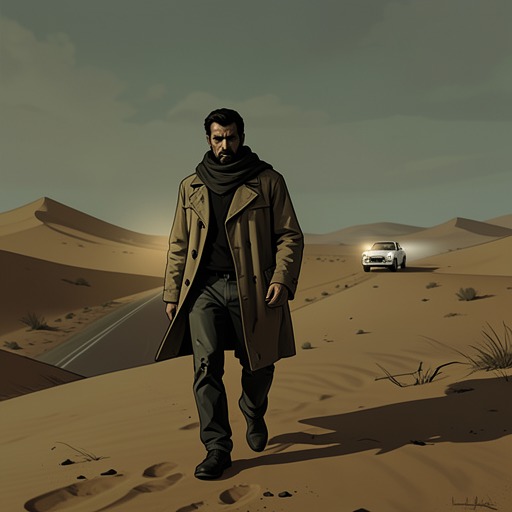
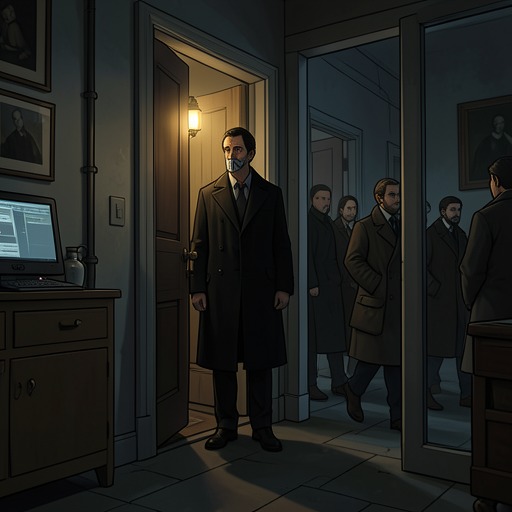
The ForgivenDavid Henniger’s claim that Driss was alone when David struck him is a lie whose force lies in the widening gap between a qualified first answer and a categorical second one. Under Abdellah’s direct questioning, David supplies an account that leaves Driss’s death apparently without another witness or companion, while the exchange offers no explanation for David’s choice to conceal the truth. The pause that follows does not settle whether Abdellah accepts the account; it leaves the answer hanging between them as Abdellah turns back to his pipe and David remains in his custody.
The Question and the Answer
Abdellah asks David plainly whether his son was alone on the night David struck him with the car. The question ties the claim to a specific moment and consequence: Driss’s fatal encounter with David. David’s reply comes automatically, a detail that makes the answer sound less like a considered explanation than a response produced under pressure. He says, “As far as we could see, he was alone.” The wording presents the assertion as limited to what the speakers could see, rather than as absolute knowledge. It also puts David and an unnamed other observer into the sentence through “we,” without identifying that observer or explaining what either person saw.
Abdellah immediately tests the qualification by asking whether David is sure. David answers, “Absolutely.” The change is consequential: the first response contains a hedge, but the second removes it. Rather than clarifying the limits of what he knows, David strengthens his claim when challenged. The exchange’s compact sequence—question, qualified assertion, demand for certainty, emphatic assurance—makes the deception audible in the movement of the words themselves.
The Lie Under Pressure
The account does not emerge during a neutral conversation. Abdellah is asking about his son’s death while David is being held at Tafal’aalt. The imbalance is present in the scene: Abdellah controls the questioning, while David has to answer within the conditions of his confinement. Yet David’s automatic response does not make the lie less consequential. His later assurance is definite, and the subject of the question is not incidental: it is whether Driss faced the fatal moment alone.
The exchange supplies no explicit motive for David’s false account, so it does not establish why he chooses to maintain it. Its observable effect is narrower but important: Abdellah is given an answer that represents Driss as alone, and David confirms that representation when asked to verify it. The lie therefore works not through an elaborate story but through a small assertion made harder to challenge by the certainty attached to it. Its brevity also leaves what David withholds conspicuous. The conversation reaches the boundary of the truth without disclosing what lies beyond it.
Abdellah’s Response
Abdellah replies, “Well, there we are, then.” The words close the questioning for the moment, but they do not prove that he believes David or that he has stopped suspecting him. The scene records only that Abdellah accepts the exchange as a stopping point and moves on. Keeping that distinction matters: David has delivered a confident answer, but the narration does not confirm that his confidence persuades Abdellah.
Afterward, Abdellah wipes his hands and gathers the split apple pips. He and David sit listening to the wind pick up while Abdellah slowly empties and refills his pipe. The deliberate actions and the awkward silence extend the encounter beyond the spoken exchange. David’s answer has not freed him from the scene or changed the visible fact of his confinement: he remains on his piece of cardboard as Abdellah eventually gets up, takes the lamp, and leaves him there.
Narrative Significance
The lie’s immediate significance is its placement within Abdellah’s effort to establish what happened to Driss. It gives David a way to answer the father’s question without opening the circumstances further, but the categorical “Absolutely” also makes the answer more exposed: David does not merely offer a limited impression and leave it there; he affirms certainty when Abdellah asks him to account for that impression. The exchange thus presents speech as an action with relational consequences. David’s words shape what Abdellah is told about his son, even though the scene does not show whether they shape what Abdellah believes.
The silence after the answer preserves the unresolved tension. Abdellah’s measured pipe ritual occupies the space where another question might have followed, while the image of David left behind on cardboard returns attention to the unequal conditions under which the answer was given. The lie is brief, but it does not conclude the confrontation: it becomes part of the uncertain knowledge between a bereaved father and the man responsible for Driss’s death.