Driss
The ForgivenDriss is the only son of Abdellah Taheri, a young man whose life is pieced together through work, migration, family memory, and the objects left behind after his death. He is remembered both as a restless figure on the margins of ordinary security and as a child whose father once took him prospecting across the mountains. The distance between those memories and the dead young man gives his story its central tension: Abdellah must face not only his loss, but how little he could fully know of the son he mourns.
Identity and Early Life
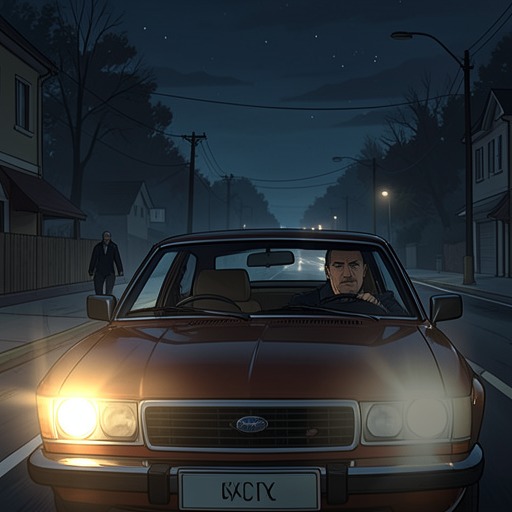
After the fatal car collision, Driss is seen as a slender, quite tall young man of about twenty, with a slight beard and a tattoo on his right hand. His body is recognizable through small, particular features rather than through any public account of his life. A scar on his left hand prompts people to recall a tall, tense boy who had worked in the fossil-preparation yards in Erfoud and had been injured in an accident with a lathe. Their recognition is tentative at first, then settles into certainty: this was the boy they remembered, though the anger they had noticed in him seemed unusually deep and prolonged.
That scar becomes one of the details by which Abdellah continues to picture his son. In later recollection, Driss has long hands, wandering eyes, and the small mark on his left hand. His father remembers that his eyes had seemed green when he was young, a quality that gradually disappeared. These details do not resolve Driss into a single, settled character. They instead preserve an intimate, changing image: the child Abdellah knew and the young man whose activities and choices he could not always follow.
Work, Movement, and the Search for Money
Driss’s adult life is shaped by movement between places and by the need to find work. He worked in the fossil-preparation yards in Erfoud, and his past also included time in Paris. He told Ismael that, even there, he had kept the memory of the house where he grew up close to his heart. The recollection connects migration to attachment rather than simple escape: distance did not erase his connection to the family home in Tafal’aalt.
In Spain, Driss works in the Bloodworths’ household as a gardener. During the summer, Roger Bloodworth makes him coffee each morning in an outbuilding when guest rooms are occupied. European visitors come down to the pool, while Roger keeps Driss out of their sight until he is dressed for work in a straw hat and gardening jacket. Driss then goes outside with pruning shears and a pail. The arrangement gives him employment but also makes his presence conditional: he is kept apart from the guests and presented, through his work clothes, as someone unlikely to attract questions.
By October, Driss has saved a thousand euros. He knows there is more cash in the office, where Roger keeps bundles of notes and stores them in a safe. Driss watches Roger close the safe and tries to learn the combination, but cannot yet remember it. The narration presents his thoughts about the money as a developing possibility, not as a completed theft: he believes he may eventually learn the numbers and would then have to decide what to do. He understands such an act not as theft but as necessity and a law of life. The distinction reveals how survival becomes, for him, a way to explain conduct that would otherwise be condemned.
Father, Home, and Memory
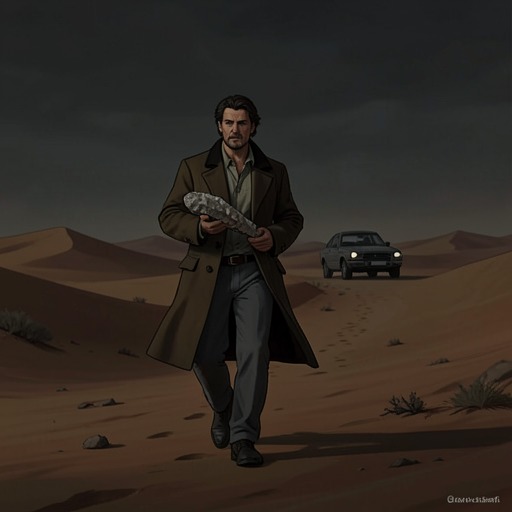
Driss’s relationship with Abdellah is marked by both closeness and conflict. Abdellah remembers taking his son prospecting across a mountain when Driss was ten. He recalls the boy’s round, freckled face and a Dicranurus they found together near the trenches. The fossil remained in Driss’s room, a material trace of an experience shared with his father. Years later, the contrast between that childhood excursion and Driss’s precarious adult work gives their bond a history that reaches beyond the circumstances of his death.
Another memory places Driss at fifteen, secured by a rope while prospecting from a high ledge. The children’s tapping at stone later brings that image back to Abdellah as he sits with tea and a pipe. The sound belongs to the present, but it draws him toward an earlier Driss, and toward the remembered risks and routines of their life together. After the funeral, Abdellah recalls the same son through the small scar, his changing eyes, and the music he listened to alone in his room. These recollections offer affection without making his father’s knowledge complete.
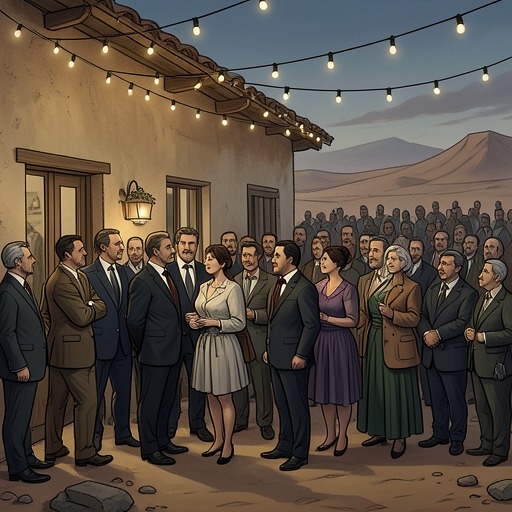
Abdellah also remembers hearing that Driss had sold drugs and illegal trilobites in Erfoud or Rissani. In his account, Driss was not the only young man doing such things; what set him apart, Abdellah thinks, was that he was less discreet. This remembered judgment is neither a denial of what Driss did nor a simple condemnation. It shows a father trying to place his son among other young men while confronting the particular choices that had brought dishonor and conflict into the family. On the evening of a gathering at Azna, Driss is in a dark mood after quarrelling with his father. The detail places unresolved tension within the ordinary history of their relationship rather than presenting their estrangement as a single, isolated break.
Death and the Presence of What Remains
At the burial, Driss’s body is lowered into its place as prayers are said. Abdellah’s attention turns to the son he knew at ten, and to the fossil they had found together. He bites his lip; his tears are exhausted, leaving him with sight and memory. The scene gives the burial a double weight: it is the final act performed for Driss, and a moment in which Abdellah’s remembered childhood image of his son presses against the fact of his death.
Afterward, David Henniger wakes in Driss’s room. The walls are pale red and marked with scratched words and numerals; dust coats the room and David’s fingernails. Beside the mattress are a glass jar holding a Biro, a small British Dalek toy from Doctor Who, folded underclothes, and a notebook. These are identified as the few things a teenage boy needed in his room. To David, their presence feels like a deliberate reminder of the dead young man, and he interprets the room as an attempt to make him confront Driss’s continuing presence. The scene does not give Driss a new voice; it lets ordinary belongings keep his absence immediate.
Abdellah’s memories also return to Driss’s solitary hours listening to raï, his journeys away from home, and the reports of his activities. He imagines his son’s soul as nearby and clings to fragments of remembrance, including the habit of slipping banknotes into his socks. In this way, Driss remains present through incompatible pieces of evidence: the child who shared a fossil-hunting expedition with his father, the young worker trying to make money, and the son whose choices could not be wholly explained by those who loved him.
Narrative Significance
Driss’s story is assembled retrospectively, through other people’s recognition, recollection, and response to his belongings. His appearance and the scar help identify him; his father’s memories supply a childhood; and the scenes in Spain disclose the constraints and calculations of his working life. None of these perspectives is sufficient on its own. Together they show how a person may be known through scattered signs while remaining partly unknowable, even to a parent.
His remembered attachment to the house in Tafal’aalt also resists the idea that movement has severed him from home. He carries that place with him to Paris, while his work and search for money take him elsewhere. After his death, the Dicranurus in his room, the toy, the notebook, and the scar each hold a different scale of time: childhood, private adolescence, labor, and the life cut short. Driss therefore remains central to the novel not only as the dead young man whose loss shapes the surrounding events, but as a character whose identity has to be reconstructed from fragments, and whose family’s grief cannot turn those fragments into a complete account.