Elvis fossil
The ForgivenThe Elvis fossil is both a coveted commodity and the recovered object that makes the chain of events surrounding Driss’s death visible. Abdellah reveals that Driss had stolen it from him and carried it onto the road where David Henniger struck him. Its rarity and imagined market value had offered Driss a possible route out of a life he found intolerable; after the collision, the fossil instead becomes a material reminder of the chance that failed and of the loss Abdellah cannot undo.
Identity and Appearance
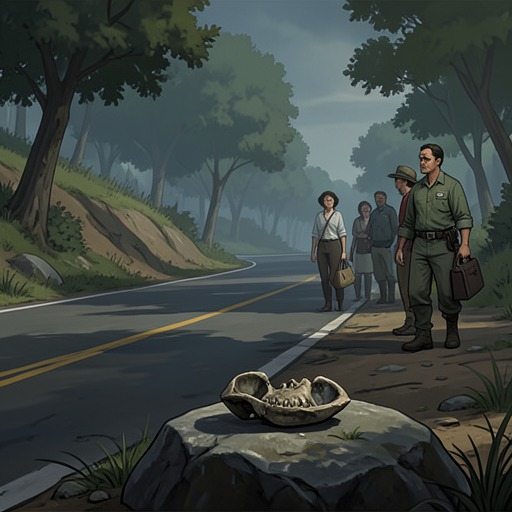
Abdellah identifies the specimen as an Elvis when he tells David that it was recovered by the police and returned to him because it was valuable. The object has been wrapped in newspaper. When Abdellah removes the paper, David sees a creature armored with a row of irregular spines, with widely spaced eyes and three distinct humps. A label gives its geological period as Devonian. Abdellah does not know its technical name, but says that only three specimens have been found in the Sahara. Dealers, responding to its rarity and appearance, have given it the celebrity nickname Elvis.
The distinction between the specimen’s scientific label and its sales name captures the competing ways it is made meaningful. Devonian locates it in geological time; Elvis makes it recognizable as a scarce, desirable object in a commercial market. The fossil is not valuable to Abdellah because he can identify its technical species. Its worth comes to him through the attention dealers and buyers have already attached to it—and through the money that attention might bring.
From Theft to the Road
Driss took the Elvis from his father and left to try to sell it. Abdellah describes this not as an isolated act of greed but as part of a recurring pattern among young men who see no prospects in fossil digging and do not want to spend their lives following the same work as their fathers. In his account, their thefts answer frustration, poverty, and the desire to escape. He even says he understood Driss’s choice and would have been glad if his son had sold the specimen for a few hundred euros.
The scale of the hoped-for escape is concrete. Abdellah says the fossil could fetch ten thousand dollars in the United States, while a sale in Midelt might bring a thousand euros—enough, in Driss’s imagined plan, to go to Casablanca and find a woman. The different sums describe not only an uneven market but two versions of possibility: a much larger international price and a nearer, smaller sum that still seemed capable of buying a new experience. The fossil’s worth therefore depends on where it is sold and what the money promises, not simply on its rarity.
Abdellah’s account also reverses the apparent moral weight of the theft. He says that, had Driss sold the Elvis to David for a few hundred euros, he would have been happy for him. The object is a lump of rock in one sense, and a chance to get away in another. Abdellah’s acceptance does not make the outcome less painful: he weeps as he imagines the counterfactual in which David stops and buys it, allowing Driss to reach Casablanca while David returns to Azna with his wife. Instead, Driss takes the fossil onto the open road, meets David, and dies. Abdellah calls the force that led him to run bedazzlement rather than greed, leaving the fossil as the center of a lost possibility rather than a simple explanation for the tragedy.
Desire, Value, and Misrecognition
Abdellah cannot understand the appetite that makes outsiders pay for fossils. He tells David that he knows only that they want such objects and will pay for them; he wonders whether they are deranged. Some people around him, he explains, believe fossils are the forms of dead demons, and their frightening appearance may itself account for their influence. The same specimen can thus be an object of scientific classification, a source of income, a means of escape, or a demonic remnant. No single interpretation settles its meaning.
David cannot explain what he sees in the fossil. His inability to answer leaves Abdellah’s question open, and underscores the mismatch between possession and understanding: the people prepared to pay for the object may not share the beliefs of those who dig for it, while the person who wants it may not be able to articulate the desire. Its market price travels more easily between people than a common account of what the fossil is for.
Presence After the Collision
When Abdellah first tells David about the Elvis, David blushes and says he had not heard that the police recovered it. Abdellah then brings the specimen from behind him and unwraps it in front of David. The scene gives the fossil a physical presence that David’s earlier ignorance could not accommodate: he must look at the thing Driss carried when the car struck him. The disclosure does not change the collision, but it connects the dead man’s last journey to a particular object, stolen from his father and loaded with the prospect of escape.
After Abdellah has explained the theft and its consequences, the men eat apples by lamplight as wind enters through cracks and glassless windows. David looks down at the fossil, whose eyes seem to glisten and whose body appears to move. The impression remains David’s perception; the scene does not establish that the specimen is alive. Yet its apparent animation gives visual force to Abdellah’s account of fossils as creatures that can exert a disturbing hold. The Elvis is at once inert stone and, in the strained aftermath of Driss’s death, an object that seems unwilling to remain merely an object. Its recovery preserves the chain of events, but cannot provide a satisfying answer to why this particular desire, on this particular road, ended as it did.