Fate and free will
The ForgivenFate and free will are not settled doctrines in the novel but competing explanations its characters reach for when their lives turn. Jo experiences a sequence of disruptive events as the opening of a new self; David, facing Ismael, understands choice as an illusion. Between those positions lies the novel’s central uncertainty: a person may be changed by events beyond their control, yet still remain answerable for actions taken within them.
The Language of Change
The concept emerges most clearly through moments of retrospective interpretation. Jo looks back on the weekend and cannot identify the exact instant when the ground shifted. What matters to her is that the change became undeniable: she saw the bottom fall out and recognized that her old understanding of herself no longer held. Her account does not establish that some force had planned the upheaval. It shows instead how a person, after events have happened, can read their sequence as a decisive turning point.
That distinction matters throughout the novel. Fate is a way of describing the pressure and apparent direction of events; it is not confirmed as a power that dictates them. Free will, meanwhile, is neither presented as complete independence from circumstance nor simply dismissed. The characters confront choices within conditions they did not choose, and their later explanations reveal as much about their needs and self-understanding as about the events themselves.
Jo’s Retrospective Freedom
Jo’s sense of liberation follows a weekend in which several parts of her life have been unsettled. She connects her new feeling of youth with having committed adultery, waking with a heightened sense of possibility, and swimming before experiencing what she calls a flash of insight. The account makes these experiences part of one emotional turning point without claiming that any single one mechanically caused the change. Her description is both an assertion of agency and a recognition that the change arrived through circumstances she had not deliberately arranged.
She also gives Driss a startling place in this reinterpretation. Jo thinks that, had David stayed beside her, nothing would have happened, and that without the fatal collision with Driss, nothing would have happened either. In her view, Driss’s death has indirectly liberated her by disrupting the life she had expected to continue. She recognizes the grim logic of connecting that loss to her affair with Day, but her sense of freedom does not erase the moral weight of the connection. The sequence feels consequential to her; it does not become morally simple merely because it produced change.
Jo’s interpretation of David supplies a further complication. When Richard asks whether David had suffered a breakdown, she rejects that account. She believes that the crisis allowed David’s true self to emerge, and that he was relieved to have an excuse to act as he did. This is Jo’s judgment, not a neutral explanation of David’s motives. It presents apparent loss of control as possible self-revelation, while leaving open whether circumstance merely exposed a character or gave him cover to express it.
David’s Final Understanding
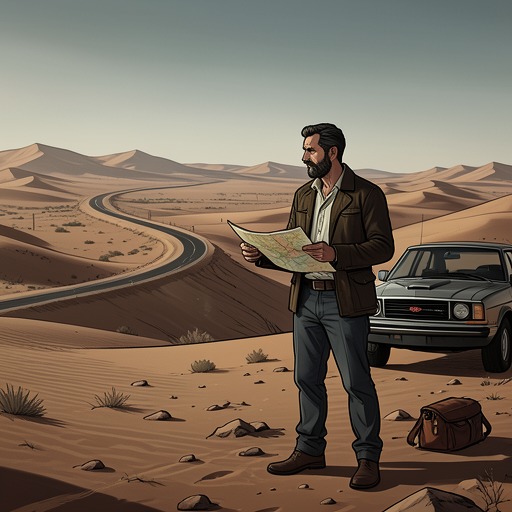
At the road encounter with Ismael, the question of choice becomes immediate. Ismael approaches the Hennigers’ car carrying a fossil and a revolver. The couple respond with trust rather than recognition of danger. Ismael remembers David burying Driss’s identification, and interprets that earlier act as characteristic of a gaouri. David, in turn, recognizes Ismael and understands the reason for the encounter. The past has become part of the present: a concealed piece of evidence, remembered by another person, returns with fatal consequences.
In that moment, David thinks that nothing he could have done would have altered the outcome and that freedom of choice is absurd. This is not established as the novel’s final philosophical answer. It is David’s perception at the point when his remaining options seem to have vanished. His belief also sits uneasily beside his earlier choices, including the act Ismael remembers. The narration does not make those choices disappear; instead, it shows how a person facing death may experience their accumulated consequences as inevitability.
David’s thought that he had not been forgiven because he had forgiven himself deepens the conflict. He recognizes his own remorse, but self-forgiveness has not settled the moral relationship between his actions and their consequences. His final attempted expression of regret cannot change what happens. The scene thus distinguishes the inward sense of repentance from any power to undo harm or secure forgiveness from another person.
Consequence, Responsibility, and Uncertainty
The novel places Jo’s and David’s interpretations side by side without making them equivalent. Jo treats upheaval as an opening through which she can become different; David experiences the final consequence of earlier events as proof that choice was never real. Her account looks backward from a newly felt possibility, while his arrives at the limit of his life. Together, they show how the meaning of freedom can shift with a person’s position in the chain of events.
Neither perspective cancels responsibility. Jo’s liberation is bound to Driss’s death and to her adultery with Day; David’s sense of inevitability arises alongside his responsibility for concealing Driss’s identification. Ismael’s memory demonstrates that actions persist beyond the moment in which they are taken, acquiring consequences that their author may neither predict nor control. The novel therefore holds two propositions in tension: people are shaped and constrained by circumstances, and their actions remain consequential even when the future feels beyond their command.
Fate and free will remain unresolved because the novel offers no view from outside its characters’ partial understandings. Jo finds a pattern of liberation in events she did not set in motion; David finds inevitability where responsibility and consequence have converged. The difference between their accounts does not prove that one is right. It makes the effort to interpret a life—whether as a chosen course or a chain of events—part of the moral and emotional struggle itself.