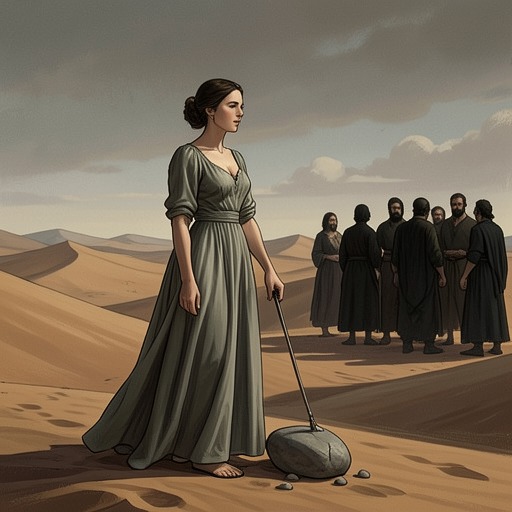
Fossils and deep time
The ForgivenFossils and deep time are not remote abstractions in the novel: they lie exposed in the stone around Tafal’aalt, where people seek them for income and where David encounters evidence of life vastly older than his own. A fossil can be a saleable object, a trace of a world preceding humanity, or the result of dangerous labor. The novel holds these meanings together, making the ancient record inseparable from the lives and losses of those who excavate it.
Stone, Landscape, and Deep Time
In the moonlight, David leaves the houses and crosses a small garden into the stony open ground. The cliff is difficult to make out, its caves and ladders merging into one scar. The darkness softens his view of the children who work there, small enough to wriggle into the openings with hammers. That softened image does not erase what he knows: Driss had been one of those children, and his labor ended in a grave behind the gardens. The fossil-bearing cliff is thus at once a geological formation and a workplace whose costs are borne by the living.
David continues from the oued toward a larger, dried riverbed, among piled white stones and a desert that begins abruptly beyond them. The ground seems like a petrified sea, its blistered stones stretching toward ridges that will become visible at dawn. This landscape gives deep time a physical scale: the desert appears not as empty space but as the remains and exposed surface of a world whose history exceeds ordinary human measure. Yet the scene never leaves human history behind. The cliffs hold ancient traces, while the children’s hammers and Driss’s recent grave make the present painfully legible against them.
The Fossil as Encounter
At first light, a digger leads David across the oueds to a sloping shelf of rock. The stone bears a spread of subtle, writhing forms, among them a huge fish with a beaked mouth and fins like claws. The narrative identifies it as an Ichthyosaur and imagines it as a Devonian mermaid. The creature is not a loose specimen but a striking image still embedded in the slab, its completeness made visible by the dawn brightening behind Jbel Issomour massif.
The digger offers to hack the fish out and sell it. When David resists, he says it could become a kitchen table, translating the ancient creature into a practical commodity that might please David’s wife. David first objects that he cannot buy a fish. But the encounter becomes less a simple negotiation than a contest over how the fossil should be seen. The digger circles him, tapping the fossil’s scales and tailbones with his stick and pressing the sale; David’s resistance weakens. He crouches, covers his eyes, then reaches out and runs a hand along the spine. What finally draws him is the fossil’s completeness: it is palpable evidence that life existed long before the people now bargaining over it. His refusal to have it cut out follows that recognition. The fossil’s value cannot be reduced, for him, to a purchasable object or a piece of furniture.
Extraction and Human Cost
The cliff’s prehistoric record is also the basis of precarious work. Children enter caves that adults cannot reach, hammering at stone for fossils. The text links this labor directly to Driss: David sees the caves and remembers that the dead boy had worked in them. Their age and size, rather than any protection from danger, make the children suited to the task. Geological wealth is therefore not simply a natural wonder waiting to be admired; access to it depends on vulnerable bodies entering the rock.
The same labor persists in Abdellah’s memories. As a boy, Driss was strapped to a long rope and left dangling from a high ledge while he worked, a sight that made the family fear for his safety. Years later, the sound of children tapping at the cliff brings those fragments back to his father. The tapping is both the continuing rhythm of fossil extraction and a reminder of the son whose life was shaped by it. The fossil economy joins generations through repetition: the children at work now recall Driss at work then, while Abdellah’s grief gives that repeated sound a private, irrecoverable meaning.
Commerce, Imitation, and Recurrence
On the road beyond Rissani, David and Anouar pass people selling fossil imitations from roadside hovels. Their Psychopyge trilobite and Comura trilobite forms are embellished with car-repair resin; Anouar laughs at the fraud and calls it a disgrace. The scene sets the market’s appetite for fossils beside the difficulty of distinguishing an authentic trace from a manufactured likeness. In a region where fossils are sold for income, the appearance of ancient life can itself be reproduced and traded, while the actual stone remains tied to arduous extraction.
A fossil also enters the final roadside confrontation. Ismael has waited on a stony hill for David and Jo, carrying an old pistol and keeping the events of Friday night to himself. When he runs down to stop their car, he raises a palm-sized Psychopyge trilobite. The fossil is present at the moment the past violence returns to the road, though the scene does not explain the precise purpose he assigns to it. Its appearance links the region’s ordinary fossil trade to a new, threatening encounter without making the object itself a complete explanation of his actions.
Across these scenes, fossils move between geological evidence, merchandise, labor, imitation, and the charged objects people carry into human encounters. Their deep time unsettles the scale of individual lives, but does not make those lives insignificant: the ancient fish David touches, the children still working the cliff, and Driss remembered by his father occupy the same material landscape. The fossil’s completeness points toward life before humanity; the novel’s repeated attention to extraction insists on the human consequences of bringing that past to the surface.