Guilt, denial, and moral responsibility
The ForgivenGuilt, denial, and moral responsibility are bound together in the aftermath of David Henniger and Jo Henniger’s collision with Driss. The novel does not present responsibility as a single admission made once and for all. It unfolds through competing accounts, evasions, practical calculations, and encounters with people who cannot be reduced to the couple’s fear of legal consequences. David is convinced that the collision was not his fault, yet his certainty does not settle the moral question. The dead man’s identity and his father’s presence make the consequences impossible to keep entirely abstract.
The collision and David’s certainty
David’s first response is a powerful conviction of innocence. In the room after the collision, he is confused and indignant, and cannot talk himself out of believing that he is not at fault, even when he is being truthful. The distinction matters: the narrative does not equate David’s insistence with a simple, conscious lie. Instead, it shows how sincerely held innocence can coexist with the facts that a person has helped cause a death and now faces responsibility for it.
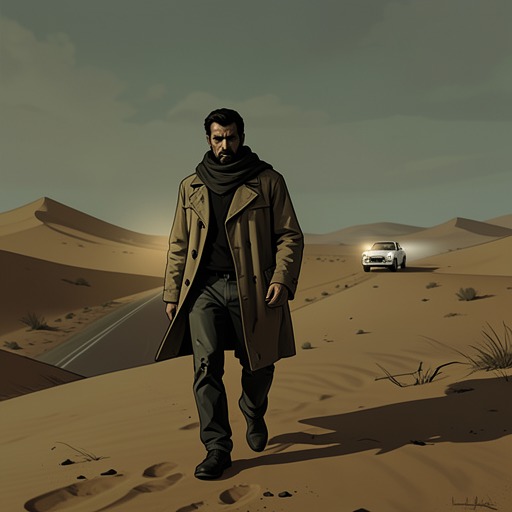
When Richard Galloway asks David to explain what happened before he speaks to the police, David describes driving toward the sign for Azna, seeing a fossil seller on the road, and being unable to see clearly through blowing sand. He says the man stepped in front of the car and that the travelers feared a carjacking. This account gives the collision a context of poor visibility and fear, but does not undo its outcome. Jo cuts through the explanation by stating that they hit the man. Her response shifts attention from the story David tells about what he could see and expect to the fact that the couple’s car struck and killed someone.
That difference between explanation and consequence governs the concept throughout these scenes. The circumstances may help account for how the collision occurred; they do not make the death disappear. David’s belief in his innocence persists alongside his need to consider what to say and what may happen next. The result is not a tidy opposition between an honest account and a proven falsehood, but a portrait of someone whose self-understanding is under pressure from an event he cannot reverse.
Managing responsibility
Richard’s advice initially treats the aftermath as a problem to be managed. He tells David to cooperate with the police, appear contrite, and be prepared for the possibility of a discreet bribe. This practical counsel recognizes that the collision may have legal consequences, but it also frames those consequences as something the English travelers might navigate through performance and money. Richard even wonders whether David had been drinking on the road, and considers whether to help him or let him face the Moroccan police. The possibility remains an apprehension in Richard’s mind here, not an established fact about the collision.
The travelers’ shared English identity becomes part of that management. The narrative describes a complicity between them and distinguishes their sense of us from the Muslim officials they regard as them. But the division falters at the thought of the dead man in the garage: does he belong to the people they are excluding, or has he been excluded even from that category? They do not yet know his name. He has no identification or money in his pockets, details that make his absence of social and material standing part of the couple’s attempt to understand the situation.
The later comment that the victim is poor, comes from a distant village, and is unknown to those handling the case gives this exclusion its starkest form. The speaker presents these details as reasons that nothing can be done, then has to qualify that claim when asked what the group has done. The exchange exposes the moral danger in treating a person’s poverty and obscurity as if they diminished the importance of his death. The narrative places that reasoning beside the couple’s concern about police procedure and their own exposure, making the unequal value assigned to the dead man visible without suggesting that his anonymity cancels the obligation to answer for what happened.
Jo’s disclosure and the limits of silence
At dinner, Jo publicly says that she and David had an accident on the way and killed a Moroccan man. Her statement brings the fact out of private discussion and into a gathering where the guests stop eating and stare. David blushes; the company’s attention fixes on Jo, who is described as outside the social game in which the others are participating. The disclosure changes the terms of the evening: the collision can no longer be treated only as a private crisis to be handled between the couple and Richard.
Jo’s statement is consequential in its plainness. Earlier, when David recounts the encounter with the fossil seller, she rejects the emphasis on the travelers’ fears and returns to the essential fact that they hit him. At dinner she repeats that moral clarity before others. The account does not establish every motive behind her decision to speak, so it should not be reduced to a calculated confession or a completed act of atonement. What it does establish is that she refuses to let the couple’s explanation replace the outcome. Her words make the dead man’s death part of the group’s knowledge, while the guests’ stunned response registers how sharply that knowledge interrupts their ordinary gathering.
The body, the father, and responsibility beyond calculation
When David is brought into the garage, the victim is identified as Driss, and his father, Abdellah Taheri, stands beside the body. Richard sees that Abdellah’s grief is not calculating. This recognition unsettles Richard because it removes the possibility that the encounter is simply a negotiation staged for advantage. David, meanwhile, looks at Driss’s body more directly than he had during the night. He cannot find the appropriate emotion in himself, though he manages to look grave and astonished. As his fear subsides, he begins to calculate the probable financial damage.
The sequence holds David’s outward composure and inward accounting in the same frame. He has not yet found a response that matches the loss, and the narrative does not claim that a show of grief would resolve his responsibility. Instead, it records the distance between the solemnity required by the encounter and his return to calculation. Abdellah’s presence makes that distance harder to ignore: Driss is not merely the unidentified victim of an incident but a son whose death has brought his father to the garage.
Hamid introduces David to the gathered Aït Kebbash as the driver, saying that David declares his innocence before God. Hamid’s tone nevertheless communicates that he has doubts. The formulation places David’s claim within a moral and religious register, but does not certify it as true or false. Abdellah looks at David without visible acrimony, yet his questioning gaze does not absolve him. In these encounters, responsibility is not settled by David’s certainty, Richard’s advice, or the prospect of financial loss. The narrative keeps the unresolved tension between a claim of innocence and the consequences of the collision in view, and makes recognition of Driss and his grieving father the condition that prevents the event from remaining merely an administrative problem.