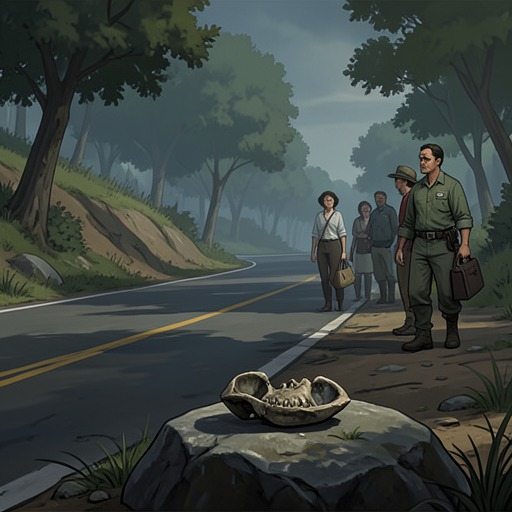
Ismael Ambushes the Hennigers
The ForgivenIsmael’s ambush of David and Jo Henniger converts a roadside robbery plan into a killing shaped by memory and unresolved guilt. The scene first presents Ismael as a figure appearing unexpectedly before a slowing car; only then does it disclose the earlier agreement with Driss that brought him to the road. As the Hennigers stop and offer him the ordinary courtesies of a greeting, Ismael approaches with a loaded revolver. David recognizes why he has been targeted, and the encounter closes with David’s death and a last, unspoken apology.
The plan on the hillside
Ismael has spent much of the day watching the road from a stony hill, waiting for the two people he seeks. He shelters beneath a coat propped on three sticks, scans for cars, and repeatedly descends the slope when vehicles from Azna estate pass. By nightfall, traffic has thinned; he shivers as he prepares the old, heavy pistol that Abdellah gave him. The account of this vigil is also a delayed disclosure: Ismael has kept the events of Friday night to himself, and his waiting leads him back to the plan he made with Driss.
The two had previously waited at the same spot after hitching a ride from Erfoud with the Elvis fossil and other specimens. They got out at the bottom of the hill, where the cement truck left them. The party at Azna estate was known across the desert, and Driss was already in a dark mood because he had quarrelled with his father. He proposed stopping the first car, expecting its occupants to be carrying cash and assuming they would be too soft to resist. When Ismael asked what they would do if the occupants fought back, Driss dismissed the question and treated the travellers’ status as unbelievers as a reason not to care what happened to them.
Their conversation over a can of sardines sharpened the plan into an order. Driss said that the travellers always stopped and urged Ismael not to be a coward but to act when they did. Ismael answered that he had promised to do so; Driss replied that he was always afraid. The exchange records more than a criminal scheme: it establishes the pressure between the two young men and makes Ismael’s eventual use of the weapon both a fulfilment of his promise and a moment burdened by Driss’s absence.
The Hennigers stop
On the night of the attack, Ismael strides toward the Hennigers’ car carrying a small Psychopyge trilobite in his left hand and a revolver loaded with six shells in his right. He has no thought of hesitation. Jo winds down her window with a searching, sympathetic expression, while David relaxes his hands on the wheel and turns off the engine. Their response contradicts Driss’s expectation that the people in the car would be easy targets because they were foolish or weak: they stop because they are trusting.
Ismael greets them with “Salaam aleikum.” Their astonishment suggests that they recognize him and are trying to understand what they owe him, but he sees no possibility of forgiveness that he can grant. He drops the fossil, raises the revolver, and moves around the back of the car as David opens his door. The small fossil, which had served as the reason for stopping, is abandoned at the instant the encounter becomes an attack. Ismael no longer needs it to draw the Hennigers close; their willingness to stop has already exposed them to him.
Recognition and death
David’s eyes are not frightened, but filled with curiosity and wonder. Ismael’s cruelty is tied to a specific recollection: he remembers seeing David dig a small hole in which to bury Driss’s identification. For Ismael, that act marks David as the gaouri who took away a piece of Driss’s identity after his death. David, in turn, suddenly understands the reason for the attack and is not surprised. The recognition comes without an explanation between them; what Ismael remembers and what David grasps converge in the silence beside the car.
David experiences the moment as if there were no alternative he could have chosen, and the narration describes his belief in freedom of choice as absurd. He does not think about why he has not been forgiven, because he has forgiven himself. That inward absolution does not prevent the attack or settle the injury between the men. As time seems to slow, the nightmare of the turbine that had come to him earlier in the day washes over him. He raises one hand and tries to form a word, but cannot speak; his apology is conveyed only through his eyes. He closes them as the turbine image returns, and the scene ends with his death.
The ambush’s reversal
The attack reverses the assumptions on which Driss’s plan depended. The travellers do stop, but not because they are stupid or incapable of resistance; their trust makes them vulnerable. Ismael’s earlier promise to Driss is fulfilled in a manner neither the sardine-can conversation nor the language of initiation could contain. Driss had said that the shooting would be Ismael’s initiation. Now, with Driss dead, Ismael acts alone, carrying out a plan first framed as robbery while the memory of David’s conduct toward Driss gives the encounter its personal force.
The scene also brings the novel’s questions of guilt and forgiveness into a final, unequal confrontation. David’s internal forgiveness cannot erase the remembered act that has become decisive to Ismael, and Ismael’s sense of grievance does not make the attack a resolution between them. David’s apology arrives only when speech has failed and death is immediate. The road, previously a place where Ismael and Driss expected passing strangers to stop, becomes the site where their plan returns in altered form: Ismael stands in Driss’s place, and David dies facing the consequence of a past he had believed he had already forgiven.