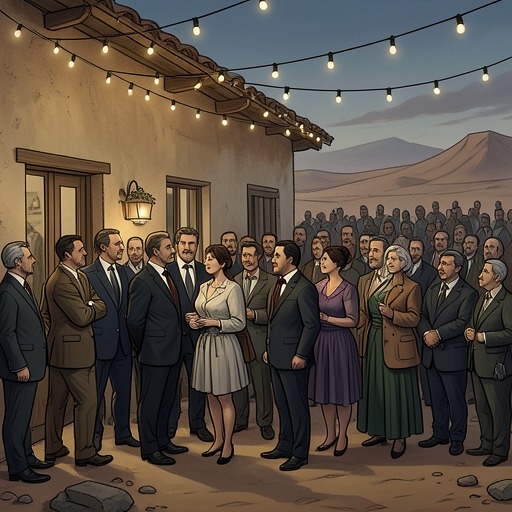
Jo Henniger
The ForgivenJo Henniger is the observant but increasingly dissatisfied wife of David Henniger, a children’s-book writer whose marriage and creative life have both settled into long silences. During a trip to Morocco, the fatal collision with Driss brings her private discontent into contact with grief and responsibility. Her subsequent affair with Tom Day does not resolve that crisis; instead, it makes visible how far she and David have drifted and gives her a brief, unsettling sense of having become someone new.
Identity and Arrival
Jo arrives in Africa alongside David, but the couple do not experience the journey in the same way. On the ferry, she reads a Spanish newspaper with apparent indifference, then briefly removes her sunglasses to look toward the approaching city. David studies her confusion; she is present at the threshold of a new place, yet not readily drawn into his excitement or expectations. The scene establishes a pattern in their marriage: they travel together, but their attention and inner lives do not necessarily meet.
The distance between them is not new. Later, Jo recognizes that they have slept apart for the last two years, though she had not previously considered being unfaithful. Their shared life has become a form of absence rather than a declared separation. In Morocco, that existing estrangement is tested by events that neither can simply leave behind.
The Collision, Disclosure, and Grief
On the road, Jo catches David’s arm as they argue about whether to turn. After sand dims the route, she sees two men beside the road, one holding a cardboard sign advertising fossils. She calmly tells David to stop, but he continues; the car strikes Driss. Jo’s perspective preserves the collision’s suddenness: the apparent scam and the argument give way to an impact too swift for considered thought. Her warning, and David’s decision not to heed it, remain part of how she understands what happened.
At dinner, Jo states plainly that they hit a Moroccan man and killed him. The announcement stops the table and forces the guests to confront what had been kept outside their social performance. David blushes, while the room falls silent. By speaking, Jo makes the death publicly present, rather than allowing the couple’s account of their journey to proceed as if nothing decisive had occurred.
Her response continues after the disclosure. She thinks she should see Driss’s body and say something to it, if only a prayer, even though she doubts she has the right language or religious tradition. At the gathering, guests approach to express sympathy, and Tom Day takes her hand as he guides her through the crowd. She does not pull away. The gesture does not erase her grief; it marks an opening through which she accepts a kind of attention she has not been receiving from David.
That night, a dream of running toward a well unsettles the boundary between sleep and waking. Jo sees a dark presence in the well and senses someone behind her carrying an axe. When she wakes alone in the chalet, she works through the previous night’s events until she recognizes that the experience was not merely a dream. The passage gives her disturbed consciousness a form without explaining it away: the imagined danger and the reality she is trying to absorb remain close together.
Exclusion and a Life Coming Quiet
Jo wants to accompany David when he leaves with Driss’s body, but Abdellah’s rule excludes women. She offers little resistance and soon accepts that she does not actually want to go. Instead, she packs David’s shaving bag and sports bag, arranging his toiletries and clothes with the care of someone sending a child away. The task makes their changing relation tangible: she can still perform the gestures of a wife, while recognizing that the past those gestures belonged to has begun to disappear.
At Azna, her creative life is also losing its hold. She considers the fading visibility of her children’s books and the possibility that no future reader will need them. Writing now seems to offer nothing she wants to say, and silence brings relief as well as a sense of failure. Her thoughts turn from the vanishing of a career to the unwanted privacy of aging and to a wish to be noticed. This inward inventory matters because her later awakening is not simply romantic excitement: it grows from the feeling that her work, desirability, and place in her marriage have all receded from view.
Tom Day and the Awakening
The third and final dinner at Azna feels different to Jo from the earlier evenings. Its elaborate decorum frays into a more openly sexual atmosphere, and she reflects on age, desire, and the possibility of freedom from the expectations that have governed women’s lives. The young Moroccan staff do not become the object of her interest; her attention is fixed on Tom Day, who has taken time to notice her and consider her as a person. The distinction is important to her: she responds not simply to availability, but to being attended to.
Jo wakes in Tom Day’s arms with panic and disorientation. She has never before been unfaithful to David, and she cannot recall the encounter clearly. What troubles her is the knowledge she now carries and the effect it will have on the future, whether or not she can reconstruct every detail. She understands the affair as emerging from several pressures at once: alcohol, Tom Day’s attentiveness, and anger toward a husband who was absent in more than a physical sense. She does not treat those pressures as an excuse. The secret remains a burden even as the experience gives her a sudden, almost startling sense of having returned to life.
Swimming, she recalls her childhood by the River Ouse and her dead father’s image of an inner stream that remains alive. The memory connects the present moment to a self that predates her marriage and career. Later, she judges the upheaval of the past forty-eight hours as both destructive and liberating. In her own reckoning, Driss’s death set events in motion, and she links Driss, Tom Day, and David as the three figures through whom the weekend has changed her. Her claim that Driss liberated her is not a claim that his death was welcome; it is her severe recognition that, without the rupture, she believes she would have continued toward the same old discontents.
Return and Narrative Significance
When Jo speaks with Tom Day, she describes feeling young again and presents the affair and the swim as part of a sudden revelation, while acknowledging that revelation may be too strong a word. The moment is brief, but it breaks the assumption that her future must simply repeat her settled dissatisfaction. Her independence is not presented as a completed escape or a clear new plan. It is an altered awareness of what she has been missing and of what she may still choose.
After David returns, Jo understands that both of them have been changed by what happened while they were apart. Their experience cannot be discussed openly, but it cannot be forgotten; she recognizes that their relation has altered forever. She calls him Stumblebum, tells him they can go home, and he echoes the word home. The departure restores the familiar setting of their marriage without restoring its former terms. Jo’s arc therefore binds the public fact of Driss’s death to private transformations: her act of disclosure, her grief, her silence about the affair, and the changed intimacy between herself and David.