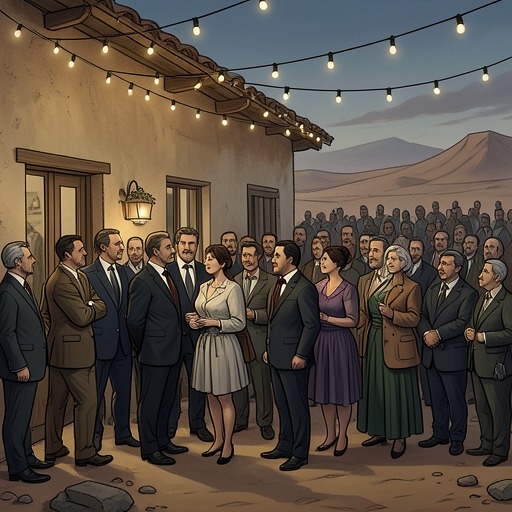
Ksour Azna
The ForgivenKsour Azna is a ruined hillside settlement where the remains of an old fortified community have become the setting for a wealthy foreign household and the arrival of Abdellah Taheri. Its broken architecture and nearby spring bring distinct worlds into close proximity: the memories and customs of local residents, the visitors’ conspicuous wealth, and the urgent claim of a father seeking his son.
Setting and architecture
The ksour stands high on a hillside beyond Tafnet, above a river valley whose cliffs hold houses, some still inhabited and others abandoned. Its main mansion, built of dark brown pisé, rises within old walls that have survived while time has worn down the settlement around them. The granaries, or ghorfas, are described as four hundred years old; their eroded forms are linked by irregular adobe staircases. The result is not a single intact fortress but a layered place, in which the surviving structures make abandonment visible.
The settlement had been deserted since Moroccan independence in 1956. Its position beside a natural spring helps explain the continuing cultural meaning of the landscape even after the old community declined. The spring, known as La Source des Poissons, was said to have the power to help sterile women become pregnant. A flight of steps descends from the houses to a pool where women of the Aït Atta were believed to go in secret to recover their strength. The water and the ruins thus belong to more than the site’s physical geography: local accounts attach fertility, privacy, and restoration to this particular landscape.
The foreign household and local perceptions
The settlement’s abandonment does not mean it is empty. A few older residents remain in habitable houses by the cliffs, and the wealthy foreigners who occupy the main house have become a recurring presence in their lives. Locals call them visitors, a term that carries an expectation that their stay will eventually end. They are recognized as rich and as generous spenders who employ household staff, pay extravagantly, and contribute money to the community. They also pay for improvements to the ksour itself, making the ruins a place where foreign money is both welcomed and watched.
The visitors’ routines and tastes appear strange to the older residents. Their nighttime stargazing, unusual sleeping hours, twilight walks, and dependence on imported drinking water distinguish them from local life. Their use of swimming pools, and occasional swimming in the Source des Poissons, is seen as an intrusion on a spring with established local significance. Gossip about Dally Margolis and Richard Galloway’s relationship expresses disapproval, but it sits alongside private admiration for their wealth and cosmopolitan habits. The locals’ view is therefore not simple rejection: economic advantage and cultural unease coexist.
The supernatural explanations attached to the ksour sharpen this mixture of fascination and suspicion. Residents imagine that jinn resent the presence of non-Muslim visitors in a place built for Muslims, and interpret disturbances in the house through that belief. Such accounts do not establish that supernatural forces act there; they reveal how the foreign household is understood from outside. The ruined granaries and mansion become a setting in which local explanations, social judgment, and the visitors’ private life meet without fully converging.
Parties and the spectacle of wealth
The house is also the center of repeated parties. From the surrounding valley, music and voices signal a gathering before the residents need even turn to look; festivities have become familiar. On one evening, workers prepare lights in nearby tamarisk trees and decorate the grounds, while Day watches the preparations and the bustle around the house. The lights fail at first, the generator is restarted, and the staff continue arranging bulbs and small tangerines among the branches. The staging makes the party’s extravagance visible as work undertaken by people whose labor supports the guests’ leisure.
As cars arrive along the dirt road, hired attendants greet the guests in costumes designed by Dally. The visitors arrive dressed for the occasion, and some have already been drinking during the journey. The procession is likened to an old Russian ball, turning the approach to the ruined ksour into part of the entertainment. Once the floodlights come on, the facade is brightly illuminated. The contrast is pointed: an abandoned settlement, shaped by centuries of use and gradual decay, is temporarily transformed into a theatrical backdrop for the guests’ display of money and style.
The gate and Abdellah’s arrival
The ksour’s main gate becomes the setting for a decisive change in the household’s evening. Richard Galloway leaves the dinner after a servant approaches with news that the English arrivals are in a terrible state and that there has been an accident on the main road. The party continues, with more wine and dessert, while Day notices two empty place settings that he had forgotten. The report brings the outside road into the enclosed world of the celebration, though the gathering does not immediately stop.
Later, Abdellah Taheri arrives in a battered vehicle with several companions. The travelers are dusty from the road, and the men are understood to have weapons with them, although none is openly displayed. Abdellah identifies himself as an Aït Kebbash man from Tafal’aalt and says he has come to collect his son. He kneels before the closed gate and repeats his request that it be opened. His manner is described as grave and controlled, not as an outburst; the repetition itself carries the demand from the gate toward the people inside.
Hamid, a servant who has worked for the household for almost seven years, recognizes the voice and approaches the gate. His long experience in the visitors’ daily life makes him a point of passage between the household and the people outside it. When Abdellah’s call reaches the guests, Richard comes quickly to the gate. The scene gives the architecture a new function: the gate that marks the division between the foreign party and the surrounding community becomes the threshold across which a family claim and the consequences of the road accident enter.
Narrative significance
Ksour Azna is more than a picturesque ruin. Its physical decay places past habitation beside present occupation, while its spring holds local meanings that the foreign visitors do not share or always respect. The lavish parties make wealth visible against the settlement’s abandonment; the locals’ mixed response shows that material benefit does not erase cultural distance. Finally, Abdellah’s arrival turns the boundary of the property into a point of confrontation and communication. Across the same landscape, the story moves from the visitors’ expectation of a temporary stay to a demand they cannot keep outside the gate.