La’gaaft
The ForgivenLa’gaaft is one of five villages lying beneath the mountain’s north face, and the novel’s brief account of it reveals a social boundary as stark as the immense cliff above it. Although the village appears much like its neighbors, Abdellah treats it as a place David should avoid, exposing the prejudice that shapes relations between La’gaaft and Tafal’aalt.
Setting and Appearance
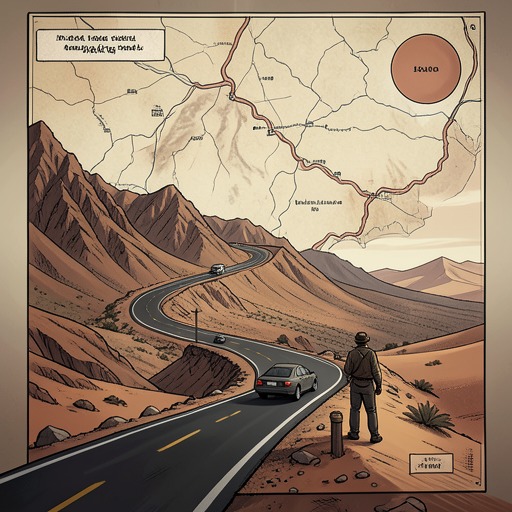
La’gaaft lies below the north face of the mountain, between Boudib and Ambon on the route toward Tabrikt and Tafal’aalt. As the Toyota stops outside the village for a tire inspection, David sees the mauve cliff towering above the settlements. Its caves are cut into the rock, with ropes and ladders hanging from them, and its long shadow engulfs La’gaaft.
At the well, two figures stand with their faces visible through bundles of rags. The travelers then pass through the village in silence, clutching their old rifle. High on the cliff, David notices a boy on a cave ledge waving a white cloth. The scene places a small, distant human gesture against the scale of the rock and the shadow covering the settlement.
Residents and Social Boundary
La’gaaft is identified as the village where the haratin live, a community treated with contempt by Abdellah. His account makes clear that the boundary is not simply geographical: he instructs David that, if asked in Tafal’aalt whether he has visited La’gaaft, he may acknowledge the visit but should not mention drinking its water. He presents even that ordinary contact as something better left unsaid.
The warning also carries a tension between the villages’ closeness and their separation. La’gaaft is directly on the travelers’ route, and David observes that it looks much like Tafal’aalt, yet Abdellah singles it out for avoidance. The shared landscape and similar settlements do not undo the hierarchy imposed on their inhabitants.
Abdellah’s Warning and the Village’s Significance
Later, Abdellah tells David that he is free to go wherever he likes, with one exception: he must not walk to La’gaaft. He again identifies it as the haratin village and warns David that he will regret going there. The restriction is therefore presented not as a locked door or formal confinement, but as a permission hedged by intimidation and prejudice.
David recognizes the contradiction between Abdellah’s apparent friendliness and his emphatic hostility toward La’gaaft. He also questions why Abdellah’s hatred of the haratin persists between neighbors who have presumably lived beside one another for centuries. La’gaaft’s narrative importance lies in this contrast: the village seems physically ordinary and near at hand, while the social order surrounding it makes proximity itself fraught.