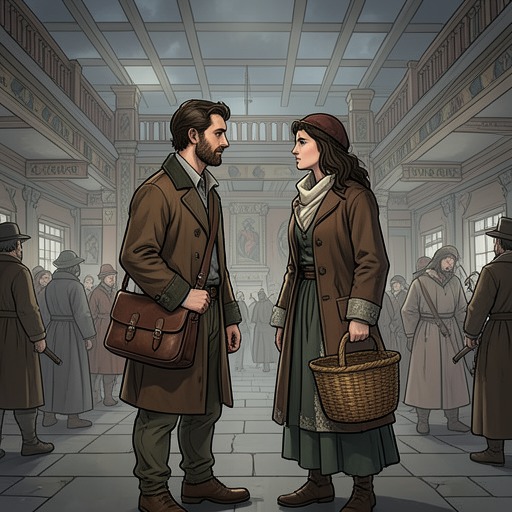
The dehumanizing image of treating people like flies
The ForgivenThe dehumanizing image of treating people like flies gives the novel a shared but unequal vocabulary for contempt: Jo Henniger imagines that the local staff dismiss her and David Henniger as negligible outsiders, while the staff later use a similar idea to interpret Driss’s death. The image does not establish what either group truly thinks; it shows how suspicion makes each side read the other’s actions as proof of disregard. Its force lies in that reversal, as the visitors who feel reduced to insects are themselves accused of treating a human life as disposable.
Jo’s perception of the visitors’ reception
At the house in Azna, Jo and David return to a lounge crowded with people, many of them asleep or eating crackers spread with majoun. They recognize no one, and the ordeal they have just experienced has left them less able to enjoy the gathering. They go downstairs to the baking patio, where they drink hot chocolate on the only bench and hear voices from the first floor. The scene makes their separation palpable: they have little to say to each other, while the sounds of the gathering carry across a social boundary they cannot cross.
Jo senses that the laughter and conversation are directed at the couple. In her understanding, the people around them regard the foreigners as absurd and offensive, judging their food, perfumes, manners, and women. Her thought that they are being regarded as flies condenses this perceived contempt into an image of insignificance: not simply that the visitors are disliked, but that they do not merit serious attention. The account remains close to Jo’s suspicion rather than confirming what the others are saying. That distinction matters. The image records her experience of being judged, but also the uncertainty through which she interprets an unfamiliar group whose words she cannot confidently make out.
David responds to the moment differently. He complains about the dogs and asks whether there is a boy to drive them off; he then takes Jo’s hand. The small gesture offers reassurance without resolving what she has heard or feared. The narration’s qualification that things would be all right, except that they would not, prevents the handclasp from becoming a simple restoration of security. In the patio scene, the image captures Jo’s exposure to imagined ridicule while the couple remain unable to address the larger distance between themselves and their surroundings.
The staff’s interpretation of Driss’s death
After the death, the staff gather near the garages as the wind drives sand through the grounds. They look at the body and exchange accounts of what may have happened. Their suspicions do not rest on a single confirmed explanation: some imagine that the vehicle passed over Driss more than once, while another invokes fate. The staff’s discussion moves between rumor, inference, and an effort to make the event intelligible. The image of people treated like flies turns that uncertainty into a moral judgment about the foreigners’ capacity for care.
One speaker connects the suspicion to religious difference, describing a Muslim killed by a Christian as something the mind cannot readily accept as an accident. Another recalls an uncle’s view that the visitors regard local people as insignificant and are not mindful of them. The conversation then focuses on the possibility that the car reversed. To the staff, that detail seems to imply deliberate concealment rather than an accidental maneuver. Their reasoning is not presented as established fact: the passage shows a group trying to interpret what it has seen and heard, and moving from a disputed circumstance to an accusation about intention.
The image is sharpened by the staff’s belief that the foreign couple reversed to avoid leaving a witness or evidence. In their account, the act would be comparable to swatting an insect: an apparently casual movement that erases a life without reflection. This is their inference, not a confirmation that the death was intentional. The distinction between what happened and what the staff believe happened is central to the image’s work. It makes visible how an unexplained death, filtered through social and religious mistrust, can acquire the shape of a crime in the minds of those left to interpret it.
Reversal, distrust, and narrative meaning
The image binds together two different scenes without making their situations equivalent. Jo feels exposed to mockery as a foreign visitor; the staff confront the death of Driss and fear that his life has been discounted. In the first scene, the fly is the figure through which Jo understands her own vulnerability. In the second, the figure becomes an accusation against the people she belongs to. That reversal denies the visitors an uncomplicated position as observers of local prejudice: they too are seen, judged, and suspected, while the staff’s grief and anger resist being reduced to mere hostility.
The staff’s complaint that the police have done nothing adds to the atmosphere of distrust. It does not prove their theory or explain the authorities’ inaction, but it leaves their suspicions without a clear answer. The conversation also holds incompatible possibilities together: accident, fate, and intentional action all appear, even as the speakers lean toward blame. The image supplies emotional coherence where the available facts do not. By comparing disregard for a person with an unthinking act against a fly, the narrative exposes how easily a feared pattern can stand in for proof.
Human attention as a counterpoint
Elsewhere, Jo’s response to David is markedly personal: she leans down and brushes his sunburned nose with her lips, then jokes that he resembles a pirate after a sword fight. The exchange does not resolve the wider mistrust around the couple, nor does it directly answer the staff’s suspicions. It does, however, offer a small counter-image to abstraction. Where the fly metaphor makes a person negligible, this moment attends to a particular face, a sunburned nose, and a teasing exchange between two people whose relationship is strained but not wholly without tenderness.
The concept therefore operates less as a stable label than as a contested way of seeing. Jo’s perception tells of alienation; the staff’s use of the same underlying comparison expresses grief, suspicion, and the belief that outsiders may fail to recognize local people’s full humanity. The novel leaves the accusation unverified while making its consequences legible: once people imagine themselves treated as insignificant, they may interpret ambiguous actions through that expectation. The recurring image gives mutual othering a concrete form, and keeps the difference between a person’s death and the stories told about it in view.