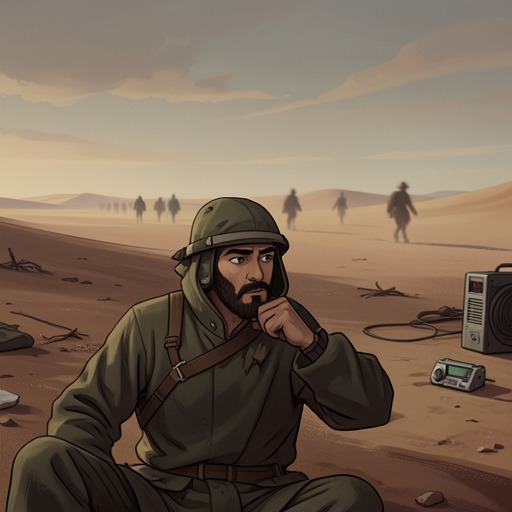
The dying desert
The ForgivenThe dying desert is more than a bleak setting: it is a slowly failing home whose dwindling resources structure work, settlement, and expectations of the future. In Abdellah’s bitter description, the desert is a fishing ground and fossils are its catch, but the fish are already dead. His joke gives the landscape an economic and moral weight: people depend on what the desert yields even as the villages around it appear to be running out of life.
Abdellah’s account of decline
During the journey toward Tafal’aalt, Abdellah pauses to watch the empty road that crinoid dealers will use on their way back to Erfoud. He has stopped to buy specimens from stonecutters, and the possibility of making such calculations can seem frivolous against the harsh struggle for survival. The episode joins commercial attention to a wider sense of precariousness: even a few specimens matter in a place where livelihoods are narrow and uncertain.
Abdellah calls the place wretched and says, “It is dying, as you can plainly see. The desert is what we fish, and the fossils are our fish. Dead fish! It is a joke. God has played a joke on us.” David Henniger answers grimly, refusing to share the joke. Abdellah insists that it makes him laugh, but his insistence does not cancel the despair beneath it. The metaphor turns fossil collecting into a kind of fishing, while the fossils’ deadness makes clear how meagre and strange the available sustenance is.
His prediction is stark: “Soon, there’ll be nothing here. No people, no trees. We’re the last ones.” He repeats that they are the last ones, tapping the steering wheel with his nails, and reduces what remains to fossils and children. The pairing is telling. Fossils preserve evidence of lives long vanished; children represent lives still present, but not necessarily a secure future. The desert’s decline is therefore also a crisis of continuity: what can be extracted from the ground and who may remain to inherit the place.
A journey through signs of exhaustion
The route itself makes Abdellah’s words legible. As the road becomes a track across the desert, acacias multiply into the distance, their dagger-like thorns scattered on the ground. Near the Jbel Issomour massif, the terrain is not the open sand David expected but dark, cracked, pitted rock. Man-made fossil trenches interrupt the exposed country, with workers’ tools and camping gear left beside them during the hot season. The workers flee to the Atlas Mountains for a gentler living and return when temperatures fall. Their belongings wait in place through the seasonal absence, giving the landscape the appearance of a camp emptied long ago.
The mountain route does not offer relief from this impression. On its high roof, the party sees pale expanses of desert and more carefully cut trenches, with tool bags lying in the sun. Abdellah drives across the wasteland without stopping, and the journey descends toward five villages beneath the mountain: Boudib, Ambon, La’gaaft, Tabrikt, and Tafal’aalt. The changing altitude reveals the villages as small settlements held beneath an immense, apparently immobile landscape. The desert is not a distant backdrop; its heat, exposed rock, and routes of seasonal work govern how people move through the region.
Villages and unequal vulnerability
At Boudib, domed houses have yellow trilobites painted on their metal doors, while spindly, dying trees fringe the back gardens. Dust rolls through rubble lanes. At midday, the inhabitants have gone indoors and even the dogs shelter from the heat. Huge white stones lie beside dried oueds, where infected trees appear to gasp out their last. The details make decline cumulative rather than spectacular: failing vegetation, dry watercourses, dust, and houses surrounded by signs of life under stress.
Ambon offers little more than its well to the men who pass through it. Beyond it, Issomour’s mauve north face rises above La’gaaft, its man-made caves and hanging ropes marking the fossil workings. The settlement lies under the mountain’s long shadow; two figures stand near the well, while a boy waves a white cloth from a ledge high above. The contrast between the boy’s gesture and the immense cliff does not turn the scene into a simple emblem of rescue. It places human life, work, and vulnerability within a terrain that overwhelms the scale of the villages.
The social geography is unequal as well. Abdellah warns David that the haratin live in La’gaaft and instructs him not to say that he has drunk their water. The warning marks the village and its inhabitants as subject to prejudice, even within a region where all communities face material hardship. At Tafal’aalt, the final village before the open desert, two dozen domed homes stand behind vegetable plots and date palms. The gardens still produce a sign of cultivation, but the shadow of Issomour reaches them too. The settlement is neither an empty ruin nor a secure refuge: it is inhabited, worked, and already imagined under the threat of disappearance.
Fossils, children, and the future
Fossils are at once the region’s livelihood and its emblem of extinction. The trenches show purposeful labor, and Abdellah’s attention to specimens and passing dealers gives fossil commerce a practical place in the journey. Yet the trade depends on the remains of life from another time. His fish metaphor captures that contradiction without resolving it: fossils can be gathered and sold, but they are not living food, and their presence cannot by itself make the future of the villages viable.
The children complicate Abdellah’s claim that only fossils and descendants remain. On the road, the party encounters a boy of about fourteen, wrapped in indigo cloth and following camels that have disappeared below the horizon. At Tafal’aalt, David sees the village’s vegetable plots and palms, while the narrative also registers child labor among the fossil workings. These details do not refute the father’s fear; they make its stakes concrete. Children are present in the landscape, but their presence does not guarantee that they can remain there without inheriting its precarious work and conditions.
The landscape and the work of mourning
The desert’s physical desolation persists into the account of Driss’s burial. David wakes to the cliff burning in the first light of a Sahara dusk and assumes the burial is over. It has indeed passed quickly: the grave plot is exposed to high wind, and the men stand silent as debris is hurled around them. Driss’s aunts and cousins weep and curse; Abdellah remembers his son as a ten-year-old boy and the Dicranurus they once found together in the trenches. The fossil, still kept in Driss’s room, connects their shared past to the work that sustains the present.
In this scene the desert is not only an economic resource or a warning of future abandonment. Wind, exposed ground, and the encroaching dark make the burial’s harshness part of the characters’ lived grief. The narrative thus places human loss within the same landscape Abdellah calls dying, without making the two interchangeable. His forecast of an emptied region remains unresolved, but the villages, working trenches, children, and mourners give the desert a densely human present even as its conditions make that presence seem fragile.