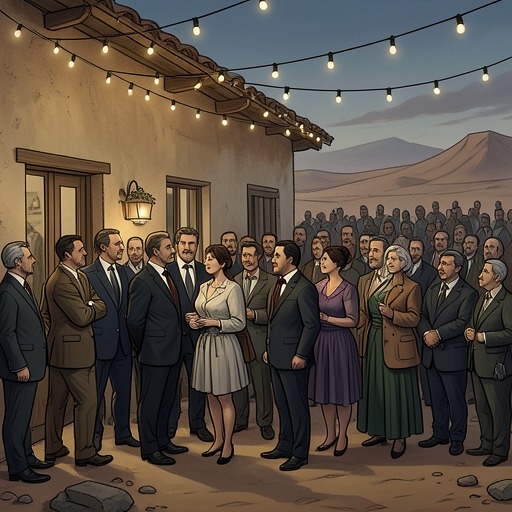
Tom Day
The ForgivenTom Day is a middle-aged American investor who moves through the festivities at Azna as both participant and outsider: he has money in Dally’s business, but little appetite for its parties, and watches their theatrical excess with a mixture of amusement and weariness. His importance emerges less through any control over events than through a contrast between his guarded account of himself and the quiet, unshowy concern he offers Jo when she is struggling with the aftermath of the collision.
Identity and Background
Day is about forty-five, with Italian features, and initially unknown to the men of Azna. He wears a Huntsman suit and a poppy while walking beside an unrepaired section of the ksour wall, carrying a paper plate with pieces of chocolate cherry cake. His appearance makes him conspicuous against the village setting, but the narrative also makes him an observer: he notices the people, preparations, and small failures unfolding around the party rather than simply joining the celebration.
He is a private investor in Dally’s business, although he never asks questions about it and rarely appears at Dally’s frequent gatherings. Day does not disclose how he made his money; the account of his past offers only that he retired at thirty-eight. He lives alone in New York and keeps a house in Ubud, Bali. A few years earlier, his wife left him for a hedge-fund manager, after which she disappeared from his life. These details sketch a man with considerable financial freedom and an established preference for distance, without explaining his wealth or turning his former marriage into a story of reconciliation.
Day describes himself, in the narrative’s close access to his thoughts, as having spent his earlier life too freely. At the party he is conscious of age and of wanting to preserve what remains of his energy rather than spend it in an endless round of social entertainment. That reserve is not simply shyness: he takes pleasure in watching the spectacle, but resists pretending that he belongs to its younger, more exhilarated world.
The Party and the Observing Outsider
From the wall, Day looks over the valley road toward the white edge of the Sahara. Around him, staff struggle to hang fairy lights in tamarisk trees according to designs requested by the boss, while the cattle egrets chatter and are beaten back with sticks. The electricity fails when tested. Day enjoys the swagger and bustle of the gathering as it seems to inflate around him, like a monstrous cartoon taking shape. His vantage makes the party both entertainment and performance: the preparations, the frustrated labor, and the failed lights all belong to the same display of affluence.
When guests spill into the courtyard, Day watches them gather around fruit punch, iced rose water, figs, and the arriving Gnawa musicians. He notices the tall European and American women in locally acquired clothes and their studied, knowing manner among the performers. Rather than sharing their cosmopolitan ease, he recognizes them as people of the great cities and feels the distance between their youth and his own approaching old age. His self-mocking response is to regard himself as an accidental invitee who will not even put on a good face for other people’s fun.
The performance itself sharpens his ambivalence. The drums are wild and hypnotic, yet the music is already familiar from record stores, and the guests bring with them the cultural references they have dutifully absorbed. Dally leads the applause, thanks the travelers, and points out that the honey is local; dinner is delayed until eleven. Day’s attention rests on the gap between the performance’s apparent remoteness and its familiarity to the international guests. He is not detached from the party so much as alert to how readily an exotic setting becomes another element of its guests’ cultivated entertainment.
Encounters with Jo
At dinner, Day sits across from Jo and looks at her for long periods, unblinking and intent. She looks back, and for a moment their suspicions meet without either knowing the other. The exchange is brief and unexplained, but it gives their later encounter a small antecedent: before they speak more personally, each has already registered the other as someone worth watching.
The following day, Jo finds Day farther along the same wall, kneeling behind the parapet to take photographs. He is absorbed enough not to notice her until she is only a few feet away. He greets her, rises, and removes his straw porkpie hat; turning it over, he explains that he bought it in Casablanca and that it was made in China. The joke is modest and self-deprecating, and Jo decides on the spot that she likes him. She reads him as affable and solid, a person who watches and takes notes rather than looking away. Her sense that they may be the only sane people present links them through a shared unease, though it does not mean they understand the crisis in the same way.
Kindness in the Aftermath
Jo is distressed that David has left, believing he has ridden away because he cannot face what the morning will bring. She feels that the crisis remains unresolved and that she will be left to confront it. When she admits that for a moment she had thought the previous events were a dream and asks how they could have been so stupid, Day touches her arm and suggests they go down for lunch. He tells her there is little point in blaming herself. When her eyes fill with tears and she remains fixed against the wall, he waits rather than forcing her to move or speak.
Day’s later insistence that everyone speeds is a practical effort to ease Jo’s self-reproach. He says it firmly, separating the general fact of speeding from the issue at hand. The remark does not undo the fatal collision or establish that the Hennigers bear no responsibility; the evidence does not show Day investigating what happened or offering a resolution. Its immediate significance is relational. He stays with Jo through her distress and offers company, a meal, and a perspective that interrupts her solitary cycle of blame. Against the elaborate social performance of the party, his most consequential action is small: he notices another person’s suffering and waits with her.