Trilobites
The ForgivenTrilobites are the fossil wealth of Tafal’aalt and the material trace of Driss’s life: he spends his childhood extracting them from the cliffs and, decades later, their polished forms make his labor visible to David. In the village, they are not merely remnants of an ancient sea. They are work, subsistence, and merchandise, moving from dangerous rock faces into collections far from the desert. The distance between those who uncover them and those who buy them gives the fossils their double force: objects of wonder to outsiders, and the product of exhausting labor to the people whose lives depend on them.
Fossils in the Desert
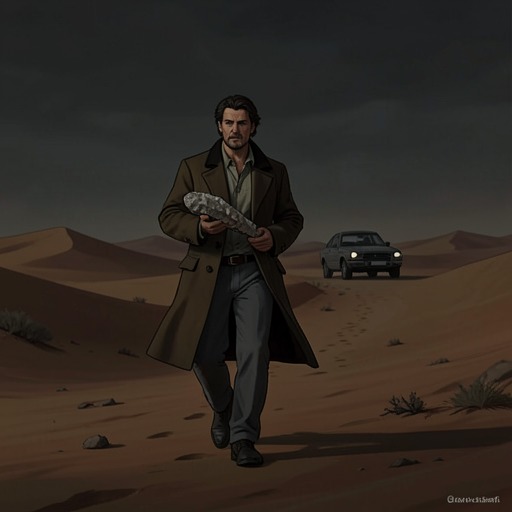
The trilobites belong to a deep past in which the Sahara was a vast sea. David encounters them not as a scientific abstraction but as spined, armored, crablike forms wrapped in newspaper, their labels bearing names such as Psychopyge, Asaphus, and Dicranurus. The Dicranurus has splayed, spiderlike legs and two coiled, ram-like horns; its label places it in the Devonian. In the dim, hot room, the specimens’ shapes strike David as fierce and unsettling. Their appearance makes the distant past seem less like a vanished paradise than a nightmare ocean crowded with strange life, lending a new plausibility to the local association between fossils and demons.
The specimens can also be extraordinarily delicate. David picks up a tiny Comura trilobite whose single row of articulated spines is fine enough to trace with a finger. Other fossils have broad, smoothly armored heads, while the value of a specimen rises with the detail of its corrugated eyes and the extravagance of its spines. Preparation gives their surfaces a polished sheen; they can resemble elegant prehistoric tools even as their forms remain alien. The fossils hold these contrasting impressions together: exquisite workmanship and unsettling antiquity, beauty and apparent menace.
Driss and the Work of Extraction
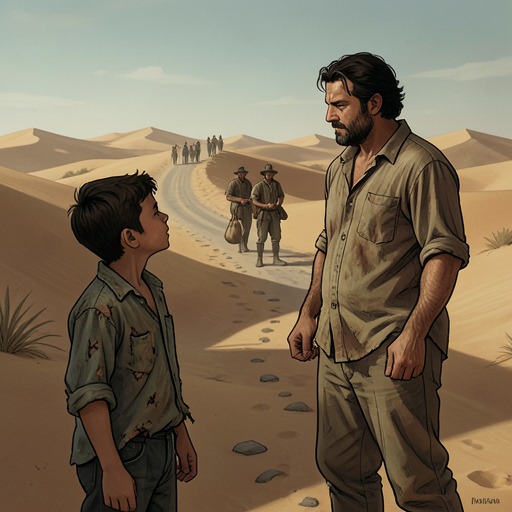
For Driss, trilobites are first encountered through labor rather than collecting. At ten, he is made to climb the cliff faces with hammers and chisels, working for ten hours a day from dawn toward dusk, sometimes longer. Alone at the end of a secured rope tied around his middle, he moves from hole to hole and taps at trilobite shells until they come free of the rock. His father’s beatings and demands turn the work into a childhood discipline imposed by poverty and authority; Driss comes to hate the place that is both home and workplace, straining his eyes toward whatever might lie beyond it.
The work persists into adulthood. The specimens David examines were hacked from Issomour cliffs by Driss, whose waking life had been filled for more than twenty years with Comura and Psychopyge trilobites. The fossil is therefore also a record of repeated bodily effort: a form carefully removed from stone by someone whose own history is largely absent from the finished object. David sees the result in the neat packages and polished surfaces, but those surfaces conceal the childhood rope, the long hours, and the danger of working on the cliff face.
A Local Trade and a Distant Market
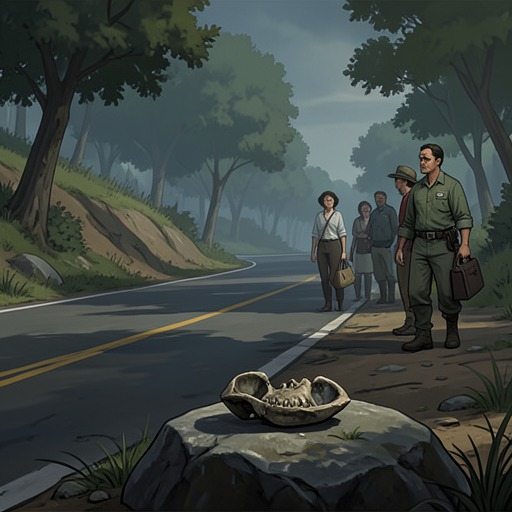
The trade organizes itself around local distinctions as well as foreign demand. On the road toward Merzouga, Anouar explains that the Aït Atta prospect for aquifers and crinoids, while the men of Tafal’aalt deal in trilobites alone. Issomour is described as Africa’s richest source of trilobites. Traders from Germany, France, and the United States pay substantial sums for well-preserved Comura Tridents, and some specimens sell for hundreds of euros. What can seem like a narrow specialization is, in this account, the basis of a village economy built around the fossils of its mountain.
That economy is sharply unequal. David watches diggers return at dark, after working until they can no longer see what they are doing, with hammers and stones clinking as they pass. He imagines a European buyer selecting a Dicranurus from the same room and having it wrapped. The money, in his reckoning, may keep a family supplied for a few weeks with basics such as flour, oil, butter, tea, and bread; meanwhile the fossil begins a glittering career on the other side of the world. He sees little of the profit reaching the diggers and much of it accruing to middlemen and dealers. Yet he also compares this system with low-paid factory labor elsewhere, resisting the easy certainty that one distant economy can be judged by the standards of another. The comparison does not erase the disparity; it shows David trying to understand it without imagining that wealthier consumers are themselves outside the chain.
Collectibles and the Human Cost
Once removed and prepared, trilobites enter a world of affluent collecting. David thinks of wealthy buyers purchasing fossils at exorbitant prices at the Butterfields auction in San Francisco, then using them to decorate bathrooms in Palo Alto, Manhattan, and Venice Beach. He measures that luxury against the scale of village need: he reasons that a single bathroom renovation for a Silicon Valley executive could sustain a Saharan village like Tafal’aalt for a year. The contrast turns the fossil from a beautiful object into evidence of how unevenly its value is distributed.
The specimens’ labels make that movement concrete. One tiny Comura trilobite is marked for a buyer in the United States; its fine spines and careful preparation are legible as qualities that can raise its price. A Dicranurus, too, can leave the desert in a package, while the diggers return from the mountain with the tools of their work. Trilobites thus connect deep geological time to an intensely present economy. Their ancient forms survive, but the people who extract them remain bound to the precarious exchange that gives those forms a market value—and sends the most prized examples away from the place that produced them.