Apollo
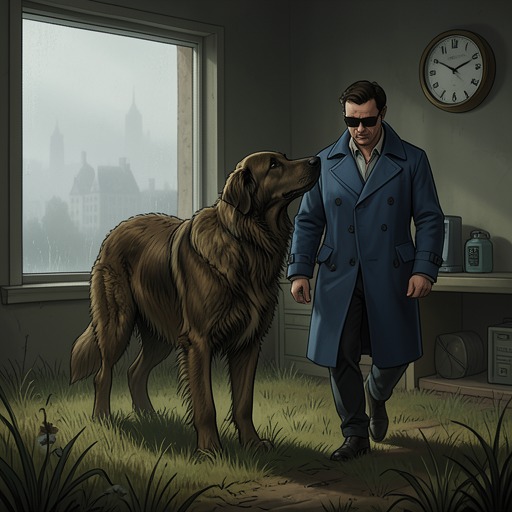
The FriendApollo is the narrator’s companion and the center of a relationship built from routine care, mutual protection, and attention to his particular habits. As he grows old, that bond becomes both a source of contentment and a confrontation with approaching loss. His declining mobility makes the future hard to ignore, while his continued pleasure in familiar play and a summer morning brings the narrator back to the day they still share.
Daily Care and Mutual Protection
One evening, after a four-mile walk, Apollo sleeps warm, dry, and well fed. The narrator has guarded him from passing cars when he stopped in the street, and in the park Apollo has barked and blocked a texting jogger who was about to run into the narrator. Their protection runs in both directions, though in different forms. The day has also included tug-of-war, conversation, singing, poetry read aloud, nail trimming, and brushing his coat. Watching his flank rise and fall, the narrator first feels contentment and then recognizes a deeper, familiar feeling: attachment expressed through the accumulated work of looking after one another.
That closeness is not presented as a human relationship simply transferred onto a dog. The narrator imagines Apollo and the narrator as two solitary beings who protect one another while keeping their own boundaries. A session in a therapist’s office, with Apollo at the narrator’s side, prompts a comparison to couples therapy, qualified by the narrator’s observation that the two companions get along. On the street, a passing woman makes a joke that a dog would make a better husband than a husband who behaves like a dog. The remark turns Apollo’s companionship into a public shorthand for human disappointment, but the private relationship described in the book is more specific: it depends on daily attention and does not require Apollo to become a person.
Play, Temperament, and the Limits of Knowing
Apollo’s favorite toy is a bright red tug toy made of hard rubber. During their games he makes mock monster-dog noises, while the narrator suspects that much of his enjoyment comes from letting the narrator win. That remains an inference rather than knowledge: the narrator has never seen him use anything like his full strength and cannot tell how aware he is of it. His reserve also shapes their outings. Other toys do not interest him, and repeated trips to the dog park have not produced the hoped-for play with other dogs. Apollo seems no more interested in dogs than in people.
The narrator is troubled by this apparent indifference, in part because of a wish familiar from human relationships: that a loved one should find a friend. The narrator imagines Apollo befriending another dog, perhaps even forming a special attachment, and repeatedly encounters Bella, a striking silver Italian mastiff. The narrator recognizes that imagining such feelings for Apollo is anthropomorphism, but no longer tries to suppress it. The text sets that affectionate projection against the possibility that Apollo’s social life simply does not conform to the narrator’s hopes. Invoking Karl Kraus’s observation that dogs are loyal to people rather than to other dogs, and that dogs may hate one another, the narrator complicates the familiar ideal of canine loyalty. Apollo’s bond with the narrator is vivid; his inner relation to other dogs remains beyond the narrator’s confident reach.
Aging and the Narrowing of the Walk
The signs of age appear in Apollo’s body before they become an abstract fear. Gray hairs mark his muzzle, redness rims his eyes, and some days he walks stiffly or needs two attempts to get to his feet. Between veterinary checkups six months apart, his arthritis has worsened. The veterinarian’s list of signs to watch for in senior dogs makes the narrator imagine the practical demands of caring for Apollo if he becomes infirm, as well as the possibility of losing him.
The beach, only a short walk away, becomes a measure of both what remains possible and what is being lost. On their first visit, the narrator wonders whether Apollo has ever seen the ocean, swum, or walked on sand; his large footprints might give some people pause. They go early in the morning or at dusk, when the sun is low, and the walk is short. Even so, Apollo moves ever more slowly, and the narrator fears that they might reach the beach together but that he might be unable to make the return journey.
A frightening episode in the city gives that fear immediate force. On the first truly scorching day of the season, while they are heading toward the park’s shade, Apollo stops, buckles, and sinks onto the concrete, visibly distressed. The narrator nearly panics, thinking Apollo might be lost then and there. Afterward, every walk carries the possibility of another collapse. Yet the veterinarian says Apollo must continue to walk and get at least some daily exercise. Care therefore requires the narrator to keep moving him while watching closely for the moment when exertion becomes too much.
Pain, Signs, and the Question of an Ending
Medication offers relief without resolving the narrator’s uncertainty. Pain relievers and anti-inflammatories are working: Apollo may not always be completely comfortable, but he is not in agony. That condition could change, and the narrator’s fear centers on not knowing when it has. J. R. Ackerley’s description of Queenie returning her face and then her back to him haunts the narrator; Ackerley understood that gesture as the sign that it was time to have her killed. The narrator hopes Apollo will likewise give a sign when suffering becomes unbearable, while acknowledging that a human caretaker may be less perceptive than the animal in their care.
The narrator intends to accompany Apollo on the final journey to the veterinarian, but wishes the journey could be avoided altogether. The narrator wonders why Apollo cannot die at home, peacefully in his sleep, as a good dog deserves. Questions about animal mortality remain questions: the narrator considers whether animals know they are dying, when they might become aware of it, and how they understand the signs of aging, while admitting that these speculations may be foolish. Their persistence reflects the limits of care as much as its depth. Loving Apollo does not give the narrator access to his experience or certainty about the right moment to act.
One More Summer
At the beginning of the section devoted to an aging pet, the narrator recalls poet Gavin Ewart’s wish that his fourteen-year-old convalescent cat might have one more summer before the final trip to the veterinarian. Apollo’s own old age makes that wish feel inadequate. Having already escaped the threatened separation or eviction discussed earlier in the book does not satisfy the narrator: one reprieve only sharpens the desire for another. The narrator wants Apollo to live as long as the narrator does, a wish explicitly acknowledged as unfair to ask of time.
Even an untouched breakfast briefly becomes a possible warning. The narrator gives Apollo a piece of breakfast bread by hand, and he eats it; by evening, his appetite has returned. The alarm passes, but it does not make the larger fear disappear. Instead, the narrator chooses to attend to the present rather than continue rehearsing the loss ahead. Apollo has one more summer, and the closing image is not of cure or certainty but of him stretched out contentedly in the sun. His character is revealed through this ordinary life—his guarded strength, his preferences, his slowing body, and his capacity to remain beside the narrator—while the narrator’s care finds its most honest form in making the day itself count.