Canine subjectivity and anthropomorphism
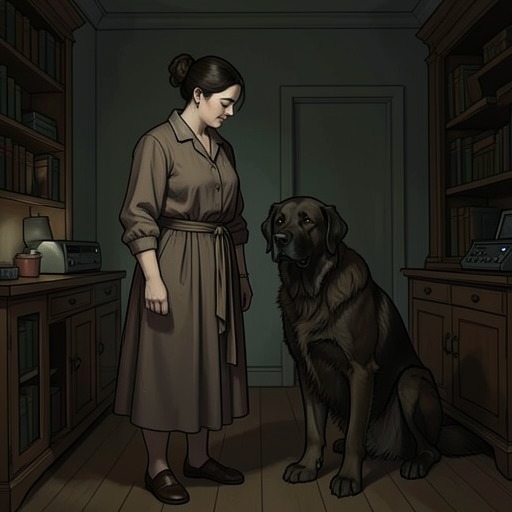
The FriendCanine subjectivity and anthropomorphism are explored through the Narrator’s relationship with Apollo, a dog whose feelings and perceptions invite interpretation but resist certainty. The Narrator increasingly accepts that imagining his inner life is unavoidable, while remaining alert to the gap between what a human can observe and what a dog may experience. Apollo’s conduct, gaze, memory, and scent-based perception give that gap emotional and ethical weight: he is not simply a human idea in animal form, but a being the Narrator can approach only through signs.
Interpretation and Its Limits
The question of whether dogs have opinions opens onto a larger uncertainty about animal minds. The Narrator asks whether dogs think and whether they have opinions, but does not claim to settle what those terms mean for them. Instead, the writing holds together two impulses: a desire to understand Apollo’s distinct experience and the recognition that human language can only approximate it.
The Narrator admits to anthropomorphism rather than presenting it as a mistake that can simply be eliminated. Hoping Apollo might make a friend, the Narrator imagines him forming a special attachment to another dog, despite his having been neutered. The hope resembles a parent’s wish that a child not be lonely. Yet the Narrator also recognizes that this longing may say as much about human ideas of companionship as it does about Apollo. The admission that anthropomorphism is inescapable does not make every imagined feeling a fact; it makes the act of imagining visible.
A similar tension shapes the question of gratitude. The Narrator believes Apollo may feel grateful toward the person who cares for him, but the belief remains an interpretation of their relationship, not a translated statement from Apollo. The text allows such readings to matter without pretending that affection abolishes the difference between human and canine understanding.
Social Conduct, Loyalty, and Character
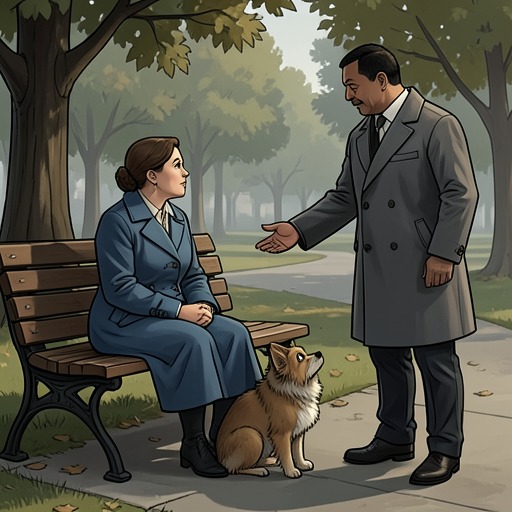
The Narrator’s wish that Apollo play with other dogs makes his quietness socially legible. At the dog park, Apollo shows little interest in either dogs or people, and the Narrator continues to hope that he might connect with one dog, perhaps Bella, a striking silver Italian mastiff they often encounter. The hope becomes a measure of the Narrator’s concern about his apparent solitude, rather than evidence that Apollo himself experiences it in the same way.
That concern is complicated by what the Narrator observes of dogs more generally. Two leashed dogs may lunge and snarl at one another, straining so violently against their restraints that they nearly choke themselves. The scene unsettles the familiar association between dogs and loyalty: as Karl Kraus observed, dogs are loyal to people, not necessarily to other dogs, and they may be hostile even toward their own kind. Canine sociability cannot therefore be reduced to a simple expectation of universal friendliness.
Apollo, by contrast, has never been seen insulting, attacking, or bullying another dog. When a cat sitting at his head height jumps up and swipes at his face, Apollo briefly swipes a paw back, but then continues walking. The Narrator fears for the cat for an instant; Apollo does not pursue the conflict. The episode gives his gentleness a concrete, limited meaning. It does not prove that he possesses human morality, but it shows a repeated pattern the Narrator can describe: Apollo does not seek trouble and appears to prefer peace. Calling this quality humanity is itself an act of anthropomorphism, one the Narrator openly questions even while finding the word difficult to resist.
Gesture, Memory, and the Wish to Communicate
The Narrator’s understanding of Apollo develops through small changes in his attention and posture. At first, the Narrator sometimes catches him staring, only for him to turn away when noticed. Later, he often rests his heavy head on the Narrator’s knees and looks upward with an expression that seems to speak. These gestures do not disclose a precise message, but they make the relationship feel reciprocal: Apollo is not only watched and interpreted; he also looks back.
The Narrator wonders whether Apollo anticipates ordinary events, remembers the past, feels longing or regret, or has memories with the vividness of a Proustian recollection. The questions remain open. Their force lies in the possibility that a dog’s mental life includes more than immediate appetite or response, while the Narrator has no reliable access to its contents. The question of canine subjectivity thus becomes a question about the limits of human inference, not an invitation to furnish Apollo with an invented biography of thoughts.
When a psychiatrist asks what the Narrator talks about with Apollo, the answer is mostly questions. They range from whether Apollo has slept well, wants to go outside, is hungry, happy, or in pain from arthritis, to whether he wants to hear a book or a song. The Narrator also asks whether he loves the Narrator and whether he will do so forever. The varied questions reveal care, playfulness, and the wish for reassurance, but they cannot produce an answer in human language. The song about talking to animals is turned around: the deeper wish is for animals to talk back.
The Narrator also notes that Apollo does not judge people as humans do, a quality that helps explain why dogs have been used as nonjudgmental companions for children practicing reading aloud. The passage connects this perceived acceptance to the appeal dogs hold for performers who imagine their audiences as dogs. Such examples describe human responses to canine presence, while also showing how the idea of an uncritical dog can become another projection. The distinction between Apollo’s possible inner life and the comfort people find in imagining it remains unresolved.
Scent and Unequal Knowledge
Apollo’s sense of smell offers a more material account of the distance between canine and human perception. The Narrator contrasts an estimated three hundred million odor receptors in a dog’s nose with roughly six million in a human nose, and cites the claim that a dog can detect one rotten apple in two million barrels. The figures do not make Apollo’s experience fully knowable; they emphasize how much information may be available to him that the Narrator cannot perceive.
The Narrator imagines that Apollo can distinguish the many scents reaching him from every direction, an ability that would overwhelm a human. Earlier, Apollo used to wake the Narrator in the night by sniffing every inch of the person lying on the floor, apparently investigating who that person was and what might be concealed. He still sniffs the Narrator, but no longer with the same investigative intensity. The change offers a small history of their relationship while preserving uncertainty about what Apollo learns from the act.
The text extends canine olfaction into daily and bodily knowledge: a dog may detect what someone ate, where sandals have been, or a change in sunscreen. A woman who walks two dogs with her mother and daughter says they recognize her approach from a block away by the level of her scent in the air. The Narrator then considers a more intimate asymmetry: Apollo may read the Narrator more accurately than the Narrator can read him. His nose might register anxiety about classes beginning, wounds, fear, loneliness, rage, and grief, while the person he reads cannot know precisely what that information means to him.
The possibility that a dog could detect malignant cells before medicine, or recognize pregnancy before the pregnant person does, is raised speculatively, not established as something Apollo has done. That distinction matters. The passage grants dogs a form of sensory access that exceeds human perception without turning possibility into certainty. In the end, canine subjectivity remains partly unknowable, but not empty: it is approached through Apollo’s restraint, changing gestures, attention, and extraordinary nose, and through the Narrator’s ongoing effort to regard him as a subject rather than a human-shaped reflection.