Cats
The FriendCats occupy a double place in the narrator’s life: they are companions whose independence seems to resist human control, and animals whose suffering can leave a person facing painful decisions they cannot explain to them. The narrator says cats and dogs are liked about equally, yet cats’ capacity to get along without people makes them seem less troublingly bound to human authority. That attraction does not spare the narrator the costs of attachment. After years of living with cats and witnessing their illnesses and deaths, the narrator stops keeping them, carrying the memory of one cat’s final days as both grief and guilt.
Independence and Human Dominion
The narrator’s preference for cats is not simply a matter of liking one species more. Dogs’ devotion to people is described as instinctive and freely given, even to people unworthy of it; the narrator finds that dependence unsettling and values a pet that can manage without human care. Cats thus stand, in the narrator’s account, for a relationship less organized around devotion and command. The distinction is not absolute—the narrator says the two species are liked about equally—but it shapes a persistent unease about what people expect from domesticated animals.
That unease becomes explicit in the discussion of naming and ownership. Some people object to calling an animal a pet, an owner, or a master because each word seems to affirm human dominion. The narrator recognizes the force of that objection: domesticated animals, including dogs, have been bred to be dominated, used, and made to do what people want. Cats are set apart with a brief contrast: not cats. The distinction does not establish that cats are untouched by human power, but it marks their independence as a meaningful counterpoint to the human claim of mastery, a claim traced back to Adam.
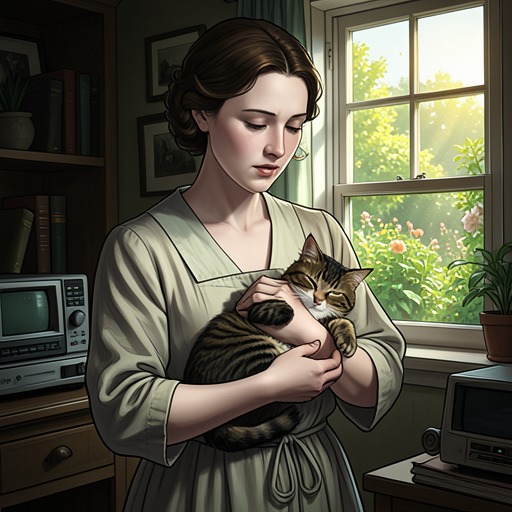
The narrator’s experience complicates any simple portrait of cats as aloof. One cat who would not allow cuddling or lap-sitting nonetheless waited until the narrator was asleep before slipping onto the narrator’s hip. Its closeness came on its own terms and outside the usual demand for demonstrative affection. After the cat died, that small, private act became part of what made its absence so difficult to stop thinking about.
Illness, Care, and Euthanasia
The narrator’s explanation for giving up cats is bound to how the animals suffered and died. A sick animal cannot say what is wrong, and even a diagnosis does not resolve the uncertainty of care: whether pain is being endured, whether treatment is helping, or whether the decision to continue treatment is serving the animal or the person who cannot bear to lose it. Cats intensify this uncertainty because their stoicism can conceal how ill they are. The narrator recalls the fear that a proud, independent cat might be hiding the severity of its pain.
In one case, a cat the narrator had lived with for twenty years died in the narrator’s arms. Not long afterward, the surviving cat became sick. It paced the apartment without resting, tried and failed to eat, and developed a hoarse, insistent mew. An ultrasound revealed a mass. The veterinarian offered surgery but warned that the cat’s age mattered: at nineteen, it might not survive the operation. The other option was euthanasia. The narrator chose to put the cat to sleep, confronted not only with the animal’s suffering but with the fear that a decision made to end that suffering might also be a mistake.
The first injection did not go smoothly. Dehydration affected the cat’s veins, and the animal, previously very still, became alert. It stretched out a paw and touched the narrator’s wrist, then raised its head on a frail, unsteady neck and stared. The narrator is careful not to claim that the cat literally spoke. Instead, the scene records what the narrator heard in that disbelieving look: a plea for relief, not death. The distinction between the cat’s actual gesture and the human meaning assigned to it remains unresolved, making the moment painful without pretending that the animal’s wishes can be known with certainty.
Grief After the Cats’ Deaths
The narrator says that one cat was the least favorite of all the cats owned: aloof, unwilling to be held, and yet quietly affectionate when the narrator was asleep. After its death, this was the cat the narrator could not stop thinking about. A stray hair or whisker in the apartment brought back the memory of its frantic, hoarse mewing near the end. The return of such small remnants connects ordinary domestic space to the animal’s final illness; what had once been an unassuming trace becomes a prompt for recollection and guilt.
The narrator’s reluctance to adopt another cat is therefore not indifference. It is a refusal to undergo again the sight of a beloved animal suffering and dying, together with another fear: that a future cat might outlive the narrator and be left without care. The narrator presents the decision to stop keeping cats as a consequence of these losses, not as a verdict against companionship. The thought of becoming an old cat lady is treated with irony, especially because the label is losing its stigma as internet culture renews the worship of cats as gods. A medical resident once said that psychiatric training had treated owning multiple cats as a possible sign of mental illness; when asked how many cats crossed the line, the resident answered three. The anecdote places private attachment beside the uneasy social judgments made about people who keep cats.
Cats Among Other Animals
Cats appear not only in the narrator’s memories but in scenes that resist making animal behavior conform to a comforting human story. When a cat sitting at roughly Apollo’s head height jumps up, arches its back, and spits in his face, Apollo turns the other cheek until a paw shoots out and swipes him. The narrator briefly fears for the cat, but Apollo keeps walking. The encounter gives the cat a forceful presence of its own: it initiates the confrontation, while Apollo’s restraint ends it without escalating the trouble.
The book also tests idealized accounts of animal character. Cats have been associated with ancient worship and, in contemporary internet culture, are again treated as gods. At the same time, a study the narrator has heard about claims that cats, unlike many other species, do not forgive. The narrator offers this as hearsay, then connects it wryly to writers who are said never to forget a slight. Neither the study nor the comparison settles what cats feel; both expose how readily human beings use animals to think about temperament, memory, and moral character.
Narrative Significance
Cats matter because their apparent independence does not remove the narrator from responsibility for them. Their inability to explain pain, the difficulty of judging what care requires, and the irreversibility of euthanasia make the human-animal relationship ethically intimate and epistemically uncertain. The narrator can recall a paw on a wrist and a gaze, but cannot turn either into reliable access to the cat’s wishes. The restraint of that account keeps the animal’s unknowability visible rather than resolving it through sentimental certainty.
In this way, the cats’ place in the narrative differs from a simple emblem of comfort. They offer a form of companionship that seems less governed by human command, yet their sickness and dependence expose the limits of that ideal. The narrator’s memories move between affection, practical decisions, and guilt, showing how a relationship can be valued precisely while remaining unequal and imperfectly understood. The cats are not only reminders of loss; they are the beings through whom the narrator confronts what it means to care for another life without being able to know, or undo, everything that care entails.