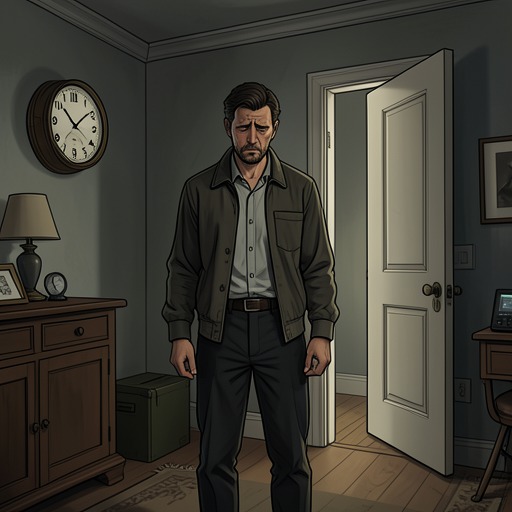
Depression
The FriendDepression in the book is neither a visible condition with a dependable outward measure nor an explanation that can account for everything that follows. A friend had suffered severely, then seemed to recover: he was writing, walking, reading, and socializing again before he died by suicide. Elsewhere, a writer’s inability to work and fear of exposure become signs of a different, unresolved crisis, while discussion of depressed dogs tests the limits of diagnosing an inner life from the outside. Across these episodes, apparent improvement matters, but it does not make suffering fully legible.
Depression and the mistaken reading of risk
The narrator recalls assuming that her friend would not take his own life partly because suicide was something he discussed often. The assumption rested on comparison as well: he did not seem like the unhappiest person they knew, nor the most depressed or suicidal. His death near the beginning of the year could even be mistaken for a resolution. The passage exposes the danger of treating depression as a visible ranking, or talk about suicide as evidence that action will not follow. Neither other people’s relative suffering nor the timing of a death makes its meaning transparent.
A story about another family gives this uncertainty a longer history. A woman describes her paternal grandfather’s suicide when she was a child. Her parents did not discuss his death, but its silence shaped the household; after she grew up, her mother said there had been no note, no apparent depression, and no reason anyone could identify. The woman’s father kept suspecting foul play, angry that his father had not explained himself. Set beside the friend’s known depression, the story marks two different forms of not knowing: an apparently inexplicable death and a suicide that occurs despite a recognizable history of suffering. In neither case does an explanation arrive simply because survivors need one.
A crisis followed by apparent recovery
The friend’s depression had been especially severe during the six months before the year of his death. He could hardly get out of bed in the morning and did not write. One cause of that period’s worsening was a back injury sustained while moving boxes: for weeks, exercise was impossible and even walking hurt. His remembered maxim joined physical movement to creative work: “If I can’t walk, I can’t write.” The injury’s effects therefore reached beyond pain, interrupting routines on which his ability to work depended.
By the summer, the injury had healed and the long drought of writing had ended. After false starts, the friend had begun a project that excited him; he sat at his desk each morning and often reported that the work had gone well. He read heavily, as he usually did while working on a novel, resumed long walks and running in the park, and returned to socializing with people he had avoided during the depression. These are specific changes, not a vague claim that he seemed better. Their force lies in the contrast: his life appeared to have regained movement, company, and creative purpose, yet that visible recovery did not settle what his death meant.
Finding a dog while out running became another part of the friend’s renewed life. The enormous, collarless Great Dane had been standing on an overhang, and he tried to locate its owner before deciding to keep it. He described his wife as appalled and the dog as a great deal to manage; the animal was thirty-four inches from shoulder to paw and weighed 180 pounds. The episode records energy and attachment returning to daily life, while the later account of the dog’s grief also makes clear that taking in a new companion did not erase the animal’s distress over its previous owner.
Distress that resists simple treatment
The veterinarian accepts that the dog may be mourning its previous owner and that repeated changes of environment could have intensified its distress. The dog sometimes howls; at other times it has episodes in which it looks around in confusion, crouches with its tail between its legs, and shakes uncontrollably for minutes or as long as half an hour. The narrator tells the veterinarian about these attacks but keeps to herself that watching them can bring her to tears. The scene shows distress registering through behavior and affecting its witness, even when its cause and subjective meaning remain uncertain.
The veterinarian discusses drugs for canine anxiety and depression but advises against making them the first resort. They may take weeks to work and may not work at all; for now, the advice is not to leave the dog alone too long, to speak to it, exercise it, and try massage if it allows. The veterinarian warns that the dog may never recover and that its history leaves the reasons for its condition unknown. He also rejects the easy assumption that animals are simple to understand: without their language, their inner lives remain partly inaccessible. The question of depression thus widens from a human diagnosis to an ethical problem of care—how to respond attentively without claiming certainty about another being’s experience.
Creative paralysis, panic, and the limits of labels
A separate portrait concerns a young writer known among her peers as O.P. After winning prizes and attracting attention for a first novel, she finds that the book, despite excellent reviews and another prize, does not sell. For two years she has been unable to write. The account does not simply label this condition depression; it details the pressures around the paralysis. Teaching overwhelms her: she is close in age to her students, unsure of her authority, and prone to flushing and a quavering voice when anxious. She sometimes has panic attacks before class and tries meditation, sometimes supplemented with benzodiazepines.
Her fear extends beyond a stalled manuscript. She suspects that her achievements resulted from mistakes, doubts why anyone wanted to publish her or thought her capable of teaching, and believes that no extension will enable her to complete her second novel. She fears being exposed as a fraud and resents the nickname O.P. The contrast with the friend’s recovery resists a single account of stalled writing: in his history, inability to write came during a period of severe depression and physical pain, then lifted as his health and activity returned; in hers, writer’s block is bound to professional disappointment, panic, and fear that her identity has been built on error. By placing these accounts beside one another, the book treats depression and related distress not as transparent explanations but as conditions whose signs, causes, and course cannot be reduced to a reader’s first impression.