Dogs
The FriendDogs occupy a double position in the book: they are praised for their devotion to people, yet their feelings and experiences remain beyond reliable human explanation. Stories of loyalty make them seem legible, while Apollo’s distinct habits and the narrator’s questions about his inner life expose how much humans can only guess. The book uses dogs not simply as symbols of human attachment, but as animals whose lives deserve attention in their own right.
Loyalty, Loss, and Waiting
The book sets the familiar image of the devoted dog against the problem of explaining death to an animal. After an owner dies, one dog is left waiting at home; the bereaved household eventually sends him to a kennel because his distress has become impossible to manage. The account offers no easy way to tell whether the dog understands the loss. It instead records a changed routine, a refusal of food, and behavior that repeatedly renews the household’s grief.
The narrator recalls Hachikō, the Akita who went to Shibuya Station in Tokyo to meet his owner’s train. After the man died suddenly, Hachikō continued returning at the usual hour for nearly ten years. People could not explain death to him; they made a public legend of his fidelity and raised a statue in his honor. The story’s cultural afterlife is itself significant: human commemoration gives meaning to conduct whose meaning to the dog remains inaccessible.
Other examples complicate the idea that Hachikō’s waiting is exceptional. Fido reportedly returned for fourteen years to the bus stop where his owner had once arrived home from work, after the owner was killed in an air raid during the Second World War. Greyfriars Bobby, a Skye terrier, spent the last fourteen years of his life at his dead owner’s grave in Edinburgh. These stories affirm canine attachment while preserving a gap between observable persistence and what a dog knows or feels.
Companionship and Apollo’s Place in the Household
The narrator initially describes a preference for cats, whose independence seems less emotionally demanding than the dog’s instinctive devotion to humans. That preference is qualified by prior experience: the narrator has shared a household with a mixed-breed dog that was half Great Dane and half German shepherd. When Apollo enters the narrator’s life, the practical scale of the arrangement becomes clear. The apartment is barely five hundred square feet, and its narrow bathroom requires the large dog to maneuver in and out carefully.
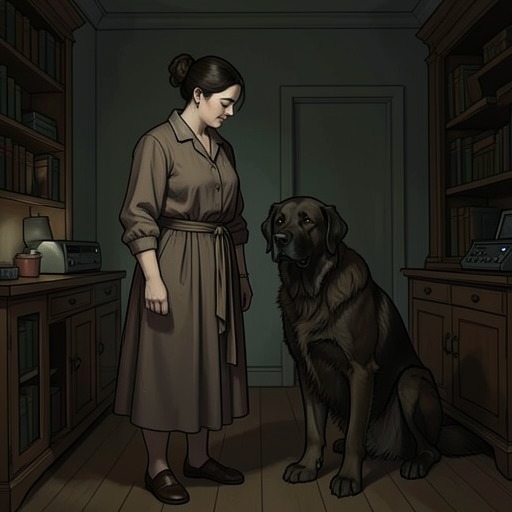
Apollo cannot be kept out of sight. The narrator walks him several times a day, and neighbors take notice of the conspicuous dog. After one resident declines to share the small elevator with them, the narrator chooses the stairs; Apollo’s descent down five flights is described as the rare occasion when his size makes him look ungainly. The building’s rules and neighbors’ reactions make care a public, everyday responsibility rather than a private feeling. Apollo is also remarkably quiet. The narrator wonders whether his earlier experience of being sent to a kennel might be connected to his no longer howling, but marks that explanation as uncertain. The silence becomes one reason to suspect that Apollo has stopped expecting his former owner to return.
The narrator’s bond with Apollo is made up of repeated acts of care rather than a single revelation. In one account of an ordinary day, Apollo has eaten, stayed warm and dry, gone on a four-mile walk, played tug-of-war, and received grooming and attention. The narrator has also guarded him from passing cars and watched him block a jogger from running into them. These practical exchanges culminate in a sense of contentment and in the recognition that the pair are two separate beings who protect, meet, and make room for one another.
Training, Breeding, and Animal Suffering
The book places domestic affection beside the human power to shape dogs for desired traits. A woman who walks two mixed-breed dogs argues that breeding produces animals burdened by traits and bodies selected for human purposes. The narrator then considers Tibetan Mastiffs, bred for size, protectiveness, and loyalty, and imagines the contradiction of such a dog being taken to slaughter by the very person it is inclined to protect. The passage does not claim certainty about whether a dog understands betrayal. Its force lies in the unresolved question of what human breeding and ownership ask of animals.
A related uncertainty concerns the nature of animal suffering. The narrator notes that dogs and other animals may tolerate pain differently from humans, but that their actual capacity for suffering cannot be measured with confidence. J. R. Ackerley’s concern that a dog’s emotional involvement with people might make its life anxious adds another complication: affection is not automatically proof that an animal’s experience is uncomplicated or wholly beneficial to it.
The film White God gives this conflict a dramatic form. Hagen, a mixed-breed dog belonging to Lili, is forced from home after her father refuses a tax on non-purebred dogs. Hagen tries to return to Lili, is caught by dogcatchers, and is trained to fight. After his first fight, he escapes; later, when he is again captured and faces destruction at the pound, he breaks free and leads other dogs through the city. The uprising turns the mistreatment of dogs into collective action, but Hagen’s reunion with Lili does not restore his former innocence: he confronts her with the hostility learned through his ordeal. Lili plays her horn, which had once soothed him, and the music calms Hagen and the assembled dogs. The scene offers a moment of peace without erasing the harm that made it necessary.
Apollo’s Particular Habits and the Limits of Interpretation
Apollo is presented as an individual rather than an emblem of perfect canine sociability. He shows little interest in other dogs or in people at the dog park, despite the narrator’s wish that he might make a friend. The narrator recognizes the parental quality in that wish and acknowledges that imagining Apollo’s possible attachments is an unavoidable form of anthropomorphism. A claim about dogs’ loyalty to humans rather than to other dogs further unsettles the ideal of canine sociability: devotion to people does not mean dogs necessarily seek one another’s company.
Yet Apollo is not portrayed as aggressive. The narrator has not seen him bully or attack another dog. When a cat startles and swipes at him, Apollo responds briefly and then moves on; the narrator reads his conduct as a preference for avoiding further conflict. That interpretation remains the narrator’s, but the episode gives Apollo a pattern of behavior that resists the stereotype of the enormous dog as a threat.
Play and communication also become ways of attending to his individuality. Apollo favors a bright red rubber tug toy, and the narrator notices that he often seems to let the human win. At the dog park, however, he remains uninterested in other dogs, a difference the narrator cannot resolve. The narrator asks whether Apollo feels gratitude, anticipates meals or a person’s return, and retains vivid memories. Such questions make the gap between care and knowledge central: close attention can reveal habits, but it cannot turn conjecture into access to another species’ mind.
The narrator’s effort to understand Apollo extends to reading aloud. The book describes therapy dogs and programs in which children read to dogs, noting reported gains in children’s speech and literacy while observing that research into what the dogs themselves receive from the practice is lacking. The narrator imagines that someone may once have read aloud in Apollo’s presence, or that he may have listened as a form of work, but cannot establish that history. Apollo’s response to books encourages interpretation without confirming it. The episode keeps his possible memories open rather than assigning them a definite story.
Dogs in Stories and Human Moral Imagination
The narrator’s childhood reading provides another frame for thinking about dogs. Books such as Old Yeller, The Red Pony, Black Beauty, Flicka, White Fang, and Buck make animal suffering part of the reader’s early encounter with attachment. Beautiful Joe, based on a real dog’s life, begins with cruelty to its animal protagonist. The narrator remembers crying over such books without regretting having read them, and recalls once wanting to write about the bond between a child and an animal. Those stories can move readers precisely because they invite identification, but they also raise the question of whether humans first recognize animals as kin before learning to regard their own species as uniquely superior.
Across these examples, dogs are both deeply present and never fully transparent. Their waiting, habits, apparent calm, and relationships with people are available for observation; the meanings of those behaviors remain uncertain. By holding together attachment, human control, and limits of knowledge, the book asks readers to take canine lives seriously without pretending that sympathy grants complete understanding.