Lilya
The FriendLilya is the sixteen-year-old central figure of the film Lilya 4-Ever, whose story the book’s narrator recalls as both indelible and based on a real girl’s life and death. Abandoned by family, she is left to navigate poverty and betrayal with little protection. A promise that seems to offer escape from those conditions instead carries her into captivity and exploitation; her attempt to get away ends in a fatal jump from a bridge. The book’s account makes Lilya’s fate more than a sequence of private misfortunes: it places the apparent choices available to her against the repeated abandonment and violence that narrow them.
Identity and Circumstances
Lilya is living with her mother in a bleak housing project somewhere in the former Soviet Union. She believes that she, her mother, and her mother’s boyfriend are about to emigrate to the United States. When they leave, however, Lilya is left behind. The departure overturns her expectation of a shared future and leaves her without the family protection on which that expectation depended.
Her situation deteriorates further when an aunt takes over the apartment where Lilya has been living. Lilya is forced to move into a filthy, makeshift place, with no money and no reliable support. The account presents these circumstances as a chain of losses rather than as a single misfortune: first separation from her mother, then the loss of her home, then the absence of resources with which to secure another life. Prostitution follows amid this abandonment and poverty, not as an independent path she freely chooses.
Attachment and the Promise of Escape
The people around Lilya have taught her to expect cruelty and betrayal. Volodya, a boy a few years younger, is a marked exception. His drunken father abuses him and eventually throws him out; Lilya takes him in and offers him shelter. Their bond is mutual in its limited but consequential way: Volodya loves Lilya, while she befriends and protects him. Together they experience a few happy moments within lives otherwise described as grim.
Andrei, a handsome young Swede who speaks softly, arrives as another apparent exception to the world Lilya has learned to distrust. He tells her that he can help her move to Sweden and begin again. Lilya falls in love with him and accepts the promise as a route out of the housing project and the precarious life she has been living. That hope comes at a cost she can see: leaving will mean leaving Volodya, her only friend. She nevertheless goes, and Volodya responds to the loss of the only friend in his world by killing himself. His death exposes the devastating consequence of a departure that, to Lilya, had looked like a chance for survival.
Volodya continues to appear in the film as an angel. This image keeps him present after his death, but it does not undo the loss or restore the companionship Lilya had left behind. The brief happiness they shared and the film’s recurring image of Volodya as an angel stand against the worsening reality of Lilya’s journey: the person who had sheltered her has become someone she can no longer reach.
Sweden and Captivity
Lilya reaches Sweden alone; Andrei has promised to join her later. At the airport, a man she has been told will take care of her meets her and drives her to an apartment in a high-rise tower. Instead of helping her begin a new life, he locks her inside. The promised destination of safety becomes the setting of captivity, and the promise of protection is revealed as a means of bringing her within another person’s control.
The man is the first to rape Lilya. Afterward, she is repeatedly handed over to clients. They vary in age and type, but none treats her youth or her lack of consent as a reason to stop. The account emphasizes the surrounding social failure as well as the individual acts: the clients behave as if sexual exploitation were Lilya’s proper purpose. Her vulnerability is thus not presented as an accident of one encounter. The repeated exploitation makes clear that the apparent rescue has led into a system in which other people act as though they are entitled to use her.
Escape, Death, and the Story’s Afterlife
Lilya attempts to escape twice. The first time, she is caught and beaten. The second time, she finds herself on an expressway bridge. A policewoman is nearby and help is within reach, but Lilya panics and jumps. The contrast between the two attempts is stark: the first ends with her recapture; the second brings her close to possible assistance, yet she cannot make use of it. The account does not offer a further explanation for her panic. It leaves the final action as the outcome of a life shaped by abandonment, coercion, and failed escape rather than turning it into a simple, fully explained decision.
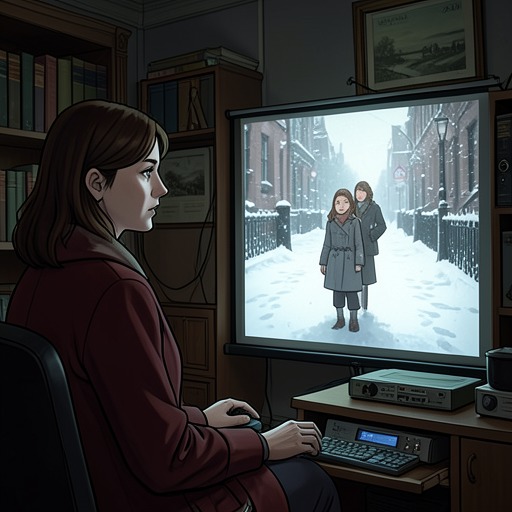
The film’s story is identified as based on a true one. After the real girl jumped, letters she had written were found on her body, and this was how her story came to be known. That detail gives Lilya’s fictionalized story an afterlife beyond the events it depicts: the letters made a life otherwise obscured by exploitation legible to others. The narrator had watched Lilya 4-Ever years earlier without knowing that it was based on a true story. More than a decade later, the experience remained so indelible that there was no need to watch the film again. Lilya therefore occupies two connected places in the book: as a character whose hopes are repeatedly betrayed, and as the figure through whom the narrator encounters a real girl’s suffering and the difficult fact of how little can be explained about her death.