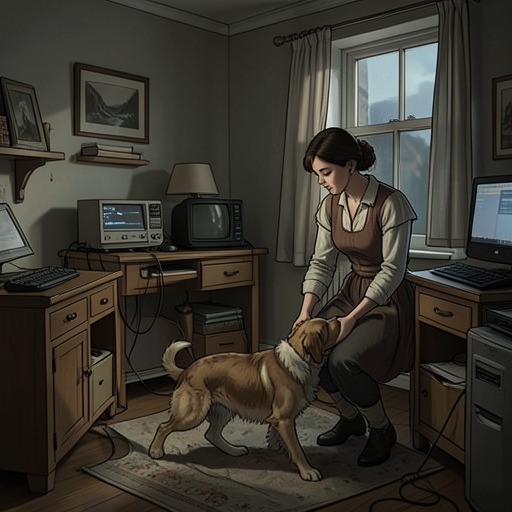
Narrator
The FriendNarrator is a writer and teacher whose account of bereavement unfolds through acts of attention: listening to a psychologist friend describe survivors of trafficking, reading poetry aloud to Apollo, and trying to name what the Deceased Friend meant to her. Her narrative does not present writing as a reliable cure. Instead, it follows the tension between expression and silence, and between the wish to preserve a lost relationship and the fear that describing it may alter or bury it.
Identity and Perspective
Narrator recounts events in the first person, but her experience is also examined through the judgments and interpretations of others. Her psychologist friend asks her to write about the women at the center of the friend’s work, while a therapist later suggests that her grief resembles the mourning of a lover or wife. Neither invitation settles what writing can accomplish or what the relationship was. Narrator remains attentive to the difference between another person’s interpretation and her own uncertain knowledge.
Her perspective moves between immediate scenes and reflective pauses. Rather than supplying a single explanation for sorrow, she returns to particular acts and phrases, testing what they can mean. This structure matters to her portrait: she records care in concrete terms, yet resists converting care into proof that she understands another consciousness. The result is a narrator defined not by certainty but by the effort to remain present to what cannot be fully known.
Witnessing Trauma and Writing
Narrator’s friend, a psychologist, encourages women receiving support to keep private journals. Participants are told they may write freely, without the psychologist reading their work; women who speak English as a second language are invited to write in their native languages. Their responses differ. Some hide their journals or carry them everywhere, while others destroy what they have written soon after writing it. Some refuse to journal, and the psychologist recognizes that revisiting painful experiences can itself be difficult.
The psychologist hopes to offer women who welcome journaling a workshop where they can write and share with one another and an instructor. She asks that spelling and grammar not be treated as measures of ability, because criticism could deepen already fragile self-esteem. Narrator hears this request as a challenge to her own habits as a writer: attention to form must not become a reason to inhibit people whose experiences deserve to be heard. The distinction between private writing and shared work also remains important. The journals are protected from scrutiny, while the workshop makes room for voluntary exchange.
Narrator sees artwork made by the women and listens to recordings of their testimony. The drawings include burning houses and threatening figures; after hearing the testimony, she experiences them differently, as images connected to lived accounts rather than isolated symbols. Her friend stresses that some of those described as women are still girls. One fourteen-year-old, recently rescued from captivity, cannot speak, although doctors have found no problem with her vocal organs. The psychologist identifies mutism, blindness, and paralysis as psychosomatic symptoms encountered in some cases. Narrator’s role is that of a listener and witness, not an interpreter who claims to make another person’s suffering transparent.
Care for Apollo
In a quiet scene at home, Narrator takes a copy of Rainer Maria Rilke’s Letters to a Young Poet from a stack of books and begins reading aloud to Apollo. The dog lies across her feet and presses against her shins. As she turns pages, he watches her, and his ears shift with the inflections in her voice. She has played music and tried massage without seeing the same response; reading appears to soothe him, and the act also calms her. The scene joins attention to another creature with the rhythms of literary language, without suggesting that Apollo understands the words as a human reader would.
Her care is also practical and repeated. Narrator watches Apollo sleep after a day in which she has taken him for a four-mile walk, guarded him from traffic while he relieved himself, and seen him bark to stop a distracted jogger from running into her. She has played tug-of-war with him, spoken and sung to him, read poetry, trimmed his nails, and brushed his coat. The account moves from these ordinary responsibilities to a feeling she takes time to identify: contentment, followed by a deeper sense of connection. She describes the two as solitudes that protect, border, and greet one another. Their bond does not erase their separateness; its significance lies in the mutual care that respects it.
The Deceased Friend and Uncertainty
Narrator says that she does not want to speak about the Deceased Friend or hear others speak about him. Her reluctance sits beside a plain recognition of absence: she misses him every day and misses him very much. The repeated acknowledgment does not explain the death or resolve the relationship. It gives grief a simple verbal form while preserving the silence around what she cannot or will not discuss.
A therapist tells Narrator that he thinks she has always been in love with the Deceased Friend, and says that she is mourning him as a lover or wife would. Narrator records this interpretation without treating it as conclusive. Later, she says she cannot be certain whether she was in love with him. She has known love before without doubting it, but this relationship does not fit so neatly into a definition. The uncertainty remains part of her bereavement, rather than a mystery the therapist’s account can settle.
Writing, Memory, and Change
Narrator reflects that people write to gain a hold on experience, understand its meaning, and keep it from being lost to time. But writing carries an opposing risk: memory of an experience can be displaced by memory of having written about it, just as a remembered place may become inseparable from photographs taken there. She wonders whether writing about someone lost, or speaking about them too much, might help bury the person instead of preserving them. This concern gives her account its ethical restraint: remembrance matters, but representation is not identical to the life it tries to retain.
By the end, Narrator does not describe herself as healed or recovered, and she does not claim closure. She does recognize a difference: a possible preparation for release, though she feels not yet to have reached it. The change is tentative, not a repudiation of attachment. She still misses the Deceased Friend and would not want that feeling simply to disappear. Her ending holds both facts together: grief persists, while the possibility of letting go begins to emerge.