The Narrator Begins Reading Aloud to Apollo
The FriendThe Narrator Begins Reading Aloud to Apollo as a practical attempt to stay at the desk becomes a private ritual of voice, attention, and bodily comfort. The episode joins the Narrator’s struggle to continue writing with Apollo’s uncertain but unmistakable presence: he cannot understand the words, yet his responses shape what the Narrator reads and how long the reading continues.
From the Desk to the Book
The occasion begins with advice the Narrator usually neglects: read drafts aloud. Hoping to remain at the desk longer, the Narrator takes up freshly printed pages and starts reading. Apollo, who has been sleeping behind the couch, gets up and trots over. At desk height, he fixes his attention on the reader. The Narrator considers two possibilities: perhaps Apollo finds the reading remarkable, or perhaps he simply wants another outing after an already long walk.
When the Narrator reaches the bottom of a page and pauses, Apollo nudges the Narrator with his nose and gives a single low bark. He steps forward, to the right, then back, cocking his head as if questioning the interruption. The Narrator takes this as a request to continue, while acknowledging that the interpretation may be mistaken. Reading resumes, but does not last: Apollo prompts again with a nose poke and bark, licks the Narrator’s face, and repeats his sideways dance. His mismatched ears and insistent gestures sharpen the Narrator’s sense of how difficult it must be for a dog to make himself understood to a human.
Reading Rainer Maria Rilke Aloud
The Narrator leaves the chair for the couch, where Apollo watches with a furrowed brow before sitting directly in front of the Narrator. After crying, the Narrator wonders what a dog makes of human unhappiness. Dogs may have been bred to comfort people, but the contrast between their dependence and human freedom also makes human distress puzzling: people can eat when they choose, go outside, and run freely, without a master whose approval must constantly be won.
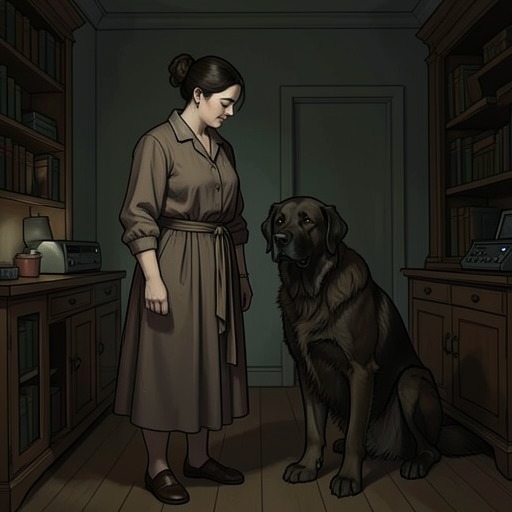
From a stack on the coffee table, the Narrator selects Rainer Maria Rilke’s Letters to a Young Poet, a book assigned in one of the Narrator’s courses. Apollo’s expression changes as the reading proceeds. His mouth hangs in the half-open smile the Narrator often sees on other dogs but rarely on him; then he lowers himself to the floor, covers the Narrator’s feet, and presses against the Narrator’s shins. He rests his head on his paws and looks up whenever a page turns. His ears shift with the reader’s vocal inflections. The Narrator recalls a pet rabbit that used to hunch beside a stereo speaker, but distinguishes Apollo’s response from that earlier experience: music and massage had not seemed to soothe him, whereas the spoken book does.
The Narrator continues with the clarity and expression that might be used for someone able to understand every word. The sound of Rilke’s prose in the mouth and Apollo’s warm, gently heaving weight across the feet and legs soothe the Narrator as well. The scene does not establish that Apollo comprehends the text. Instead, its intimacy depends on the gap between verbal meaning and the bodily attention through which the two appear to meet.
The Advice in the Letters
The Narrator knows the short book well: it contains ten letters to a student who sought advice from Rilke when Rilke was twenty-seven. In the eighth letter, Rilke imagines frightening things as potentially helpless and in need of love. The letters also counsel writers to attend to humble things, undertake difficulty, remain with questions, and seek solitude; they do not ask the reader to flee sadness or depression, which may be bound up with the work.
The Narrator has read this advice so often that it is known by heart. On first encountering the letters at roughly Rilke’s age when he wrote them, the Narrator felt that their counsel addressed any aspiring writer, not only the young poet to whom they were sent. Now the writing seems more beautiful than ever, but reading it brings uneasiness. The Narrator’s students do not experience the letters as earlier readers did, or as the Narrator’s own class did when the book was assigned alongside Rilke’s autobiographical novel The Notebooks of Malte Laurids Brigge. They feel excluded rather than addressed, and reject the idea that writing demands priestlike devotion. Their response unsettles the assumption that a beloved book’s guidance will travel unchanged from one generation of students to another.
A Shared Routine, Kept Secret
The book takes about two hours to read aloud. Before it is finished, Apollo falls asleep beneath the Narrator’s legs, like a child at a bedside story. The Narrator does not slip away: the dog’s weight has made the feet numb. When they are wiggled, Apollo wakes, seeks the Narrator’s hand without getting up, and licks it while the hand still holds the book. The reading ends in ordinary care. Both get up and head for the kitchen; the Narrator pours Apollo his kibble, then prepares to take him outside.
The Narrator decides to make reading aloud part of their routine but tells no one, aware of how the practice might appear to others. That secrecy belongs to a wider pattern in these pages: there is much the Narrator has not disclosed. The episode therefore makes reading do more than offer comfort. A voice intended for an animal becomes a way of sustaining attention at the desk, while the private act of speaking leads toward confession without guaranteeing truth. The Narrator recognizes that writing can lead to confession, but also to lying. Apollo’s silent, physical audience makes the distinction especially vivid: he receives the voice, the pauses, and the hand that holds the book, though the words remain beyond his reach.