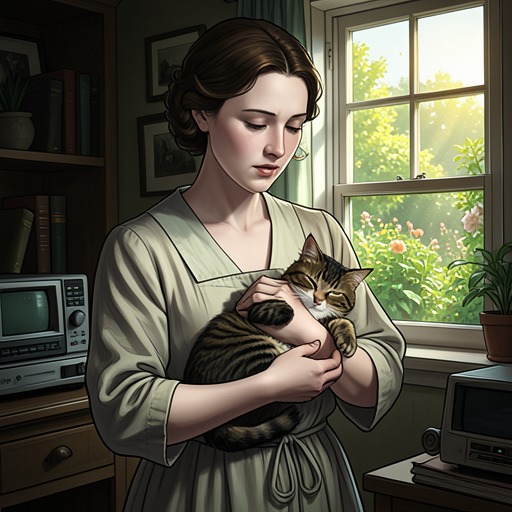
The Narrator Euthanizes Her Sick Cat
The FriendThe Narrator Euthanizes Her Sick Cat is an account of a decision made amid illness, uncertainty, and the responsibilities of care. The cat’s death follows the loss of a long-term companion and an examination that reveals a mass; the Narrator must weigh the cat’s age and suffering against the risks of surgery. The procedure does not unfold as a calm, straightforward farewell: an unexpected complication interrupts it, and the Narrator’s final response registers the distance between intending to relieve suffering and being able to know what the animal experiences.
Background and Diagnosis
Shortly after one of the Narrator’s two most recent cats died in the Narrator’s arms, the surviving cat became ill. The dead cat had shared the Narrator’s life for twenty years, longer than any person had. The account places this loss directly before the surviving cat’s decline, but does not claim that grief caused the illness. Instead, it gives the new crisis its immediate domestic setting: the surviving cat paced around the apartment and could not settle, not even briefly. She wanted food and tried to eat, but could not. Her mewing had become persistently troubled and insistent, which the Narrator understood as a plea for help. Her changed behavior made the question of what care could accomplish urgent before a diagnosis was available.
An ultrasound revealed a mass. The veterinarian explained that surgery was possible, but asked the Narrator to consider the cat’s age. At nineteen, the cat might not survive an operation, and she was already suffering. The alternative offered was euthanasia. The choice therefore was not presented as a clean division between treatment and neglect: surgery carried a serious risk, while ending the cat’s life meant acting without certainty about how much pain she felt or whether treatment might still help. The passage records the Narrator’s doubts about being selfish and about what the cat would prefer, without supplying a definitive answer to either question.
The Decision and the Language of Euthanasia
The Narrator’s hesitation is sharpened by unease about the language used for ending an animal’s life. J. R. Ackerley had objected to a familiar euphemism for euthanasia, while the Narrator finds his preferred alternative—language that names destruction—ill-suited to a sentient being. The account also observes that people generally avoid the plainer word for killing. This reflection is not separate from the practical decision: it shows how customary expressions can soften a description of what is being done without making the responsibility disappear.
The procedure is explained as involving two injections, the first intended to calm the cat. When the veterinarian asks whether the Narrator wants to remain with her, the Narrator answers yes. That answer establishes the Narrator’s presence as part of the care offered, but it does not resolve the underlying uncertainty. The cat cannot explain her pain or choose among the options in words; the Narrator must decide from her condition, the diagnosis, and the risks the veterinarian has described. Staying close is an action the Narrator can take, even as the outcome and the cat’s experience remain beyond full knowledge.
The Interrupted Procedure
The first injection does not proceed as expected. Dehydration affects the cat’s veins, and the injection becomes problematic. Until then, the cat had been still; now she grows alert, stretches out a paw, and touches the Narrator’s wrist. She lifts her head and looks at the Narrator. These gestures become the emotional center of the episode because they arrive at the moment when the procedure’s purpose is already in question: the cat’s illness has prompted an attempt to end her suffering, yet her sudden attention can be read as a response to the act itself.
The Narrator carefully distinguishes that reading from a claim to know what the cat said or meant. The account presents the imagined protest as what the Narrator heard, not as the animal’s literal speech. That qualification matters: it allows the moment to convey the Narrator’s fear of having misunderstood the cat’s need while preserving the difference between an animal’s gesture and a human interpretation of it. The veterinarian, visibly flustered, picks up the cat and leaves before the Narrator can speak. Because the hospital is large and busy, with many wards, the Narrator does not know where she has gone. The interruption turns a shared farewell into a period of separation and unanswered questions.
Death and Its Aftermath
Ten minutes later, the veterinarian returns and places the cat on the table, dead. The Narrator has no account of what happened during the time away and no opportunity, in that interval, to accompany the cat. The return confirms the outcome, but does not explain the complication or settle the doubts raised by the cat’s gesture. The Narrator’s response—an involuntary question about what the veterinarian has done—registers shock and accusation at once. It follows the earlier willingness to stay with the cat, exposing the painful gap between accepting that euthanasia may be necessary and confronting its irreversible result.
The episode also belongs to a longer history of the Narrator holding cats as they were euthanized, but this experience resists the reassurance that such deaths can be gentle and uncomplicated. Its structure moves from diagnosis and deliberation to a procedural problem, a brief separation, and a return that leaves no room for revision. The care is real: the Narrator considers the cat’s suffering, remains beside her, and tries to act in her interests. Yet care cannot guarantee understanding or erase responsibility. By preserving the hesitation over words, the uncertain interpretation of the cat’s movement, and the unanswered interval in the hospital, the account makes the limits of human knowledge part of the event’s moral weight.