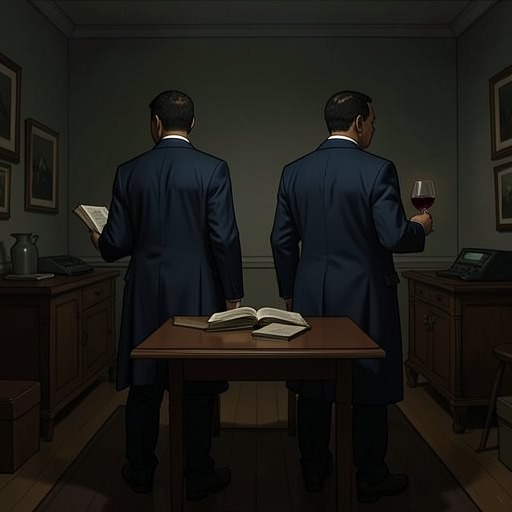
The Narrator Has Sex with Her Friend
The FriendThe Narrator Has Sex with Her Friend describes a single sexual encounter between the Narrator and the Deceased Friend, years before he met Wife Two. The encounter arose within a friendship formed at school, where he was the youngest instructor in the department and the Narrator was one of his students. Their intimacy blurred the boundaries between teaching, friendship, and romantic possibility; afterward, his judgment that they had made a mistake by trying to become more than friends left the Narrator mortified and unsettled.
Background and Proposal
The Narrator and the Deceased Friend first knew each other in the classroom, where they also met Wife One. He was already known as a gifted young instructor and a charismatic romantic presence. He considered attempts to keep love out of the classroom futile, and believed that a great teacher could be a seducer and sometimes a heartbreaker. The Narrator did not fully understand this view, but was excited by it, and recognized her own hunger for knowledge and his ability to convey it. Their friendship continued after the school year ended. During the summer when he began courting Wife One, the two friends became inseparable. He then proposed that they have sex, a suggestion that surprised the Narrator despite his reputation: by that point she was no longer anxiously expecting him to make a move. When she asked why, he answered that they should discover what that would be like between them. The Narrator recalls that neither seemed to consider that she might refuse; at a time when she intensely wanted to place her full trust in someone, the proposal met a powerful desire for intimacy and trust.
Aftermath and Estrangement
The Deceased Friend later judged that their attempt to become more than friends had been a mistake. The Narrator was mortified by this reversal. She first feigned illness, then pretended to be away; when she subsequently became genuinely ill, she blamed and cursed him, and doubted that he could still be her friend. The encounter thus gave way not to a settled romance but to a period of avoidance and injured trust.
When they eventually saw each other again, the painful awkwardness the Narrator had anticipated was absent. A tension between them, one she had not entirely recognized before, had lifted. The Deceased Friend had hoped for this easing, and their friendship grew even as he completed his courtship of Wife One. It outlasted the Narrator’s other friendships and brought her intense happiness. She felt fortunate that, although she had suffered, she had never had her heart broken; a therapist later challenged that account, while Wife Two and the therapist both regarded something in the friendship as unhealthy. The therapist also wondered whether it had contributed to the Narrator’s remaining single. The encounter’s lasting consequence is therefore left unresolved: it did not end their bond, but became part of a friendship whose intimacy and costs the Narrator only partly understood.
Retrospective Disclosure
The encounter returns in the Narrator’s later account as an unresolved question about what the Deceased Friend told Wife Two. Wife Two’s memorial piece presented him as the light and love of her life and the best thing that had happened to her, without expressing resentment; she was also writing a novelization of their marriage. Against that public account, the Narrator wonders whether Wife Two ever learned that she and the Deceased Friend had had sex once, years before he met her. The recollection establishes neither that he concealed the encounter nor that Wife Two knew of it: the possibility remains open, making disclosure itself part of the event’s lingering uncertainty.
Retrospective Form and Uncertainty
The episode is reconstructed through a later address to the Deceased Friend, after the Narrator has encountered Wife Two’s memorial tribute and learned of her planned novel about the marriage. That framing makes the sexual encounter more than a closed incident in the past: it becomes a fact the Narrator can state, while its place in the Deceased Friend’s marriage remains beyond her knowledge. The account moves from the friendship’s beginnings and the proposal to its aftermath, then returns to the question of what Wife Two may have known. This structure distinguishes remembered experience from unanswered inference; it establishes the encounter, but cannot establish whether it was disclosed.