The narrator–Apollo bond
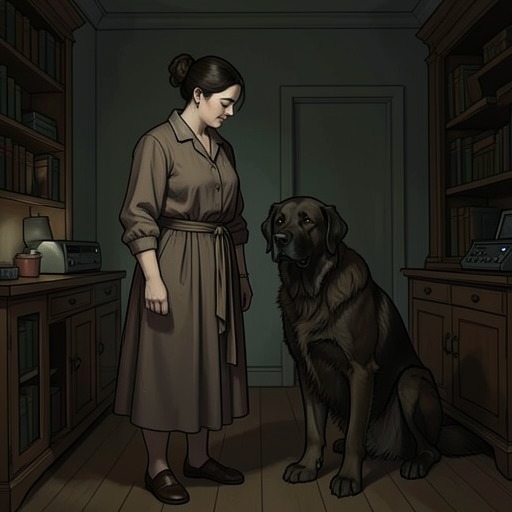
The FriendThe Narrator–Apollo bond is a relationship of practical care and mutual protection that becomes central to the Narrator’s life after bereavement. Apollo is not only a source of comfort: the Narrator attends to his needs, while he watches over her, and their companionship takes on a form that resists easy separation between human caregiver and animal dependent. As Apollo grows old and the prospect of goodbye draws nearer, that everyday reciprocity becomes both a source of contentment and a measure of anticipated grief.
Daily Care and Mutual Protection
The bond is built out of repeated acts rather than a single declaration. The Narrator walks Apollo for four miles, watches for traffic when he stops in the street, and cares for him at home by trimming his nails and brushing his coat. She plays tug-of-war with him, talks and sings to him, and reads poetry aloud. These routines attend to his physical comfort as well as his companionship: after the walk, he is fed, warm, and dry, and the Narrator watches him settle to sleep.
Protection also moves in the other direction. In a park, when a jogger distracted by a phone approaches, Apollo barks and blocks the jogger from running into the Narrator. The action gives their closeness a practical reciprocity: she guards him from passing cars, and he intervenes when she is at risk. The Narrator understands the relationship through this exchange, describing them as two solitudes that protect, border, and greet one another. The image recognizes their closeness without claiming that they are the same or that either can entirely know the other.
The Narrator’s contentment while watching Apollo sleep is preceded by a catalogue of the day’s care. A deeper feeling follows, at first difficult for her to name. The pause matters: attachment is presented as something registered before it is fully explained, emerging from accumulated gestures rather than abstract argument. The bond’s ordinary pattern—walk, play, grooming, conversation, rest—makes that feeling legible without reducing it to a single service Apollo performs for her.
Emotional Support and Social Recognition
The Narrator’s therapist puts in writing that she suffers from depression and anxiety aggravated by bereavement, and that losing Apollo’s support could harm her mental health, perhaps even endanger her life. This formal recognition gives the relationship an explicit place in the Narrator’s recovery and daily stability. It also makes clear that Apollo’s presence matters not merely as a preference or convenience: the therapist considers his emotional support essential.
The Narrator remains conscious of the difference between genuine need and fraudulent claims about support animals. She acknowledges the public anger caused by people presenting ordinary or exotic pets as service animals and says she will not take Apollo into places where dogs would not normally be allowed. Although she sends a copy of the therapist’s certificate to building management, she intends to leave the certificate and registry badge at home. The distinction preserves a tension in the bond’s public life: Apollo’s support is real to the Narrator and her therapist, while the category that makes that support administratively legible is vulnerable to misuse and suspicion.
A friend jokes that, in this case, Apollo is the one who cannot cope and the Narrator is his emotional-support human. The reversal captures an important feature of their relationship. The Narrator has formal evidence of her own need, but she also understands Apollo as emotionally affected and in need of her steadiness. Their roles are not identical, yet neither is simply a passive recipient of the other’s care.
Intimacy, Independence, and Public Perception
In therapy, Apollo sits beside the Narrator, who smiles at the resemblance to couples therapy, adding that the two of them get along. The comparison frames their companionship as intimate without making it human romance. A stranger at a book party asks whether the Narrator is in love with a dog. The Narrator considers the question and rejects an extreme analogy to J. R. Ackerley’s devotion to his dog, while acknowledging that she sometimes takes a cab rather than a train because she is eager to get home to Apollo. She sings with happiness at the thought of seeing him and recognizes that her love for him is unlike any love she has felt before.
That acknowledgment does not erase Apollo’s separateness. Early on, the Narrator sometimes catches him looking at her, only for him to turn away when she looks back. Later he often rests his large head on her knees and looks up at her with an expression she experiences as communicative. The change marks a growing ease in their shared life, but the Narrator’s curiosity about Apollo’s memories, yearnings, and regrets remains just that: a desire to understand an animal whose inward experience she cannot verify. Her many questions to him—including whether he is happy or in pain—show affection alongside uncertainty, not proof that she can translate his thoughts.
The bond also contains anxiety about its security. The Narrator repeatedly imagines that someone claiming to be Apollo’s former owner may appear with a plausible account of how they were separated and expect to take him away. This feared possibility gives the relationship a fragile edge: their present closeness is deep, but the Narrator cannot treat it as a possession guaranteed by her attachment alone. Her promise that nothing will separate them expresses a hard-won sense of settled companionship against that uncertainty.
Aging, Care, and the Approaching Goodbye
As Apollo ages, care becomes more closely tied to the question of how to recognize suffering. The veterinarian advises daily exercise and explains that pain relievers and anti-inflammatory medication are working, while warning that Apollo may not always be entirely comfortable and that his condition could change. The Narrator is troubled by the limits of her ability to know how much pain he is in and asks him, in effect, to give her a sign when it becomes too much. That appeal depends on both the closeness between them and its limit: she attends closely to him, yet knows she is less perceptive than he is in some ways and cannot assume that love makes his condition transparent.
J. R. Ackerley’s account of his dog turning her face to the wall haunts the Narrator as she considers the end of Apollo’s life. She does not treat euthanasia as an assault on nature or as a decision to be made without regard for Apollo’s experience. Instead, she understands it as a possible blessing and measures the choice against what she would want for herself. When Apollo leaves breakfast untouched, she fears the moment may have come, but he eats bread from her hand and has regained his appetite by evening. She then turns back toward the day rather than treating that single sign as a settled conclusion.
The Narrator names the time they still have as one more summer: Apollo can lie in the sun, and she can say goodbye. Even the language of farewell blurs between speaking to him and speaking to herself. Earlier, the Narrator had felt that nothing would separate them; now she must hold that assurance beside the knowledge that Apollo is old and that their time is finite. The hope of another summer is not a promise of permanence but a way of receiving the time that remains.
Narrative Significance
The relationship gives the Narrator a daily structure in which grief is met through attention: walking, feeding, grooming, reading aloud, and watching for changes in Apollo’s comfort. Those actions do not cancel bereavement or remove uncertainty. Instead, they locate the Narrator’s attachment in ongoing responsibilities and in the companionship that grows through them. Apollo’s protection of the Narrator also prevents the bond from being described only as human care directed toward an animal.
Near the close, the Narrator wants to call Apollo’s name, but the word fails in her throat; she addresses him as her friend. The moment gathers the relationship’s central tension into a small act of speech: intimate recognition persists, even as language falters before separation. The account does not make the animal fully knowable or resolve the pain of parting. It presents love as sustained attention to another being whose needs can be tended, whose inner life remains partly beyond reach, and whose absence is already imaginable.