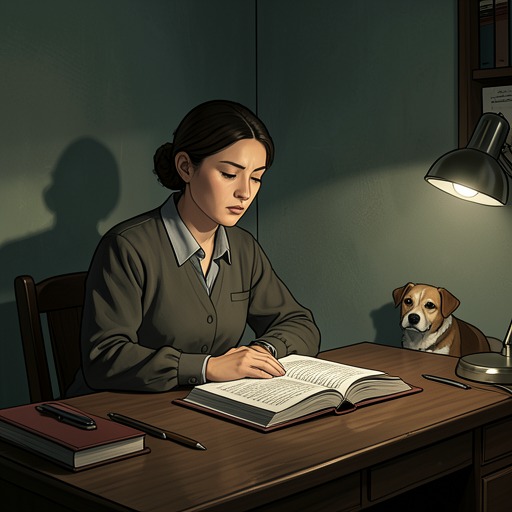
The writer’s suicide attempt
The FriendThe writer’s suicide attempt emerges through what had been arranged around it: his dog was sent to a kennel, a cleaning visit was scheduled, and a note left instructions for the cleaner to call 911. His wife’s unexpectedly early return brought the attempt into the open. He survived, but survival did not bring an uncomplicated sense of relief. When he later describes the experience to the Narrator, he speaks of humiliation, numbness, and a hospital stay that seemed longer than it was. The attempt also becomes a crisis of representation: the Narrator has made it the subject of a story, and the man recognizes himself in it despite her claim that she disguised the characters.
Preparation and Discovery
The circumstances are reconstructed during the Narrator’s visit to the man’s brownstone. His wife is away at work, and Jip, their miniature dachshund, barks as she arrives. The man and the Narrator greet each other with a prolonged embrace; beneath their raincoats they happen to be dressed alike, in blue jeans, black turtlenecks, and gray cardigans. They settle in the living room with tea, while a plate of shortbread remains untouched and daffodils glow in a crystal vase on the windowsill. Against this carefully ordinary domestic scene, the man’s pallor, gauntness, and strained voice signal that his return home has not restored ease.
The preparations for the attempt were practical and deliberate. He had taken Jip to a kennel and arranged for the cleaning lady to come the next morning. His wife was supposed to be away on a business trip, but a storm in Denver delayed her flight. She tried to call him from the airport and received no answer; when the flight was canceled, she took a cab home. There she found a note warning the cleaning lady not to enter and telling her to call 911. The account establishes both the organization surrounding the attempt and the contingency that disrupted it, without describing the method or the precise moment when he was found.
When the Narrator recounts what his wife told her, the man looks toward the daffodils rather than at his visitor. He says the sequence sounds too easy for a story written by one of his students. The remark registers the strangeness of hearing the crisis rendered as a neat chain of events, even as he is the person whose life depended on what happened. A cloud briefly darkens the room, and the Narrator feels panic at the threat of tears. The scene’s small shifts in light and attention accompany a conversation in which neither person can make the facts emotionally simple.
Survival and Hospitalization
Asked how he feels, the man names disgrace and humiliation. He also says that, like many people whose suicide attempts fail, he is glad to have survived. Relief and shame coexist rather than canceling each other. He wonders why he does not feel more: much of the time he is hazy or numb, as though the event happened decades earlier or never happened at all. He attributes some of that distance to medication, but the conversation does not resolve whether the numbness is a temporary effect or a fuller account of his emotional state.
The man is glad to have left the hospital, though the couple of weeks there felt like months. On the psychiatric ward, he had little to do, and his concentration was so impaired that he could not read: by the end of a sentence, he had forgotten its beginning. Because he did not want people to know what had happened, he could not readily receive visitors. The Narrator remains the only person outside his family who knows the whole story, and he wants that privacy to continue. His request gives the disclosure between them a particular weight: her knowledge is an intimacy, but it is also information he has chosen not to make public.
Even while describing the ward as difficult, he resists treating the experience as wholly negative. He recalls telling himself that when something terrible happens to a writer, it may still yield material for writing. The thought turns survival toward literary use, but it also anticipates the conflict that follows. To him, the possible value of an experience as subject matter does not mean that another person has permission to shape it into a story.
The Attempt as Literary Material
The man explains that, around Christmas, he watched It’s a Wonderful Life with Jip in his lap. The film’s story of George Bailey being stopped from taking his own life brought the Narrator to mind: after hearing what had happened to her, he had worried about whether she would be all right. He began imagining what the world would have been like if she had not been found in time, and that counterfactual became the subject he needed to write about. His own attempt and his concern for the Narrator therefore meet through an act of imaginative projection. The film gives him a shape for contemplating another person’s possible absence, while the real consequences of suicide remain beyond the reassuring logic of a movie’s intervention.
When the Narrator discloses that she has written about the man’s attempt, his response is immediate and physical: he turns as pale as paper and asks whether he has understood her correctly. She apologizes and explains that the work is fiction and that she disguised everyone. He answers that changing his name does not make the meaning of the disguise obscure. The exchange exposes a gap between a writer’s formal alteration of details and a subject’s experience of being recognizable. The man had entrusted the Narrator with a story he wanted kept within the family and their friendship; learning that she has made it into fiction places that confidence under pressure.
Privacy, Recognition, and Aftermath
The attempt’s aftermath is thus not confined to hospitalization. It continues in the question of who may tell the story, and under what protections. The man’s wish to keep the account private conflicts with the Narrator’s transformation of lived experience into literary material. Her assertion that the characters are disguised does not settle the conflict, because he understands the personal reference beneath the changed name. The disagreement gives the attempt a second consequence: the man must face not only the memory of what he did, but also its circulation in a form he did not agree to.
The scene does not supply a complete explanation for the attempt or a final resolution between the two friends. Instead, it holds together facts that resist a single conclusion: he prepared for his absence, survived, felt disgraced, and was glad to be alive; he was unable to read in the hospital but still thought about writing; he wanted the story kept private, yet later encountered it as fiction. The daffodils remain on the windowsill as their conversation moves between care and injury. Their brightness, which the Narrator thinks looks almost artificial, accompanies the difficulty of making either survival or storytelling appear simple.