Traumatic psychological responses
The FriendTraumatic psychological responses are presented not as one uniform condition but as disruptions in speech, memory, attention, and relation. The book places the experiences of trafficking survivors beside the Narrator’s grief for the Deceased Friend and concern for Apollo, tracing how suffering may resist speech while still returning through images, writing, and acts of address. Its account emphasizes the limits of understanding: the effects are visible, but neither a drawing nor a story can make another person’s experience fully transparent.
Conditions and Manifestations
The Narrator is invited by a former college friend, now a psychologist, to teach a writing workshop at a treatment center for victims of human trafficking. The center is connected to a large psychiatric hospital a short bus ride from Manhattan, New York City, and the psychologist has worked there for ten years. Her invitation grows from the women’s positive response to art therapy and from evidence that writing has helped other trauma survivors. The workshop is therefore conceived as a possible resource, not as a guaranteed cure.
The psychologist describes histories in which abuse began before trafficking, sometimes within a family, and continued to affect women even after the immediate abuse had ended. Some women refused to journal or became angry at the prospect of revisiting painful experiences. Others said that the best thing that could happen to them would be to die. These details make clear that recovery cannot be reduced to simply asking people to tell what happened: the invitation to write meets exhaustion, fear, and varying degrees of readiness.
Trauma also appears through the body. The psychologist recounts a fourteen-year-old recently rescued after captivity who is unable to speak, although doctors have found no problem with her vocal organs. The girl remains mute, and the staff recognize mutism, blindness, and paralysis as psychosomatic symptoms they sometimes encounter. The account does not treat these responses as deliberate performance or as evidence of a bodily injury; it presents them as serious effects of trauma whose origins cannot be read from the voice or body alone.
Writing, Silence, and Support
The workshop’s practical arrangements respond to the difficulty of speaking and writing under pressure. Women who choose to journal are asked to write by hand for at least fifteen minutes each day, quickly and without stopping to correct themselves. The center supplies notebooks, and the psychologist considers a lined page more welcoming than a blank screen for private material. Women who join the workshop can share writing with one another and an instructor, but they are told not to worry about spelling or grammar. The instruction is intended to avoid adding a judgment of technical skill to already fragile self-esteem.
Larette’s account provides a more intimate example of mutism. She remembers a period when attempts to speak caused her throat to close painfully. She could manage only a faint sound, and the laughter it drew from other people left her ashamed enough to stop trying. She communicated through writing, signs, or silently formed words, while the difficulty of speaking remained a persistent part of her experience. Writing and gesture offer ways to communicate when speech fails, but the book does not suggest that either immediately removes the distress.
Another woman at the center responds to overwhelming experience by writing incessantly without sharing what she has written. The psychologist describes the writing as repetitive and incoherent and reports that medication helped the woman stop and begin speaking again. This account distinguishes forms of writing that may provide a means of expression from a state in which writing itself has become unmanageable. The women’s different responses resist any simple claim that expression is always relieving or that silence has one meaning.
Memory and Testimony
Larette’s trauma is connected to losses and exploitation within her family history. After her mother was killed by a boyfriend when Larette was ten, and with no father present, she was placed with her grandmother, whom she remembers as the first person to sell her to men. In therapy, she recalls an incident involving her grandmother that she had not thought about for years. She repeatedly considers removing the memory from her book because she fears it will seem invented, then restores it. The revisions register a conflict between remembering and anticipating disbelief: a painful recollection must contend not only with the difficulty of telling it, but with the risk that its very strangeness will be used to doubt it.
The psychologist’s examples of the women’s artwork offer another form of testimony. The drawings include burning houses and threatening male figures; after seeing them, the Narrator listens to recordings of testimony and experiences the images differently. The recordings make the drawings legible as expressions of lives the Narrator cannot know directly. Yet the book preserves the distinction between witnessing and possession: hearing testimony changes what the images convey, without making the speaker’s experience the listener’s own.
Grief and the Limits of Knowing
The book extends its attention to trauma and silence into the Narrator’s bereavement. In the aftermath of the Deceased Friend’s death, the Narrator imagines that the dead inhabit the conditional tense: what might have happened remains grammatically present as unreal possibility. Alongside that sense of absence comes an uncanny impression that the dead friend knows the Narrator’s thoughts and even the words not yet written. The writing makes this contradiction part of grief’s form: the deceased cannot answer, yet remains an imagined reader.
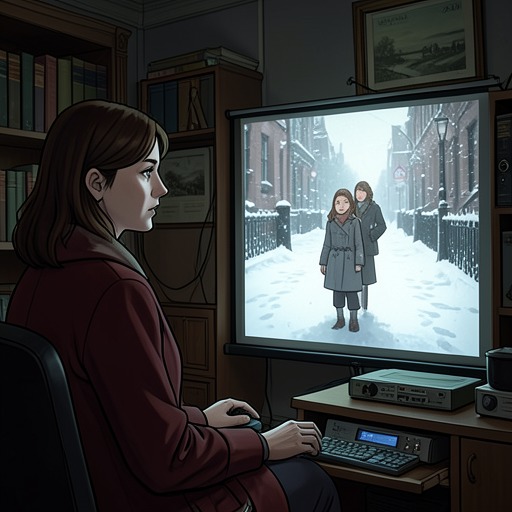
That continuing address shapes the Narrator’s care for Apollo. On the anniversary of the Deceased Friend’s death, the Narrator watches a recording of the friend reading and wonders whether Apollo would recognize the voice. The Narrator does not test this possibility, fearing that Apollo might misunderstand the recording and think the friend trapped inside it. The hesitation expresses concern for Apollo while also marking how little the Narrator can know about his experience. Later, the Narrator acknowledges that the distinction between speaking to the Deceased Friend and speaking to herself has blurred. The book thus brings traumatic response into relation with bereavement without treating grief as the same condition: both are shaped by what cannot be fully spoken or verified, while writing becomes an attempt to approach that limit rather than erase it.