Cam Hillier–Archie relationship
The Girl he Never NoticedThe Cam Hillier–Archie relationship is the emotional and practical bond between Cameron Hillier and his sister’s orphaned son, Archie. Although Cameron is Archie’s uncle by blood, he has adopted the boy and assumes responsibility for raising him after the deaths that left Archie motherless and fatherless. Their relationship therefore joins kinship, adoption, guardianship, and chosen parenthood: Cameron is the wealthy businessman who can provide almost anything, while Archie is the child whose need for presence continually tests whether provision can substitute for time.
Family Structure and Background
Archie enters the narrative as a small boy of about five, arriving excitedly at the house while a nanny tries to restrain him. Cameron identifies him as his sister’s orphaned son and states that he has adopted him. The adoption does not erase the losses behind it. Archie’s mother, Amelia, had been abandoned after an unwise love affair and was never the same afterward; she took the identity of Archie’s father to her grave. As a result, Archie has lost both parents, and Cameron’s guardianship is not merely a legal or practical arrangement but the central structure of the boy’s surviving family.
Cameron’s understanding of Archie is shaped by this history. He knows that a child who has lost his mother cannot be secured by luxury alone, and he recognizes that his own absences matter. He can give Archie possessions, travel souvenirs, books, and elaborate projects, but he privately questions whether he is doing the right thing by the boy when work and the pursuit of greater power keep him on a treadmill. His anxiety is intensified by the approaching start of Archie’s schooling, which he expects will reduce their already limited opportunities to be together.
Care, Play, and the Menagerie
The relationship is made visible through Cameron’s practical response to Archie’s love of animals. Rather than allowing the boy to keep mice in shoeboxes, Cameron creates a properly designed compound known as Archie’s menagerie. It has fencing and overhead netting, shaded shrubs, hollow tree trunks, gravel paths, rabbit hutches, a castle-like guinea-pig cage fitted with climbing wheels, slides, and bells, a cockatoo with a limited vocabulary, and ponds containing frogs and goldfish. The space is an adult-scale act of protection and an expression of the child’s imagination, built by Cameron but partly made meaningful through Archie’s participation.
Archie understands the menagerie as shared work rather than a gift passively received. When Liz Montrose asks whether he made it, he points out that he is only five, explaining that Cameron did most of it but that he helped. He introduces the guinea pigs Golly and Ginny and describes their family, turning the enclosure into a small social world that he can name, interpret, and care for. The animals thus give Archie responsibility, continuity, and a language for belonging, while Cameron’s construction of the space converts wealth into daily care.
The animals also help Cameron address Archie’s grief. He believes the menagerie has helped the boy get over the loss of his mother, though the narrative does not present grief as finished or cured. Archie remains exceptionally sensitive to separation. When five of Wenonah’s puppies are sent to new homes, he hardly eats during the day and cannot sleep that night. His distress shows how vividly earlier losses continue to organize his reactions to ordinary departures, even when the departures concern animals rather than people.
Protection, Absence, and Emotional Attachment
Cameron’s care combines direct affection with compensatory gestures. He hugs Archie when the child runs to him, and when Archie wants to keep all six puppies, Cameron patiently explains that five other children would otherwise be denied a puppy. The moment presents Cameron as both affectionate and morally instructive: he does not simply indulge Archie, but helps him understand that loving an animal may require relinquishing it for another child’s happiness.
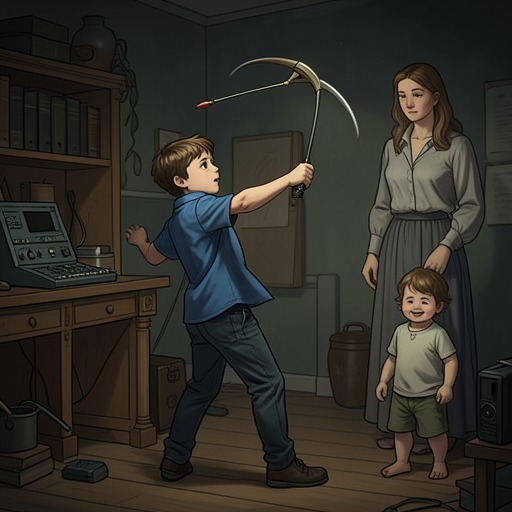
At the same time, Cameron tries to make his absences emotionally legible through postcards, books, and strange, wonderful objects sent from different parts of Australia and overseas. Archie takes enormous pride in these items and keeps them in a special cabinet in his room. One such gift, a full-size boomerang, becomes a small domestic crisis when Archie throws it indoors, breaks a window, and becomes deeply upset. Cameron responds by finding him a song about a man whose boomerang will not come back, transforming embarrassment and distress into shared amusement. The incident illustrates the particular pattern of their bond: Cameron cannot always prevent trouble or be physically present, but he tries to meet Archie’s feelings with invention, humor, and reassurance.
Cameron’s inner conflict is therefore not a lack of love but a conflict between love and availability. He has inherited and expanded the labor of his parents into a great fortune, yet feels that the resulting power has become a strait-jacket. Archie receives the benefits of that success, including the menagerie and the carefully chosen gifts, but Cameron knows that no number of objects can fully answer a child’s need for a dependable adult’s presence.
Liz Montrose and the Expanding Family Circle
Cameron’s concern for Archie directly shapes his offer to Liz Montrose. He tells her that he needs the right influence in Archie’s life because he cannot be with the boy as much as he should. Since Archie will start school the following year, Cameron wants the remaining year before school to be memorable, safe, and happy. He has observed Liz with her daughter, Scout, and has seen how deeply Scout matters to her; he also sees Liz’s immediate response to Archie. His proposal therefore treats Liz not only as an efficient prospective employee but as a possible stabilizing presence within Archie’s family life.
The proposed staff cottage is large enough for Liz, Scout, and Liz’s mother, Mary Montrose, and Cameron presents Archie as a ready-made friend for Scout. This arrangement places two children with histories of disrupted or vulnerable family life inside a shared household orbit. Liz’s mother already provides childcare for Scout, while Cameron’s household includes a nanny and other staff; the resulting structure is neither a conventional nuclear family nor a purely professional workplace. It is a selective family circle assembled through adoption, grandparental care, employment, friendship, and emotional recognition.
Liz’s increasing affection for Archie confirms that Cameron’s judgment is not merely strategic. She sees a serious, sensitive boy with grey eyes and stubbornly upright brown hair, notices how intensely he feels the departure of the puppies, and is moved by his orphanhood and his hero-worship of Cameron. She also brings Scout and Archie together in ordinary pleasures. During a garden celebration, sparklers in a chocolate ice-cream log initially frighten Scout, but Archie promises that they will not hurt her, takes her hand, and dances with her until she relaxes. Cameron’s relationship with Archie thus becomes one of the means by which the household expands: Archie is not only cared for by Cameron but helps create bonds with the people Cameron brings into his life.
Separation, Return, and the Meaning of Presence
The decisive measure of the relationship comes after Liz and Scout have been away. When they return to Yewarra, Cameron is greeted by the household, but Archie’s response carries the greatest emotional force. Archie hugs Cameron first, then Scout, and finally confronts Liz with the fear that she may leave again. He asks whether she will take Scout away and says that nothing feels the same when they are absent. His words reveal a child who experiences departures cumulatively: the loss of parents, the dispersal of puppies, and the temporary removal of new companions all press upon the same fear of being left.
Liz kneels and embraces both Archie and Scout, promising that they will not go away again. Archie studies her eyes until he appears satisfied, then immediately turns toward the menagerie to announce that Golly and Ginny have had more babies and invite Scout to see them. The movement from testing reassurance to sharing new animal life shows how attachment is repaired in this family: a promise is followed by inclusion in a continuing world of care. Archie does not need a grand explanation once he believes the adults will remain; he needs to resume companionship, responsibility, and play.
Cameron’s response is quiet but revealing. He takes Liz’s hand and thanks her, recognizing that her return has restored something he could not provide alone. The relationship between Cameron and Archie therefore reaches beyond the uncle’s individual devotion. Cameron’s deepest achievement is not simply adopting Archie or building the menagerie, but allowing a wider network of reliable attachments to form around the boy. Through presence, shared care, and the gradual enlargement of the household, an orphaned child receives a family that is defined less by conventional structure than by who stays, notices, comforts, and returns.