Dog
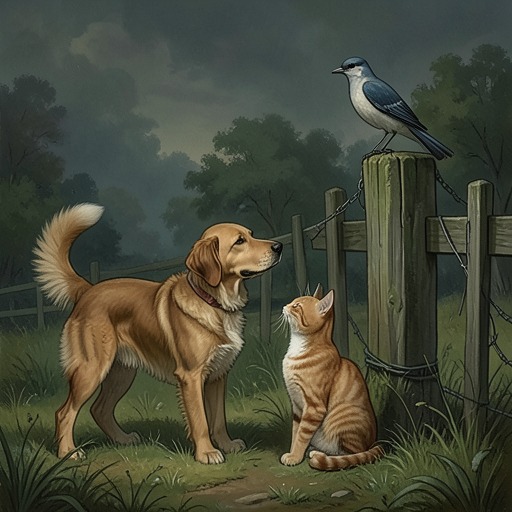
The Girl he Never NoticedDog, represented in the evidence chiefly by Wenonah and her puppies, is not merely background animal life at Yewarra. The dogs organize Archie’s emotional world, expose his unusually tender and anxious nature, and become a practical medium through which Cameron Hillier, Liz Montrose, Scout, and Archie form a household-like bond. Their presence turns care, loss, discipline, and reunion into visible actions rather than abstract themes.
Wenonah and the Puppies
Wenonah belongs to the animal-filled environment surrounding Archie, and her imminent litter is introduced as a source of acute anticipation. At a social gathering, Narelle Hastings asks after Archie, and Cameron Hillier reports that the boy is a nervous wreck because Wenonah’s puppies are due any day. The remark is brief, but it establishes that Archie’s concern for animals is intense enough to affect his appetite, composure, and daily emotional balance; the coming birth is already an event in his inner life.
When Liz Montrose first encounters Archie at Yewarra, he arrives in excitement with news that Wenonah has had six puppies. He immediately faces a moral and practical problem: he wants to keep all of them, but the adults will allow him to keep only one. Cameron lifts him up, hugs him, and explains that the other five children who would love a puppy could not have one if Archie kept the entire litter. Archie slowly accepts the reasoning, even though the decision plainly costs him. The scene presents dog ownership as an early lesson in affection governed by responsibility: loving the animals does not entitle Archie to possess them all.
The choice of a single puppy remains unresolved when Archie leads Liz toward the stables. He explains that Wenonah can be naughty about rabbits and other small creatures because she likes to chase them, while he intends to train the puppy he receives not to do the same. He is uncertain whether to choose a boy or a girl and expects Cameron to advise him, since Cameron usually has an answer. The exchange shows Archie imagining himself not only as a recipient of a pet but as its trainer and caretaker, while also revealing how strongly Cameron functions as the boy’s source of practical guidance.
Dogs Within Archie’s Animal World
Wenonah and her litter belong to a larger system of care that Cameron has built around Archie’s interests. Archie’s fenced menagerie contains rabbits, guinea pigs, a cockatoo, frogs, and goldfish, with netting overhead, shaded shrubs, hollow tree trunks, gravel paths, and purpose-built enclosures. The dog’s tendency to chase the rabbits therefore matters within an already organized community of animals: Wenonah is not an isolated pet but part of a living environment whose inhabitants require protection and management.
Cameron says that he created the menagerie because Archie had always been interested in animals and that a proper compound seemed preferable to keeping mice in shoeboxes. He also believes the project helped Archie recover from the loss of his mother. Animal care consequently operates on two levels. It gives Archie an absorbing routine and teaches him to attend to vulnerable creatures, while the compound itself becomes an adult-designed structure for processing bereavement without reducing the child’s grief to conversation alone.
Liz is drawn into this system through her work at Yewarra. After setting up a computer program for the stables, she often takes Scout and Archie with her to inspect the foals, and the children invent names for the young horses as they grow from stiff-legged newborns into confident animals. Although this activity concerns horses rather than dogs, it clarifies the wider function of Yewarra’s creatures: they provide repeated occasions for shared observation, imaginative play, and cooperative responsibility. Wenonah’s puppies fit naturally into the same pattern, giving Archie and the other children another set of animals around which relationships can gather.
Emotional Consequences for Archie
Archie’s response to the puppies confirms the depth of his attachment. When five of Wenonah’s puppies are sent to new homes, he hardly eats during the day and cannot sleep that night. His distress is not treated as childish fussiness; it is part of the serious, sensitive temperament that Liz Montrose has come to recognize in him. The departure of the puppies makes separation concrete, and it touches the larger fact of his being both motherless and fatherless, a vulnerability that repeatedly draws Liz’s concern.
The puppy episode also helps explain why Archie is so strongly attached to Cameron. Cameron spends limited time with him, but sends postcards, books, and unusual objects from different parts of the country and overseas. One such gift is a full-size boomerang that Archie throws indoors, breaking a window when it fails to behave as he expects. Cameron responds not only to the damage but to Archie’s upset, finding him the song "My Boomerang Won't Come Back," which makes the boy laugh and feel better. The dog story and the boomerang anecdote share a pattern: Cameron converts a potentially painful experience into an occasion for explanation, humor, and reassurance.
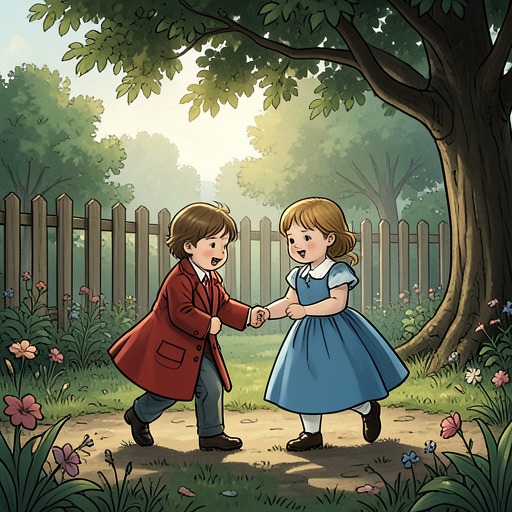
Wenonah’s puppy also helps repair a moment of tension between the children. When Scout reacts unusually and Archie is caught up in the disturbance, Daisy Kerr redirects them by proposing that they visit Wenonah and her puppy. Liz Montrose and Cameron watch the three children head toward the stables as peace returns. The dog is therefore a practical mediator: attention shifts from conflict to a familiar creature, and the children regain a shared activity without requiring a long adult intervention.
Household Bonds and Reunion
Dogs help make Archie’s emotional life legible to Liz. She sees that he is bright and sensitive, and Cameron observes that the boy has become more relaxed since Liz and Scout entered his life. Archie and Scout are both single children who receive substantial adult attention, and their relationship develops through the animals and spaces available at Yewarra. Wenonah and the puppy offer them a common focus, while the wider menagerie gives them repeated reasons to move together through the property.
The animals also connect Archie’s grief to the emerging household formed around Yewarra. Liz Montrose is herself a single mother living with Mary Montrose, who looks after Scout while Liz works. Cameron, meanwhile, has adopted his orphaned nephew Archie and worries about securing the right influence for him before school begins. Liz’s care for Scout and her immediate responsiveness to Archie allow Cameron to imagine her as a stabilizing presence in the boy’s life. Wenonah’s puppies belong to the everyday material world in which that proposed care becomes credible: feeding, choosing, training, protecting, and coping with departures are all forms of family labor.
At the reunion after Liz and Scout have been away, Archie first embraces Cameron and then Scout before anxiously asking Liz whether she will leave again and whether she will take Scout away again. He explains that nothing feels the same when they are absent. Once Liz promises that they will not go away again, Archie accepts the reassurance and immediately turns to Scout with news that Golly and Ginny, the guinea pigs, have had more babies. He invites her to see them, and the two children race toward the menagerie. Though the immediate animal news concerns guinea pigs, the moment completes the pattern established by Wenonah: animals give Archie a language of continuity, allowing him to move from fear of abandonment back into shared discovery.
Narrative Significance
Dog functions as an active instrument of care, education, and emotional regulation in the story. Wenonah’s pregnancy creates anticipation; the six-puppy litter forces Archie to confront limits on possession; the relocation of five puppies exposes his grief; and the puppy at the stables redirects a conflict between children. Each occurrence gives animal life a concrete role in shaping human conduct.
The dogs also complicate any simple division between domestic affection and adult responsibility. Cameron does not indulge Archie’s wish to keep every puppy, but he explains why generosity toward other children matters. Archie, for his part, wants to train his puppy not to chase rabbits, extending his concern beyond affection for a favored animal to the safety of the menagerie as a whole. Through these details, Dog marks the transition from wanting to keep what one loves to learning how to care for it responsibly.
Finally, Wenonah and her puppies help define Yewarra as a place where damaged or divided lives can be reorganized through ordinary, repeated acts. Cameron’s adoption of Archie, Liz’s care for Scout and Archie, the children’s shared attention to animals, and the eventual reassurance of reunion all converge around living creatures that require patience. The dogs do not simply symbolize healing; they prompt the decisions, conversations, distractions, and attachments through which healing becomes possible.