Financial insecurity
The Girl he Never NoticedFinancial insecurity is a persistent material and emotional condition in Liz Montrose’s life. It appears not as abstract poverty but as the pressure of bills, precarious employment, limited choices, and anxiety about whether she can continue to provide a settled life for Scout. At the same time, it gives practical urgency to the opportunities that draw her into Cameron Hillier’s world, where paid work, housing, and social status are concentrated in a wealthy household.
Material Conditions and Family Support
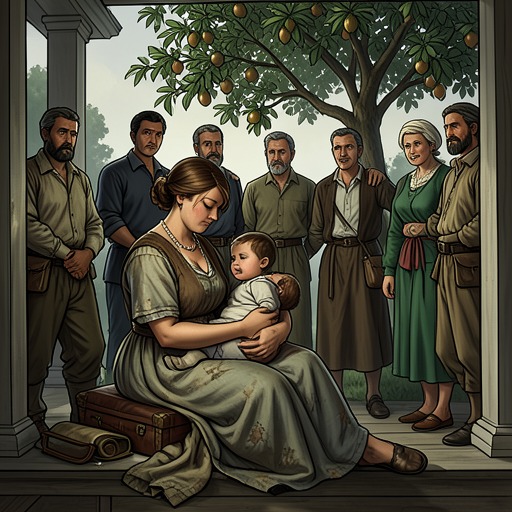
Liz is a single mother raising Scout with help from Mary Montrose, her own mother. Scout is nearly four, and Mary looks after her while Liz works; the arrangement functions, though Mary is eccentric and sometimes needs care herself. Liz therefore carries responsibility for both a young child and an older parent, making employment more than a matter of personal ambition. It is the economic framework that allows the three women to remain together.
Their flat in an inner Sydney suburb is comfortable, but the neighbourhood is not affluent, a fact Mary frequently laments. Its three bedrooms have been carefully repurposed: the study became Scout’s bedroom, while the third room became Mary’s workroom. Mary creates clothes for a small group of customers, but her earlier attempt to establish a boutique after Liz’s father died consumed nearly all her resources because, despite the quality of her garments, she lacked business sense. Her present work supports the household in a limited way, while her greatest creative labour is devoted to Liz and Scout.
The family’s apparent stylishness conceals its constrained budget. Mary makes Liz’s clothes, allowing Liz to look unusually chic without paying what such clothing would normally cost. This concealment matters socially: at Narelle Hastings’s party, Cameron reads Liz’s appearance as evidence that a single mother in financial difficulty may be less financially strained than she claims. The clothes are not proof of wealth but the visible product of Mary’s skill, sacrifice, and a domestic economy built around making do.
Financial Pressure and Custody Anxiety
Liz’s insecurity becomes explicit when Cameron asks whether she wants to leave her position after their disastrous evening. She refuses because she needs the money and asks to return to office hours and the ordinary demands of a diary secretary’s job. Her decision establishes a central contradiction: the work is entangled with attraction, humiliation, and danger, yet abandoning it would immediately threaten the household budget.
Cameron later suspects that her behaviour at the party and her escape over his wall might be connected with financial hardship. Liz explains that she saw Scout’s father, whom she had not seen for years, and that the shock caused her distress. Her anxiety is not only about money in the present. Scout’s father is gaining prestige, has been married for four years, and lives in a settled household with his wife; they have no children. Liz fears that they might somehow lure Scout away from her, not necessarily through a successful legal challenge but through the advantages they could offer as Scout grows older.
Liz understands the comparison in material terms. She is merely getting by, while Scout’s father possesses increasing professional prestige and a stable home. Her fear is therefore also custody anxiety: she worries that a child might eventually prefer the security and resources of another household. Cameron tells her that she is Scout’s mother and that they cannot take the child unless Liz cannot provide for her, but Liz remains aware that legal entitlement does not eliminate the social power of money, stability, and reputation.
The same insecurity governs Liz’s thoughts about Cameron. After attraction develops between them, she assumes that the most likely outcome would be an affair rather than marriage because Cameron would not marry a single mother who sometimes struggles to pay her bills. The thought of the relationship is immediately tested against rent, expenses, and responsibility for Scout. Even after an extraordinary day with Cameron, she reminds herself that leaving the job could damage her rating with the agency, force her to accept less money, and disrupt her budget. Her emotional choices are consequently filtered through economic consequences.
Work as an Exit from Precarity
Liz’s qualifications exceed her position. She is twenty-four, holds a degree in Business Management, and topped her class, although she expects Cameron to doubt it. Her diary-secretary work provides income but does not fully use her organisational or interpersonal abilities. The tension between competence and insecure employment makes Cameron’s later offer significant: he sees her as capable of more than administrative service and proposes that she manage the household and associated domestic arrangements at Yewarra.
The position comes with a comfortable staff cottage large enough for Liz, Scout, and Mary. It would also provide Scout with a ready-made companion in Archie. Cameron offers a generous remuneration package and a three-month trial period, presenting the job as both practical employment and a possible career move. The offer would remove some of the costs and instability associated with Liz’s existing life while preserving the family’s ability to live together.
The proposal also responds to an identifiable labour need rather than existing solely as a personal inducement. Mrs Preston, Yewarra’s long-serving housekeeper and chef, wants to concentrate on cooking and no longer manage the entire provisioning and domestic administration of a large, frequently entertaining household. She wants someone else to coordinate supplies, linen, napkins, cleaning staff, silver inventories, and records of meals served to guests. Liz is being recruited into a substantial form of paid management work: tasks that might otherwise remain invisible are named, organised, and assigned economic value.
Mary urges Liz to accept, describing the offer as a career opportunity that could open further possibilities and reduce the stress caused by money. Liz initially resists because she wants Mary to have a life of her own, centred on the work she loves, rather than simply extending her unpaid care of Scout. Her eventual decision is carefully reasoned. The Yewarra position would improve her finances, resemble working from home, eliminate the need for part-time weekend work, strengthen her résumé, and give her more time with Scout. It might also make her appear a more suitable mother if Scout’s father ever challenged her fitness to care for their daughter.
When Liz asks whether Cameron has changed his mind, she admits that she could not in good conscience turn the job down. The opportunity promises more than a wage: it offers housing, a stronger professional identity, relief from weekend labour, and a material answer to the fear that she cannot provide enough for Scout. Her acceptance is thus both an act of agency and a decision made under pressure.
Wealth, Space, and Domestic Labour
The contrast between Liz’s financial position and Cameron’s wealth is made visible through their homes. After her escape from Narelle Hastings’s mansion, Liz climbs onto a wheelie bin, throws her shoes over a high wall, and drops into the adjoining property, tearing her tights and grazing her knee. She then finds herself in Cameron’s expensive house, furnished with polished wooden floors, a jade bonsai tree, an Australian painting above the fireplace, French doors, and a floodlit pool looking toward Sydney Harbour. The sequence turns economic difference into a physical passage through walls, gates, gardens, and guarded private space.
Yewarra initially produces a similar mixture of attraction and apprehension. Liz feels briefly as though she is entering a zone beyond her control when Cameron drives her through its gates, but the estate soon enchants her with its trees, agapanthus, jasmine, honeysuckle, jacarandas, gardenias, and roses. The beauty of the place does not erase its class structure. Rather, it reveals the scale of the domestic world she may be asked to administer and the resources that make such abundance possible.
The sudden party at Yewarra exposes the demands placed on household labour. The event has been overlooked in both Cameron’s office and the Yewarra diary, leaving Liz and Mrs Preston only a few hours to prepare for six overnight guests. When Rose, the waitress, cuts her hand, Mrs Preston asks Liz to hand Scout to Daisy and take Rose’s place. Liz accepts despite the personal strain, demonstrating how quickly paid administration can become direct service work when the household’s staffing system fails.
This arrangement places Liz within a gendered chain of care. She earns access to stability by coordinating the labour of a wealthy household, while Mary continues to produce clothing and provide childcare, and Mrs Preston attempts to withdraw from administrative burdens so she can focus on cooking. Financial security is therefore created through a redistribution and formalisation of domestic work rather than through the disappearance of labour. Cameron’s wealth can house and pay that system; Liz’s economic vulnerability makes her participation necessary.
Consequences and Resolution
Financial insecurity initially narrows Liz’s choices, intensifies her fear of Scout’s father, and makes her wary of emotional involvement with Cameron. It also makes the employer-employee boundary especially important: Cameron controls access to a well-paid position and family housing, while Liz must judge whether accepting them will compromise her independence or expose her to further emotional risk. Her decision is not presented as simple gratitude. She weighs income, career, childcare, housing, and custody concerns against the dangers of becoming dependent on a powerful man.
The position at Yewarra gradually becomes associated with a broader family structure. It offers a home for Liz, Scout, and Mary, connects Scout with Archie, and places Liz among staff who respect Cameron despite his difficult manner. That environment challenges Liz’s assumption that Cameron is defined only by wealth, arrogance, or an inability to commit. Economic security becomes one condition through which trust and belonging can develop, even though it cannot by itself settle the emotional injuries inherited from Liz’s past.
The eventual marriage of Liz and Cameron on Whitehaven Beach several weeks later marks the most decisive movement away from the insecurity that once organised her calculations. The ceremony includes Scout, Archie, and the celebrant, with guests travelling from Hamilton Island by boat and Liz wearing an ivory lace-and-tulle dress made by Mary. The ending joins material and emotional forms of provision: the mother who has sustained Liz through handmade clothing contributes to the wedding, while the new marriage incorporates both children and preserves the family bonds that Liz had struggled to protect. Financial insecurity does not define Liz’s identity, but overcoming its immediate power makes possible a life in which work, care, housing, and commitment no longer have to be treated as mutually exclusive.