Guinea pig
The Girl he Never NoticedGuinea pigs occupy a distinctive place in Archie’s menagerie at Yewarra: they are not merely background pets, but named, breeding animals whose enclosure gives a five-year-old child a structured world of responsibility and companionship. Through Golly, Ginny, and their offspring, the story shows how animals help Archie process loss, organize relationships with Liz and Scout, and turn the estate into a lived family environment.
The Guinea-Pig Enclosure
Archie’s guinea pigs live in a fenced compound near the house, protected by netting and shaded by shrubs. Their cage is designed like a castle, complete with climbing wheels, slides, and bells, making it both a habitat and a miniature play space. The elaborate arrangement belongs to the larger menagerie, which also includes rabbits, a white cockatoo, frogs, and goldfish, but the guinea pigs receive especially intimate attention because Archie can handle them, name them, and observe their family life directly.
The setting reflects Cameron Hillier’s deliberate approach to Archie’s interests. Rather than allowing the child to keep animals in improvised shoeboxes, Cameron helped create the menagerie properly. He understood that Archie had always been interested in animals and believed the project had helped him recover from the loss of his mother. The guinea-pig enclosure therefore combines practical care with emotional rehabilitation: it gives Archie something living to protect while preserving a daily link to affection, routine, and responsibility.
Golly, Ginny, and Their Family
When Archie leads Liz to the compound, he hands her a guinea pig named Golly and then draws another from the castle-like cage. The second is Ginny, whom Archie identifies as Golly’s wife; the other guinea pigs are described as their children. His language gives the animals a recognizable domestic structure, allowing him to explain them not as interchangeable pets but as a family with individual members and relationships.
Liz responds with deliberate seriousness as she strokes Golly and asks where Wenonah and her puppies are, treating Archie’s animal world as worthy of his full attention. The exchange establishes a shared bond between them. Liz is enchanted by the menagerie partly because she thinks Scout would love it, but her interest also validates Archie’s knowledge. He can teach her the identities and arrangements of the animals, while she joins the imaginative order he has built around them.
Animals, Children, and Care
The guinea pigs are part of a wider network of animals that organizes life for the children. Liz later sets up a computer program for the Yewarra stables and often takes Scout and Archie to see the foals, whose growth they follow by inventing names as the animals change from stiff-legged newborns into confident young horses. At the same time, the children play with the cultural image of animals through their imitation of elephants after following the birth of a baby elephant at Taronga Zoo. These activities make nonhuman life a shared educational and emotional language for Scout and Archie.
The guinea pigs are more domestic and physically accessible than the foals or the zoo elephant. They can be held, watched, and revisited within the children’s immediate home environment. Their enclosure thus supports a form of cross-species intimacy grounded in repeated contact rather than spectacle. Archie’s knowledge of births, marriages, offspring, and individual temperaments gives him an active role in the household, while the animals provide a safe subject through which children and adults can cooperate.
Continuity and Family Reunion
The guinea pigs also become a recurring sign of continuity after disruption. Archie is deeply sensitive to separations, including the departure of five of Wenonah’s puppies to new homes; he worries, loses his appetite, and cannot sleep. His attachment to animals is therefore not casual. Their departures expose how strongly he experiences loss, while the surviving animals and their ongoing growth offer a counterforce to that anxiety.
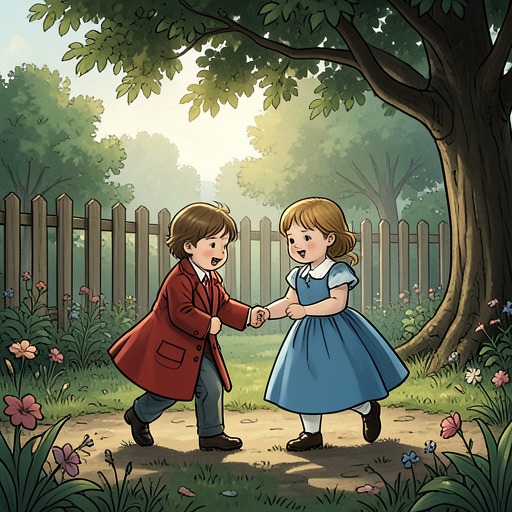
When Liz returns after being away, Archie first asks her not to leave again and not to take Scout away, explaining that nothing feels the same without her. Once Liz promises that they will not go away again, Archie immediately turns to Scout with news that Golly and Ginny have had more children and asks whether she wants to see them. The new offspring redirect the children from fear to shared excitement, and the two race toward the menagerie together. The guinea pigs’ continuing family life becomes the immediate action through which Archie accepts reassurance and re-enters companionship.
Narrative Significance
The guinea pigs embody the book’s broader movement from isolated survival toward a chosen and practical family circle. Archie is orphaned, Liz is raising Scout with help from Mary Montrose, and Cameron has adopted his sister’s son; within this unsettled network, the animals offer a manageable model of belonging. Golly, Ginny, and their young are cared for as a family, and their enclosure allows Archie to rehearse the duties, tenderness, and vulnerability that family entails.
Their importance is consequently relational rather than symbolic alone. They help Archie mourn, give Cameron a concrete means of caring for him, invite Liz into the child’s private world, and provide Scout and Archie with a common activity. When their offspring bring the children running back together after Liz’s return, the guinea pigs demonstrate how ordinary acts of animal care can stabilize human attachment and make Yewarra feel like home.