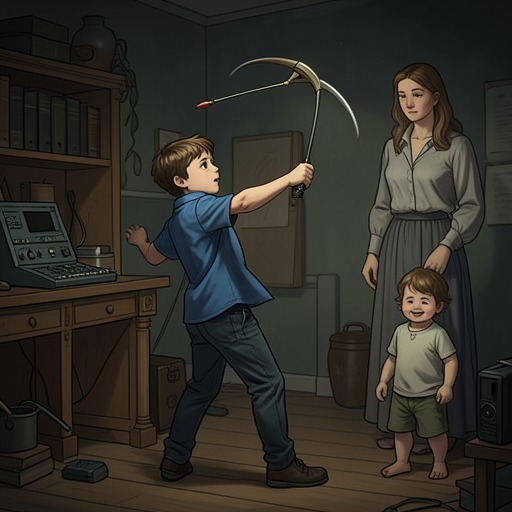
My Boomerang Won't Come Back
The Girl he Never Noticed“My Boomerang Won't Come Back,” also known as “The Boomerang Song,” is a comic song whose importance lies less in its lyrics than in the chain of human connections it creates. Cameron Hillier first invokes it as an apparently private reference, leaving Liz Montrose mystified; later, she learns that the song was chosen to comfort Archie after the child threw a boomerang through a window. The song therefore links adult courtship and professional intimacy with a child’s embarrassment, showing how Cameron’s seemingly inexplicable gestures acquire their meaning through his care for Archie.
First Mention and Delayed Meaning
Cameron introduces the song in his office while Liz is trying to understand why he is watching her so intently. After drumming his fingers on the desk, he asks whether she remembers a song about a boomerang that would not come back. Liz does not recognize the reference, and Cameron says that he seems to remember it before asking her to find it. The request is deliberately incomplete: it gives Liz a practical task without explaining its purpose, and Cameron’s brief response after she succeeds does nothing to resolve the mystery. When Liz reports that she has found the song, identifies Charlie Drake as the artist, and explains its comic premise—that the boomerang fails to return and hits the Flying Doctor—Cameron answers only that it is excellent. His restraint makes the song feel like a private clue whose significance has been deferred rather than a piece of casual office conversation.
The song’s first function is consequently interpretive. Liz is charmed by the “golden oldie,” but she cannot yet tell why Cameron wanted it. His request creates a gap between what he knows and what she knows, while the song’s comic image of a failed return quietly establishes a motif of misdirected movement and belated recognition. Nothing in the exchange explains the reference immediately; its force depends on a later scene in which an apparently random detail is reattached to Archie’s history.
Archie’s Accident and Cameron’s Response
The explanation emerges through Archie’s nanny, Daisy Kerr, when she and Liz are looking through the gifts Cameron has sent the boy from different parts of the country and overseas. Archie is serious and sensitive, and he takes extraordinary pride in these unusual presents, preserving them in a special cabinet. Among them is a full-size boomerang placed on a shelf that Archie cannot reach. Daisy explains that Archie failed to understand that he should not experiment with it indoors. He threw it through a window, broke the glass, and became deeply upset.
Cameron’s response transforms the accident from a source of distress into a comic story Archie can bear to remember. He found the song about a man whose boomerang would not come back and gave it to Archie; the child loves it and finds it hilarious. The song does not erase the broken window or deny Archie’s mistake. Instead, it changes the emotional charge of the incident. Shame and upset become laughter, and the dangerous object becomes associated with a joke that Archie can enjoy. Cameron’s practical care is therefore also imaginative: he does not merely discipline the child or replace the damaged item, but finds a cultural reference capable of reaching Archie’s feelings.
The details matter because the song is inseparable from the material accident. It follows a full-size boomerang, an inaccessible shelf, a broken pane of glass, and a child who is “really upset.” Its comic energy arises from a mishap that could not be made harmless by explanation alone. By attaching the accident to Charlie Drake’s absurd image of a boomerang striking the Flying Doctor, Cameron gives Archie a narrative in which failure can be funny rather than humiliating.
Liz’s Recognition and the Shared Circle
When Daisy tells Liz the story, Liz realizes why Cameron had asked her to locate the song. Her response is immediate recognition: she knows the reference now, and the earlier office mystery falls into place. The discovery gives retrospective meaning to Cameron’s otherwise cryptic request and lets Liz see that his attention was directed not simply toward her but toward Archie’s emotional world. The song thus becomes evidence of a relationship she had not fully understood—the bond between Cameron and his motherless, fatherless nephew.
This revelation deepens Liz’s feelings toward Archie. She is already becoming very fond of him, and the story clarifies why Cameron’s care for the boy carries such weight. Archie hero-worships Cameron, while Cameron compensates for the limited time he can spend with him by sending postcards, books, and strange or wonderful objects. The song belongs to that same pattern of sustained, thoughtful attention. It is not one of the grand gifts displayed in Archie’s cabinet, but it proves that Cameron notices what frightens or embarrasses the child and responds in a form Archie can understand.
The song also enters the developing social circle around the household. Daisy is practical and conscientious but retains a streak of romance and nonsense suited to the imaginative world of children; Liz comes to appreciate both Daisy and Archie. Through Daisy’s account, a private reference between Cameron and Liz becomes part of a wider network of care involving the nanny, the child, and the woman increasingly drawn into their lives. The song’s significance expands as it passes from Cameron’s enigmatic request, through Liz’s investigation, to Daisy’s explanation and Archie’s delighted response.
Comic Motif and Narrative Significance
As a recurring expression, “My Boomerang Won't Come Back” operates through repetition with altered knowledge. Cameron’s first mention makes it sound like an eccentric personal association. Liz’s search produces a funny song but not its emotional context. Daisy’s later story supplies that context, converting the earlier mystery into a sign of Cameron’s tenderness toward Archie. When Liz understands the connection, the song becomes a compact emblem of how apparently disconnected moments in the household are joined by memory and affection.
Its central joke also carries a modest irony. A boomerang is expected to return, yet this one does not; Cameron’s use of the song likewise sends a meaning outward before allowing it to come back to Liz. The return is delayed until she hears about Archie’s accident. What initially moves away as an unexplained request returns as recognition, and the emotional result is warmer than the original exchange suggested. The song’s comic failure to come back is therefore echoed by a narrative pattern in which meaning does eventually return, carrying with it a fuller understanding of Cameron’s character.
The expression finally joins humor to protection. Archie’s broken window marks a moment when an object, a rule, and a child’s judgment all fail at once. Cameron answers not with severity but with a song that makes the event survivable. For Liz, discovering this history is equally important: it reveals the playful, attentive dimension beneath Cameron’s reserved manner and helps bind her more closely to Archie. “My Boomerang Won't Come Back” remains a small cultural reference, but within the story it becomes a durable sign of comfort, delayed recognition, and the practical tenderness through which a family circle is formed.