Rabbit
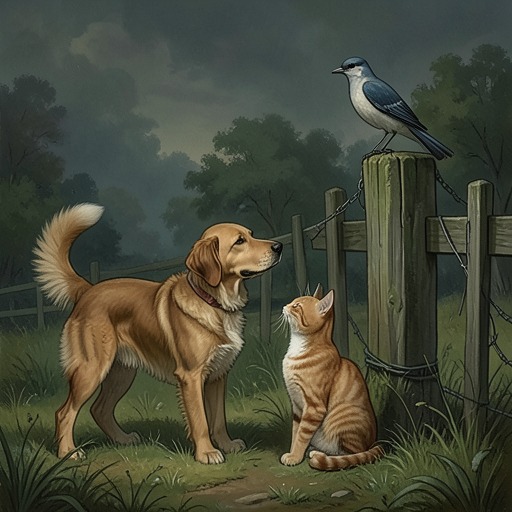
The Girl he Never NoticedRabbit is one of the animals through which Yewarra becomes a lived domestic world rather than merely a country property. Kept in hutches within Archie’s carefully constructed menagerie, Rabbit belongs to an environment shaped by care, curiosity, and the child’s developing sense of responsibility; at the same time, its presence draws Wenonah’s predatory attention and gives Archie a problem he hopes to solve through training and choice.
Place in Archie’s Menagerie
Archie’s menagerie stands in a fenced compound near the house, protected by netting and shaded by shrubs. Gravel paths, hollow tree trunks, hutches, ponds, a waterfall, frogs, goldfish, guinea pigs, a cockatoo, and a blue-tongued lizard make it an unusually elaborate setting for the animals. Rabbit occupies a practical place within this arrangement, living in hutches rather than being treated as a passing novelty. The design of the compound shows Cameron Hillier’s decision to turn Archie’s interest in animals into a properly organized habitat instead of leaving him with improvised pets in shoeboxes.
The menagerie also gives Archie a setting in which he can explain animal behavior and family relations. He identifies the guinea pigs and their offspring, introduces Liz Montrose to the animals, and leads her from one attraction to the next. Rabbit therefore shares in the ordinary educational and social life of the compound: it is part of what Archie knows, tends, displays, and uses to bring another person into his world.
Risk, Training, and Care
Rabbit is not entirely safe within the wider household ecosystem. Archie explains that Wenonah can be naughty about rabbits and other small creatures because she likes to chase them. The danger is not presented as cruelty but as an instinct that must be managed, and Archie responds by imagining a future solution: he intends to train the puppy he gets not to chase Rabbit. His uncertainty about whether to choose a boy or a girl leads him to seek Cameron’s advice, showing how animal care is tied to the child’s reliance on the adults around him.
This small conflict gives Rabbit an active function in the household’s emotional order. Its vulnerability requires boundaries, supervision, and foresight, while Archie’s concern reveals that his attachment is not merely possessive. He is thinking about how different animals should coexist and how his own decisions might protect them. The animal thus helps turn affection into responsibility.
Family Life and Emotional Repair
Cameron says that creating the menagerie has also helped Archie recover from the loss of his mother. Rabbit is one element in that therapeutic environment, not because the narrative reduces the animal to a symbol, but because caring for living creatures supplies Archie with routines, interests, and relationships beyond his grief. The menagerie gives his attention somewhere to go and gives the adults a concrete way to participate in his recovery.
That pattern continues through life at Yewarra. Liz sets up a computer program for the stables and often takes Scout and Archie to see the foals, while the children invent names for the young horses as they grow from stiff-legged newborns into lively, confident animals. Against this larger rural rhythm, Rabbit belongs to the same network of observation and care: the children encounter animals together, talk about them, and form bonds through shared attention rather than through formal declarations.
Recurrence and Domestic Belonging
Rabbit also appears in the background of family celebrations. At a garden gathering, Liz places sparklers in a chocolate ice-cream log; when Scout becomes nervous, Archie reassures her and dances with her until she relaxes. The scene is not centered on Rabbit, but it shows how the children’s animal-filled world and their human relationships coexist. Archie’s ease in comforting Scout echoes the protective concern he shows toward small creatures, and the household’s capacity for tenderness extends across both.
Near the end, Archie asks Liz whether she will leave again or take Scout away again, explaining that nothing feels the same when she is absent. After Liz promises that they will not go away again, Archie immediately turns to Scout with news that Golly and Ginny have had more children and races with her toward the menagerie. Rabbit is not the animal named in this final exchange, but the return to the compound confirms the menagerie’s enduring role as a shared home of reassurance, companionship, and renewed family continuity.