Scout–Archie relationship
The Girl he Never NoticedThe Scout–Archie relationship is one of the clearest forms of chosen family at Yewarra. Scout, Liz Montrose’s nearly four-year-old daughter, and Archie, Cameron Hillier’s five-year-old adopted nephew, begin as children brought together by the adults’ work and gradually become companions whose play, quarrels, and shared attachment to animals give emotional substance to the household. Their relationship also shows how children affected by loss and disrupted family structures can create security through repeated presence, imaginative activity, and mutual recognition.
Introduction and Family Context
Scout enters Archie’s world as Liz explains that her daughter lives with her and Mary Montrose, Scout’s grandmother, because Liz’s father is dead. Archie’s situation is different but equally marked by absence: Cameron Hillier identifies him as his sister’s orphaned son and says that he has adopted him. Archie is therefore motherless and fatherless, while Scout is being raised by a single mother within a three-generation household. Their companionship brings two children with incomplete or rearranged families into the same domestic circle.
Cameron deliberately recognizes this possibility when he offers Liz the staff cottage at Yewarra. The cottage is large enough for Liz, Scout, and Mary Montrose, and Cameron presents Archie as a ready-made friend for Scout. The phrase is practical as well as affectionate: the proposed move would not merely solve Liz’s housing and employment needs but would place Scout inside an existing child-centered community. Archie’s presence becomes part of the emotional case for Yewarra, linking employment, residence, care, and companionship.
Animals, Play, and Early Affection
The first invitation comes from Archie. After Liz discovers the fenced compound that contains his rabbits, guinea pigs, cockatoo, frogs, goldfish, and other animals, she says that Scout would love it. Archie immediately asks who Scout is and whether the child likes animals; when Liz explains that Scout is her little girl and adores animals, Archie tells her to bring Scout over to play. His response makes the menagerie a bridge before the children have even met. The animals are not decorative background but the practical medium through which Archie imagines a friendship.
Archie’s menagerie also carries the history of his own bereavement. Cameron helped build it because Archie was interested in animals, replacing the prospect of mice in shoeboxes with a carefully made compound containing hutches, a castle-like guinea-pig cage, climbing wheels, slides, bells, ponds, a waterfall, and shaded enclosures. Cameron believes the project helped Archie recover from the loss of his mother. Scout’s arrival therefore places her inside an environment that is simultaneously a playground, a therapeutic structure, and an expression of Cameron’s care for Archie.
The children’s shared life expands beyond the compound. Liz organizes stable work through a computer program and often takes Scout and Archie with her to inspect the foals born at Yewarra. The children invent names for the foals and watch them change from stiff-legged newborns into lively, confident young animals. Their companionship is thus built through recurring observation rather than a single adventure: they return to the same creatures, share discoveries, and participate together in the rhythms of the estate.
Their adult caregivers also create a common imaginative world. Liz and Daisy Kerr join forces to occupy the children with games, including an elephant walk inspired by a baby elephant born at Taronga Zoo and Henry Mancini’s recording of “Baby Elephant Walk” from the film Hatari. Liz and Daisy imitate elephants, Scout and Archie copy them, and the activity becomes a favorite. Cameron watches one such performance unseen from a doorway, when the children and the adults end in a heap of laughter. The game turns the playroom into a temporary family theater, allowing Scout and Archie to belong to the same circle of silliness and shared memory.
Hierarchy and Conflict
The relationship is not immediately equal. Archie sees himself as the senior child at Yewarra and as the owner and architect of the menagerie. He dictates what the children should do and what they should play, while Scout initially tolerates his authority with equanimity. Her restraint has limits, however. Almost a month after her arrival, Archie removes a toy from her, and Scout responds by screaming and pushing him over when she retrieves it.
This quarrel exposes the difference between nominal seniority and personal autonomy. Archie’s claim to precedence comes from age, familiarity with Yewarra, and control of the animal compound; Scout does not accept that claim once it directly deprives her of something. Her reaction surprises Liz, who has never seen Scout behave that way, and leaves Archie astonished. The conflict is brief but important because it prevents their companionship from becoming a sentimental picture of effortless harmony. They must negotiate territory, possessions, authority, and temper before their friendship can become stable.
Daisy Kerr mediates the immediate aftermath. She reassures Archie that he will be fine, declares that everyone will be friends, and redirects the children toward Wenonah and her puppy. The animals again regulate the human relationship: attention to a mother dog and her puppy restores peace and contentment. The episode establishes a recurring pattern in which Yewarra’s creatures absorb strong feelings and offer the children a shared activity through which conflict can cool without lasting estrangement.
Growing Companionship and Shared Celebration
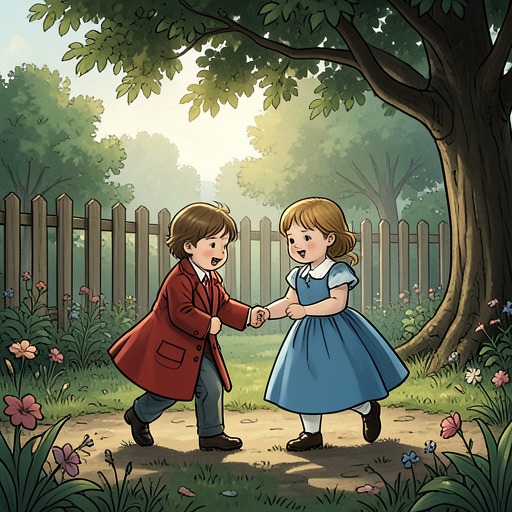
As Scout and Archie spend more time together, their relationship becomes woven into ordinary pleasures. During a garden meal, Liz serves a chocolate ice cream log decorated with sparklers. Scout is nervous when the sparklers are lit, but Archie notices her fear, promises that they will not hurt her, and takes her by the hand. He dances around the garden with her until she forgets to be frightened. His response is not merely playful; it is a small act of protection in which he uses his greater confidence to help Scout re-enter the celebration.
The scene also reverses their earlier hierarchy. Archie is not only the child who commands games or guards the menagerie. He can accommodate Scout’s unease and make room for her pace, while Scout accepts his hand and joins him. Their bond consequently develops through reciprocal adjustment: Archie learns that companionship cannot mean control, and Scout discovers that his assertiveness can coexist with solicitude.
Archie’s attachment to shared objects and songs further reveals how his relationship with adults supports his bond with Scout. Cameron sends him postcards, books, and unusual objects from around the country and overseas, which Archie stores proudly in a special cabinet. A full-size boomerang once caused him to break a window when he experimented indoors, but Cameron softened the aftermath by finding him the song “My Boomerang Won't Come Back.” These gifts and comic repairs become part of the cultural material Archie brings into the children’s world, just as the menagerie and the elephant game become common property in practice.
Separation Anxiety and Reunion
The decisive test of the Scout–Archie relationship comes when Liz and Scout leave. On their return to Yewarra, Archie hugs Cameron and Scout, then stands before Liz with visible concern and asks whether she will go away again and take Scout away again, because nothing feels the same when she is absent. His words make clear that Scout has become more than a playmate. Her absence has altered the emotional structure of Yewarra for him, making the household feel incomplete.
Liz answers by kneeling and embracing both Archie and Scout. She promises that they will not go away again. Archie studies her eyes as if testing whether the reassurance can be trusted, then accepts it and turns immediately to Scout with news that Golly and Ginny, his guinea pigs, have had more babies. Scout agrees to see them, and the two children race toward the menagerie together.
The ending returns their relationship to its founding medium: animals. The new guinea-pig litter gives Archie and Scout a shared future activity and transforms reunion into continuity rather than mere relief. Their companionship has moved from Archie’s invitation to play, through cooperation, dispute, care, and separation anxiety, to a renewed partnership grounded in the promise that Scout will remain part of Yewarra’s chosen family.