custody anxiety
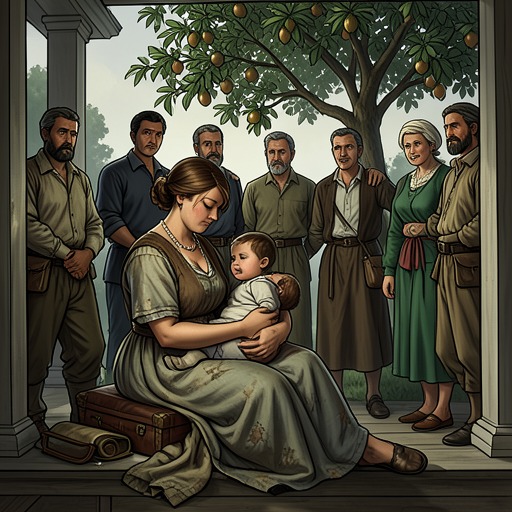
The Girl he Never NoticedCustody anxiety is one of the central pressures governing Liz Montrose’s life. It begins as a practical fear about Scout’s security but expands into a crisis of maternal legitimacy: Liz worries that limited money, an unsettled life, and the absence of Scout’s father could make her appear less capable than the prosperous household he shares with his wife. The anxiety drives concealment and flight, yet it also pushes Liz toward work and relationships that can give her greater stability without diminishing the intensity of her attachment to Scout.
Origins in Single Motherhood
Liz’s identity as a single mother is established when Cameron Hillier recognizes that her temporary work is connected to caring for a child. Scout is nearly four and, in Liz’s delighted description, a “living doll.” Her warmth when speaking of her daughter contrasts sharply with the guardedness that appears whenever Scout’s father is mentioned. The child is cared for by Liz’s mother, Mary Montrose, with whom Liz and Scout live. Liz considers the arrangement workable: Scout loves Mary, while Mary sometimes needs care herself because of her eccentricity. Their household is therefore loving but financially and practically vulnerable rather than conventionally secure.
The father is absent from Scout’s life and does not know that the child was born. Liz’s refusal to discuss him is not casual privacy. Cameron Hillier notices that the subject transforms her expression, and Liz confirms that it remains a painful point. Her silence protects the boundary around the small family she has built with Scout and Mary, but it also leaves Liz carrying the entire burden of deciding whether and when the father should be told.
Fear of Losing Scout
Liz initially wants to keep Scout’s existence from her father forever. When Scout was born, she could think only that the baby was hers; the father had not wanted the child to be born, and Liz therefore rejects the idea that he should automatically share her. Yet she recognizes that the question cannot be settled entirely by her own pain. When Scout is old enough to understand, she may want to know who her father is, and Liz may have to consider the matter from Scout’s point of view rather than from the standpoint of betrayal.
The deeper fear is not merely that the father might object to secrecy. Liz has read that he is beginning to gain prestige in his chosen field, and she knows that he and his wife have been married for four years without children. From these facts she constructs a frightening possibility: they might try to draw Scout toward their settled home and greater resources. Liz admits that Scout sometimes resembles her father, which makes the absent man feel more present and the threat more immediate. She fears that Scout could be lured away, not necessarily through a straightforward legal claim, but through the attractions of a household with status, stability, and material advantages.
Cameron tells Liz that she is Scout’s mother and that they cannot take the child unless Liz is unable to provide for her. His reassurance distinguishes formal legal protection from the less measurable pressures Liz fears. Liz accepts that the law may favor her while still imagining other forms of loss: Scout might grow up and prefer what her father and his wife can offer. Her anxiety therefore combines custody concerns with fear of emotional replacement. She does not only fear losing legal control; she fears becoming, in her daughter’s eyes, the less adequate parent.
Work, Flight, and Maternal Legitimacy
Liz’s choice to accept Cameron’s position at Yewarra is partly an economic response to this fear. The job would put her in a much better financial position, resemble working from home, eliminate the need for part-time weekend work, and strengthen her résumé. Most importantly, it would give her more time with Scout. Liz also believes that a better position would make her look like a more suitable mother, able to provide her daughter with more. Employment becomes both livelihood and evidence in an imagined dispute over her fitness as a parent.
The move is also a form of avoidance. Liz will not tell Scout’s father about the child, but she learns that he has moved back to Sydney, giving her another reason to feel safer elsewhere. She knows that she cannot keep running away from him, yet she still believes that distance would make her happier and more secure. Her desire for “stature” reveals how custody anxiety has entered her self-image: she measures herself against the father’s growing reputation and against the settled family structure he appears to possess.
That pressure is intensified by the conditions under which Liz enters Cameron’s world. His employment agency warns that he is a powerful businessman and difficult to handle, while the role of diary secretary may conceal a wide range of duties. At parties, Cameron says that Portia Pengelly had been useful in deflecting unwanted advances, and Narelle Hastings treats Liz’s presence as part of the complicated social arrangements around him. These details establish a world in which women’s competence includes managing men’s social and emotional circumstances. Liz’s ability to handle demanding people becomes a professional asset, but her real objective is more intimate: to build a life in which Scout’s care is compatible with financial independence and maternal authority.
Alternative Families and Protection
Cameron’s understanding of Liz is rooted in his own family history. He knows something about single mothers because his sister was one, and that experience gives him sympathy without making him dishonest about his intentions. He also needs an appropriate influence in Archie’s life. Cameron has adopted Archie, his sister’s orphaned son, and worries that he cannot spend enough time with the boy before Archie starts school. He wants Archie’s final year before school to be memorable, safe, and happy, and he sees Liz’s care for Scout as evidence that she might provide the same kind of influence for Archie.
This parallel between Liz and Cameron changes the meaning of custody anxiety. Liz is not the only parent attempting to protect a child within an unconventional family structure. Cameron is also building a family through adoption and seeking substitute care where ordinary parental availability is impossible. Archie’s arrival, announcing that Wenonah has had six puppies and pleading to keep one, gives the abstract issue of family responsibility a concrete domestic form. Cameron’s response—that other children would otherwise have no chance to have a puppy—shows him teaching Archie to connect love with responsibility rather than possession.
Yewarra offers Liz a network of practical care rather than a solitary refuge. Mrs Preston, the housekeeper and chef, wants to concentrate on cooking after years of managing provisions, linen, staff, silver, and entertaining. Liz’s appointment would coordinate the household and relieve Mrs Preston of those administrative burdens. The staff’s affectionate regard for Cameron, and their discreet monitoring of Liz’s adjustment, make the household a collective system in which care is observed and shared. Mary Montrose’s visits also matter: she is satisfied that Liz and Scout are in a good place, while Liz is pleased to see Mary excited by costume designs and possibly beginning a new relationship. The family is not erased; it is widened.
Marriage as a Legal and Emotional Instrument
Cameron eventually offers the protection of his name if Liz believes it will safeguard Scout from her father. He explicitly characterizes the proposal as a marriage of convenience, turning marriage into a protective legal and social instrument rather than presenting it first as a declaration of romantic fulfillment. The offer responds directly to Liz’s fear that her economic position could be used against her. It also exposes the limits of that solution: a name may strengthen her apparent security, but it cannot by itself resolve the grief, anger, and uncertainty surrounding Scout’s father.
The proposal is emotionally destabilizing because Cameron has already told Mary that he and Liz were planning to marry. Liz cannot understand why he made that announcement, while Cameron admits that he was driven by an impulsive inner force. His willingness to provide protection is therefore entangled with feelings he does not fully reduce to calculation. The contrast between a convenient marriage and the demand for believable love makes custody anxiety a test of the relationship itself: Liz must ask whether protection is being offered as a duty, a bargain, or a form of love that Cameron has not yet named clearly.
Reassurance and Reconfigured Security
The most decisive counterweight to Liz’s anxiety is not legal argument but the formation of dependable relationships around both children. Cameron sees how Scout’s name illuminates Liz and how naturally Liz responds to Archie. Mrs Preston, Bob, Daisy, Mary, and the wider Yewarra household all become witnesses to Liz’s place within the family circle. Their acceptance does not eliminate the external threat Liz imagines, but it challenges her belief that she is merely “getting by” while others possess the real resources of family life.
The final return to Yewarra gives that change its clearest expression. After Liz and Cameron come back, Mrs Preston and Daisy greet them in tears, while Bob, his wife, and Hamish wait at the helipad. Archie hugs Cameron and Scout, then asks Liz not to go away again and not to take Scout away, because nothing feels the same when she is absent. Liz kneels and embraces both children, promising that they will not leave again. The promise answers custody anxiety through mutual attachment: Liz is no longer only defending Scout from being taken; she is recognizing that her presence has become necessary to a larger household, and that security can be created through reciprocal belonging as well as through money, law, or a husband’s name.