Ashbury
The Girl on the TrainAshbury is the Buckinghamshire town where Rachel Watson lives as a lodger in Cathy’s flat after the collapse of her marriage to Tom Watson. To Rachel it is both a practical refuge and a place of estrangement: she has spent nearly two years there, yet still regards her life in it as provisional, while her repeated journeys through the town keep drawing her back toward the home and identity she has lost.
Setting and Character
Rachel describes Ashbury as a 1960s new town, with a commercial centre of cafés, mobile-phone shops and a JD Sports branch, surrounded by residential suburbs and, farther out, a multiplex cinema and Tesco. Her description is sharply dismissive, presenting the town as a familiar landscape of shops, housing and routine rather than as a place with a distinctive civic life. The view is Rachel’s, shaped by her dissatisfaction; Ashbury’s ordinariness matters because it offers little to interrupt her sense of being stuck.
Cathy’s smartish, newish duplex stands where the commercial centre gives way to the residential outskirts. Rachel occupies its small second bedroom, where a double bed and desk leave little room to move. The arrangement began as an emergency solution: Cathy, a university acquaintance with whom Rachel had never been especially close, happened to have a spare room when Rachel needed somewhere to go. Rachel expected to stay for a couple of months, six at most. Nearly two years later, she remains there.
Lodging and Displacement
Rachel is neither a homeowner nor a tenant in Ashbury; she is Cathy’s lodger, dependent on her host’s permission and goodwill. That distinction gives the flat a social as well as a physical boundary. Rachel feels like a guest whose welcome has limits, especially in shared spaces such as the kitchen and living room. Even the remote control, held by Cathy while they sit together on the sofa, becomes an emblem of Rachel’s diminished say in her surroundings. Her bedroom is the only space that feels like hers, but it is cramped and uncomfortable enough that she often lingers elsewhere, ill at ease.
Their history complicates the arrangement without making them intimate friends. Cathy and Rachel had been natural allies during the unsettled first weeks of university, when they lived across the hall and took the same course; after that, they saw little of each other apart from occasional weddings. Cathy’s kindness is forceful and conspicuous, and Rachel finds the need for it to be acknowledged tiring. Still, Cathy’s flat provides shelter. When Cathy worries about Rachel, she calls to check that she is on her way home and asks her not to go to the pub. Later, after Rachel apologizes for her behaviour, Cathy accepts the apology, or appears to, and hugs her. The relationship offers care, but it does not erase Rachel’s sense that she is living on borrowed ground.
Routine, Movement, and Return
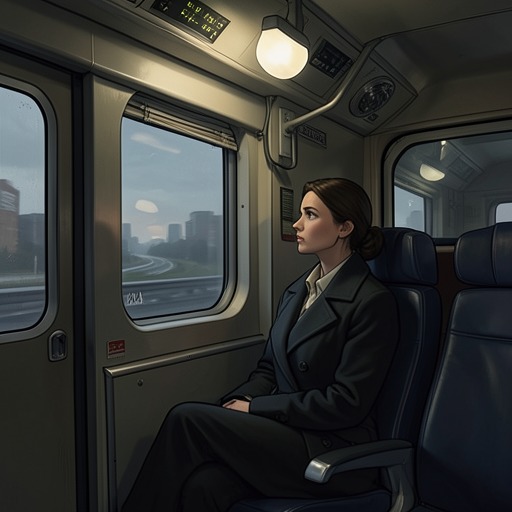
Ashbury is organized in Rachel’s life by the commute. She travels to London on The 8.04 train and returns on the 17.56, treating both departures as fixed parts of the day. When Cathy questions her pointless journeys to London, Rachel answers that these are her trains and that this is simply how it is. The routine persists even when its purpose is unclear: Rachel continues travelling while pretending to go to an office, and the journey becomes a structure she can repeat when other parts of life feel unmanageable.
The evening train takes one hour and one minute, seven minutes longer than the morning journey despite making no additional stops. Rachel does not mind the delay. She is in no hurry to get back to Ashbury, a reluctance she attributes both to the town and to the larger fact that it is not home. The contrast is especially pointed because the home she longs for is the Victorian semi beside the railway that she once co-owned, not the duplex where she now lodges. Ashbury provides an address and a place to return to, but not the feeling of belonging that the old house retains for her.
The town also becomes a route through which Rachel tries to manage the immediate struggle of drinking. After the cash machine refuses her attempt to withdraw money, she walks for more than an hour through heavy rain. With the pedestrianized centre almost empty, she decides she must do something to make amends for what she sees as her own inadequacy. On another occasion, she walks from Cathy’s flat to the church at the top of Pleasance Road, about two miles away, and back. She has attended an Alcoholics Anonymous meeting there, choosing not to go to the local meeting because she does not want to encounter people she might see on the street, in the supermarket or on the train. Even an ordinary walk is framed as a managed performance: Rachel picks a destination so she can imagine herself going somewhere, then returns to Cathy’s flat trying to appear purposeful and normal.
A Place Entangled with the Case
Ashbury’s everyday setting intersects with the investigation into Megan Hipwell’s disappearance. Rachel’s train travel gives her a way to return repeatedly to Witney and to observe people and places connected with the case, while her lodging in Ashbury marks the distance between that investigation and her unsettled private life. She is in Ashbury when Cathy calls to check on her, and she walks its streets during periods when she is trying to stay sober and recover missing parts of her memory.
The town is also where Tom admits that he met Megan in a poor coffee shop and spoke with her for twenty minutes or half an hour, after initially concealing the meeting from Rachel. The disclosure makes Ashbury more than a passive backdrop: it is one of the places where the hidden relationships around Megan’s case cross into Rachel’s domestic life. Yet the town’s broader significance remains grounded in its ordinary scale. Its shops, suburbs, church and commuter routes hold both the practical details of Rachel’s days and the encounters that unsettle her account of them.
Narrative Significance
Ashbury embodies the difference between movement and progress in Rachel’s life. She makes the same journeys over and over, walks familiar streets and returns to the same small room, but repetition does not restore the control she has lost. The routine can steady her—the train is hers in the sense that its schedule is dependable—while also exposing how little of her life feels chosen. Her insistence on the commute and her imagined destination walks sit beside her dependence on Cathy’s hospitality and her inability to regard the duplex as home.
The town’s unremarkable character also sharpens the contrast with the domestic past Rachel associates with the Victorian house by the tracks. Ashbury is where she lives; the former home remains the place against which she measures that life. As the investigation draws the residents and streets of the surrounding area into Rachel’s thoughts, Ashbury becomes the setting of a suspended present: a real home for daily purposes, but not yet a place in which she feels settled or in control.