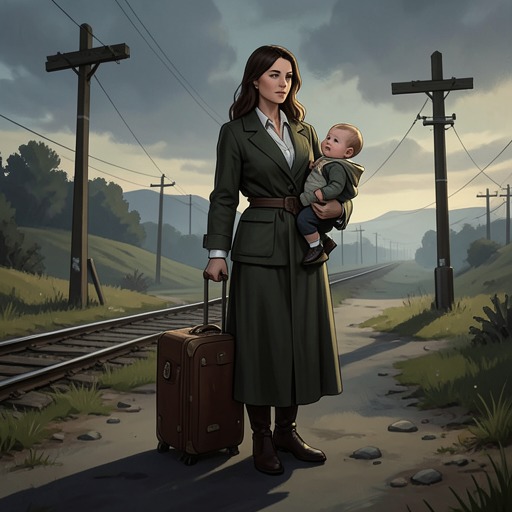
Elizabeth (Libby)
The Girl on the TrainElizabeth (Libby) is Megan Hipwell’s infant daughter, born at home and dead within the first months of her life. Although Megan recalls that the pregnancy was unwanted and that she had considered ending it, her memories of Libby are tender and particular: she gives her daughter a name, describes her as lovely and good, and remembers how well she slept. Libby’s accidental death and secret burial shape Megan’s enduring grief and become public suspicion after Megan disappears.
Identity and Birth
Megan became pregnant while living with Mac. By the time she understood what was happening, she believed it was too late to end the pregnancy; in her account to Kamal Abdic, she says that neither she nor Mac had wanted a child. She had not attended scans and, at the time, avoided medical attention and the prospect of being judged for smoking and drinking. Her account does not present this beginning as a simple measure of how she later felt about Libby: the painful circumstances of the pregnancy sit beside the affection with which she remembers her daughter.
Libby was born at home with help from a woman who had some nursing experience and was a friend of Mac’s. Megan recalls the birth as painful and frightening, but says that the baby was very small, with dark eyes and blonde hair. She cannot remember Libby’s exact birth weight, a small failure of memory that she treats as another reason to reproach herself. What she does remember is the infant’s quietness: Libby did not cry much, slept well from the beginning, and seemed to Megan to be a good girl.
A Brief Life Remembered
Megan names her Elizabeth, then calls her Libby. Saying the name aloud after so long is emotionally significant: her recollection makes the child more than the secret at the center of a past tragedy. The repeated naming conveys both the years in which Libby was not spoken of and Megan’s wish, in that moment, to linger over the sound of her daughter’s name. Megan’s account to Kamal is marked by pauses and distress, while he listens without pressing her to hurry.
The surviving account places Libby only a few months old when the fatal incident occurred. Before it, Megan and Mac had an argument of the kind they sometimes had, with one of them leaving for a time. In cold, wet weather, Megan was exhausted and drinking in an effort to warm herself. She took Libby into the bath and held her against her chest. Megan later recalled waking to the knowledge that something was wrong, with Libby in her arms. The book identifies Libby’s death as accidental; the remembered sequence is fractured, and Megan’s account emphasizes the shock and uncertainty surrounding what happened.
Death, Burial, and Silence
After Libby died, Mac came home and found Megan in the bathroom. Megan describes being unable to face looking at the baby and then running from the house into the rain. She remembers going to the beach and being in the dunes, but not everything that followed; Mac eventually found her and brought her home. These gaps leave the event bound to the same uncertainty and fear that recur in her memories of that night.
The next morning, Megan wrapped Libby in a sheet, and Mac dug a grave at the edge of the property, near a disused railway line. They placed stones over the grave as a marker. They did not talk about what had happened or look at one another. That night Mac said he had to meet someone and left; he never returned. The burial kept Libby’s death hidden, while the stones and the grave preserved a physical trace of the child whose name the adults avoided speaking.
Guilt and Narrative Significance
For Megan, Libby’s death does not become a closed episode. She later tells Kamal that the memory remains with her at night and that she fears the loneliness of the house where it happened. Her recollection joins loss to self-blame: she remembers the baby’s gentleness and her own exhaustion, and carries the unresolved knowledge that Libby died while in her care. The contrast between Megan’s early claim that the child was wanted by neither parent and her loving description of Libby prevents the story from reducing their relationship to a single feeling.
After Megan disappears, a news report attributes to unnamed sources an allegation that she may have been involved in the unlawful killing of her child years earlier, and speculates that this might explain her murder. The report is explicitly vague, and the police investigator makes no comment; it should therefore be understood as an allegation, not as established fact. Its appearance shows how the hidden burial turns Libby’s death into public suspicion and a possible motive in the case. Libby remains central to Megan’s story not through a long life on the page, but through the name, memories, and concealed grief that continue to exert force years after her death.