Life is not a paragraph
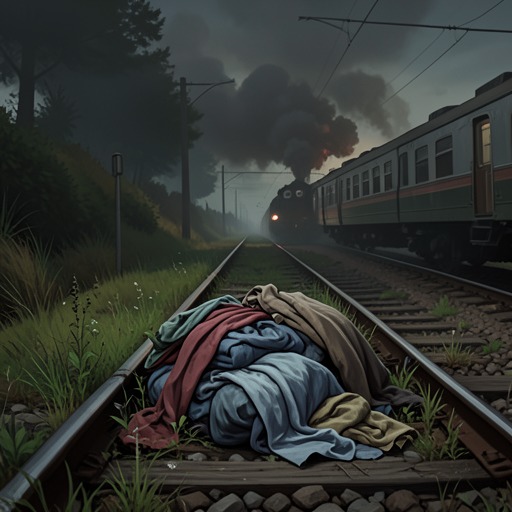
The Girl on the Train“Life is not a paragraph” is a message painted on a concrete building beside the railway, roughly five hundred metres before Euston. In Rachel Watson’s account, the inscription interrupts the ordinary movement of her commute and takes on a darker force as she thinks of the bundle of clothes beside the track.
Inscription and Context
The building is described as filthy, low-slung, and concrete; the words painted on its side read, “LIFE IS NOT A PARAGRAPH.” The message prompts Rachel to reflect that “Life is not a paragraph and death is no parenthesis.” The paired images reject the idea that life can be arranged into a tidy passage or that death can be set aside as a minor aside. Here that thought is bound to the railway scene: as the train approaches Euston, Rachel’s attention turns from the painted words to the clothes by the track, and she feels her throat closing up.
Narrative Function
The inscription appears after Rachel Watson shuts her eyes and counts to twenty, trying to make the view disappear. Her brief assurance that there is “nothing to see” is unsettled when the words on the building bring her thoughts back to the bundle of clothes beside the track. In this sequence, the phrase is more than a general reflection: it marks the failure of deliberate avoidance, as the train carries Rachel toward Euston and the image she is trying not to face returns.
Wording and Motif
The phrase changes as it passes from the building’s painted capitals into Rachel Watson’s thought: the terse “LIFE IS NOT A PARAGRAPH” becomes a paired reflection on life and death. Its second clause refuses to make death a parenthetical qualification—something bracketed off from the main account. That shift turns a stark public slogan into a private, more unsettling formulation, in which the language of writing offers no neat boundary around what has happened.
The Phrase in Motion
The train’s passage gives the inscription a formal force: the words remain fixed on the concrete while the view moves from suburbia toward the tagged bridges and empty buildings of north London. Against that changing landscape, the painted sentence briefly offers a frame, but Rachel’s inward addition refuses to let the thought end there. The movement from public slogan to private reflection makes the phrase less a settled lesson than a point where the passing view opens onto what she cannot dismiss.