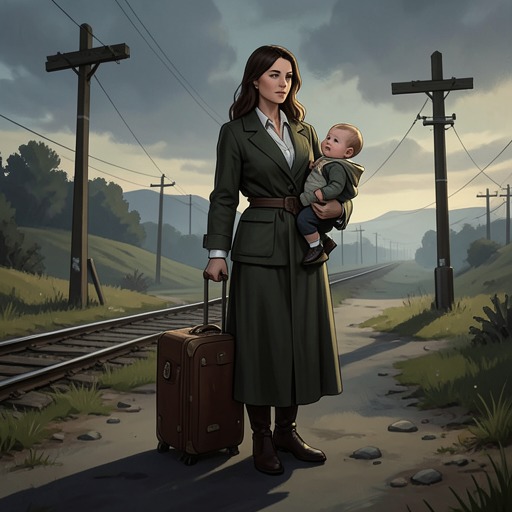
Megan’s pregnancy
The Girl on the TrainMegan Hipwell’s pregnancy brings together the possibility of a new family and the weight of an old loss. Unsure whether Scott Hipwell or Tom Watson fathered the child, Megan tries to imagine motherhood as a chance to remake herself, even as memories of Libby and fear of Scott’s response make the pregnancy difficult to disclose. Its significance lies not only in the question of paternity, but in the way Megan’s hope is inseparable from grief and apprehension.
Pregnancy and Uncertain Paternity
On Friday, 12 July 2013, Megan understands that she is pregnant and feels that the child may be a girl, though she acknowledges that she does not know. Her uncertainty extends to the child’s father. She suspects the baby may not be Scott’s, but admits that it could be; she has no certainty either way. The possibility that Scott might realize the child is not his troubles her, as does the prospect that he might reject her and the baby. At the same time, she imagines that he will be delighted and that the question of paternity may never occur to him. She does not want to hurt him, and the conflict leaves her caught between disclosure and concealment.
Scott is away at a conference when Megan dwells on these possibilities. His absence does not bring relief: she says she longs to be alone when he is present but cannot bear the silence when he is gone. She talks aloud to break it and worries about what will happen when she is alone with the child. Pregnancy therefore makes the future feel immediate while leaving its central conditions unresolved: whether Scott will accept the child, whether he is the father, and whether Megan can meet the responsibilities she imagines ahead.
Libby and the Meaning of Motherhood
The pregnancy returns Megan to the loss of Libby. When she thinks of the unborn child, she cannot separate the new baby from her memories of Libby, and the association unsettles her. Megan is frightened both by what might happen to her and by what she herself might do, yet she cannot bring herself to reject the pregnancy. She moves from expecting that she would want to end it to wanting to love the child. The change is not presented as an uncomplicated recovery: her attachment grows alongside fear and unresolved grief.
This is why Megan frames the pregnancy as an obligation to do things differently. On the morning of Saturday, 13 July, after a night in which she has barely slept, she decides to try to do what she believes is right for the baby and for Libby. She imagines raising the child with the knowledge that she tried to make a different beginning. Her resolve is bound up with a larger wish to remake herself. Recalling the many identities she has inhabited, she doubts she can become a good wife but decides she must try to become a good mother. Pregnancy offers a future she wants, while making the question of whether she can deserve or sustain that future feel pressing.
Earlier Encounters with Childcare
Megan’s response to pregnancy contrasts with her earlier experience caring for Evie. In August 2012, she walks the short distance along Blenheim Road to Anna Watson’s house to look after the baby. She resents feeling like an extra presence in a household where Anna’s attention is absorbed by childcare, and she longs instead for her former work at a gallery and conversation with adults. After leaving, she wants to wash the smell of the baby from herself. At that point, time around an infant does not awaken a wish for motherhood; Megan experiences it as something she wants to escape.
The contrast gives the later pregnancy a complicated history. Megan has already been close to the routines and demands of caring for a baby, but proximity to Evie does not prepare her for her own pregnancy or resolve her feelings about motherhood. Anna’s anxious attention to Evie also offers a view of maternal care as vigilance, while Megan’s later fear and determination reveal how much more emotionally charged the role has become for her. The pregnancy is not the fulfillment of a simple, longstanding desire; it develops against ambivalence and the memory of a child she lost.
Disclosure, Violence, and Delay
Megan does not tell Scott immediately. When she begins a difficult conversation with him, she intends to speak first about what she regards as the bad news, leaving the pregnancy until afterward because she thinks the possibility that the child might be Tom’s would make the news too cruel. Before she can tell him about the baby, Scott strikes her. Megan is shocked, though she also recognizes that she had feared this possibility. She gathers an overnight bag and prepares to leave without having disclosed the pregnancy.
The sequence underscores how the pregnancy is entangled with the danger and instability of Megan’s marriage. Her decision to delay the announcement is not evidence that she has made peace with the uncertainty; she is trying to manage the consequences of revealing it while already preparing to get away from Scott. The child remains unmentioned in this exchange, and the disclosure she has been postponing is left for another encounter.
Telling Tom
Later, Megan tells Tom that she is pregnant and then explains that the child might be his. Tom’s face is initially blank; after a pause, he congratulates her. When she clarifies the possibility of his paternity, he laughs and raises the prospect of the three of them running away together, naming Spain as a possible destination. The exchange makes explicit what had previously been Megan’s private uncertainty: Tom is a possible father, but the evidence here does not establish that he is.
The disclosure does not resolve the central questions surrounding the pregnancy. Megan has stated the possibility to Tom, but the surviving exchange offers no confirmation of paternity or settled plan for the child. Instead, her pregnancy remains suspended between two futures: the effort to become a different kind of mother and the relationships that threaten to make that effort precarious. Its connection to Libby gives Megan’s resolve its emotional force, while the uncertain fatherhood and delayed conversations keep that hoped-for future unstable.