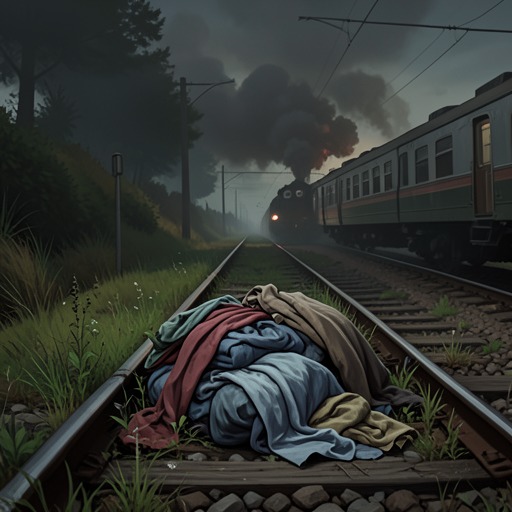
Pile of clothes beside the railway
The Girl on the TrainThe Pile of clothes beside the railway is an unidentified cluster of garments beside the tracks, repeatedly glimpsed by Rachel Watson from the train between Ashbury and London. It matters not because the narrative establishes who left it there, but because its uncertain appearance gives Rachel’s imagination a fixed point: first an unexplained sight, then a recurring image, and finally something she has to distinguish from the events surrounding Megan Hipwell’s disappearance.
Appearance and First Interpretations
On Friday, 5 July 2013, Rachel sees the pile beside the railway. A light-blue piece of cloth, perhaps a shirt, lies tangled with something dirty white. From the train she cannot determine what the garments are or how they got there. She considers several ordinary possibilities: they might be rubbish dumped in the small wood up the bank, or something left by engineers who work along that stretch of track. She also entertains the possibility that they are something else, without being able to say what.
That uncertainty draws Rachel into imagining a body behind the clothes. She recalls being told by her mother, and by Tom, that her imagination was overactive; a discarded shirt or solitary shoe makes her think of the missing counterpart and the person who wore it. The pile is therefore not identified as evidence of harm. It is an incomplete visual clue onto which Rachel projects a human story, while the actual circumstances remain unknown.
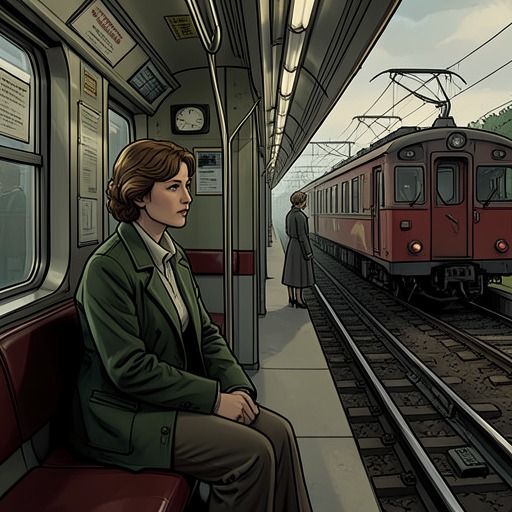
The train’s slow progress gives the sight time to register. The 8.04 train from Ashbury to Euston is delayed by old track, signalling problems, and engineering works; on this journey it jolts back into motion and moves at little more than a brisk walking pace. As it crawls past warehouses, bridges, and houses, Rachel habitually watches the outside world from a passing, unusual angle. The clothes interrupt that familiar practice. Rather than offering a glimpse into an apparently settled home, they prompt thoughts of someone absent.
Repetition and Changing Attention
When Rachel sees the pile again on Tuesday, 9 July, it has not moved. It looks dustier and more forlorn to her than it did several days earlier. Its continued presence makes the object harder to dismiss as a fleeting glimpse, though it still supplies no explanation. Rachel has read that a train can tear clothes from a person and considers deaths on the railway, including the reported annual number. She looks carefully for blood as the train passes, but sees none. Her inspection is specific, yet inconclusive: the absence of visible blood cannot tell her what the pile is or why it is there.
The same journey also shows how Rachel’s attention shifts among what lies beside the tracks. At a signal, she watches a woman standing on a patio in front of French doors, then tries not to look at the house that used to be hers at 23 Blenheim Road. The pile belongs to this routine of watching, but has a different pull. It does not offer Rachel a domestic scene to imagine; its fragmentary form invites her to supply the missing person herself.
The image returns even when Rachel is no longer looking at the tracks. One Saturday morning, awake early while Cathy vacuums the hallway, Rachel thinks of the clothes alongside thoughts of the woman she has seen kissing her lover. She cannot sleep on, and the day ahead feels empty. In that quiet interval, the pile has become one of the details that recur in her mind, linking the train journey to her unsettled waking hours without revealing anything new about its origin.
Connection to Megan’s Disappearance
Later, as Rachel follows newspaper coverage of Megan’s disappearance, she sees uniformed police outside the back door of Scott Hipwell’s house. The sight makes her wonder whether the police have found something there, and the clothes come back to her as she imagines possible explanations for what may have happened to Megan. The association is an anxious inference, not a discovery: Rachel has no evidence that the garments belong to Megan or are connected to the investigation.
Crucially, Rachel recognizes a chronological limit. She saw the pile before Megan went missing. That earlier sighting prevents it from being a straightforward trace left by Megan on the night of her disappearance, even as Rachel’s fear brings the image into her thoughts about the case. The distinction between what she saw and what she suspects becomes part of the object’s significance: the clothes are real, but the story she might attach to them is not confirmed.
Narrative Function and Limits
The pile recurs at moments when Rachel is unable to settle her attention: on the delayed train, during a later inspection of the garments, in a morning when sleep will not return, and while she reads about the police inquiry. Each return adds weight to its place in her consciousness, not to any proven role in Megan’s disappearance. Its material details remain sparse, and the narrative never identifies its owner, its precise contents, or the reason it was left beside the track.
That gap sustains a tension between observation and projection. Rachel notices concrete features—the light-blue cloth, the dirty-white material, the dust, and the lack of visible blood—but those details cannot resolve the question she keeps asking herself about the person who might be connected to them. When the police presence at Scott Hipwell’s house intensifies her need to know what has happened, the pile has already become one of the images through which she processes uncertainty. Its decisive function is thus not to solve a mystery, but to expose the distance between seeing an object and knowing the human circumstances behind it.