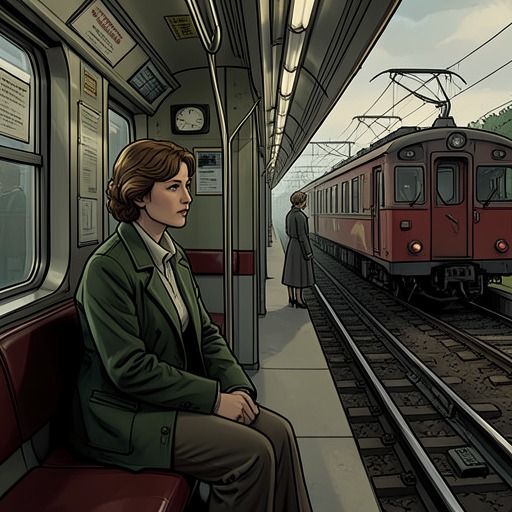
Rachel Recalls Anna Getting into Tom’s Car on the Night Megan Disappeared
The Girl on the TrainRachel Watson’s recovered memory of Anna Watson getting into Tom Watson’s car on the night Megan Hipwell disappeared turns the Witney railway underpass from a place of unease into a possible scene of testimony. The memory arrives gradually, prompted by Rachel’s deliberate return to the tunnel entrance, and immediately unsettles the explanation she had accepted about where Anna and Tom were that night.
Returning to the Underpass
That evening, Rachel acts on Kamal Abdic’s suggestion that she revisit the scene. Instead of hurrying past, she walks slowly to the underpass entrance and places her hands against the rough brick, trying to summon what happened. Nothing comes at first. The road is quiet, and Rachel feels unable to move farther into the tunnel; she turns to leave without recovering anything.
The attempt follows an earlier return to Witney, when familiar routes stirred a bodily sense of recognition. Passing the underpass, Rachel had stopped, struck by an image of herself there that she could not establish as a real memory. She remained unsure whether something had happened in the tunnel, but felt certain that the place was connected to something bad. The later visit makes that uncertainty active: rather than treating the location only as a source of fear, she tries to use it to recover a specific sequence of events.
The Memory Returns
As a woman in a deep-blue trench coat passes, the color and quality of the light trigger Rachel’s recollection. She remembers Anna in a blue dress with a black belt, walking away from her quickly. In the recovered scene, Anna looks back, stops, and approaches a red car that has pulled up beside her. Rachel recognizes it as Tom’s car. Anna speaks to him through the window, gets inside, and the car drives away.
Rachel recalls that she was standing at the entrance to the underpass on the Saturday night Megan disappeared, watching Anna leave in the car. The memory is specific, but Rachel does not experience it as secure knowledge. She believes she remembers the scene while also struggling to reconcile it with what she had been told. The recollection therefore arrives as both an image and a problem of trust: it gives Rachel a possible account of the night, but not immediate confidence in her own ability to remember it correctly.
Conflicting Accounts
The recovered scene contradicts the version Rachel had accepted from the police: that Tom came looking for her alone while Anna was at home. Rachel cannot make that account fit with what she now sees in memory, and the contradiction leaves her distressed and doubtful. Her uncertainty matters because the scene concerns people and movements she had previously treated as settled, while her alcohol-related memory gaps have made her own recollections difficult to rely on.
A later account from a man who encountered Rachel near the underpass lends partial support to the broader sequence. He remembers Rachel being upset after a quarrel with her husband, declining his offer to help, and her husband leaving. He also recalls that the man got into a car with a woman. This account does not establish that the woman was Anna or that the car was Tom’s, but it offers an independent detail consistent with Rachel’s recovered memory: Tom did not necessarily leave alone.
Significance of the Recollection
The memory changes the underpass from a site associated chiefly with Rachel’s fear and possible injury into a vantage point from which she may have witnessed Tom and Anna together. Its force lies not in resolving every uncertainty, but in exposing a discrepancy between Rachel’s recovered perception and the account she had been given. Because the memory returns through a color, a passing figure, and the familiar entrance rather than through deliberate reasoning, the scene also makes the process of recall part of the evidence: recognition comes first, while certainty remains out of reach.