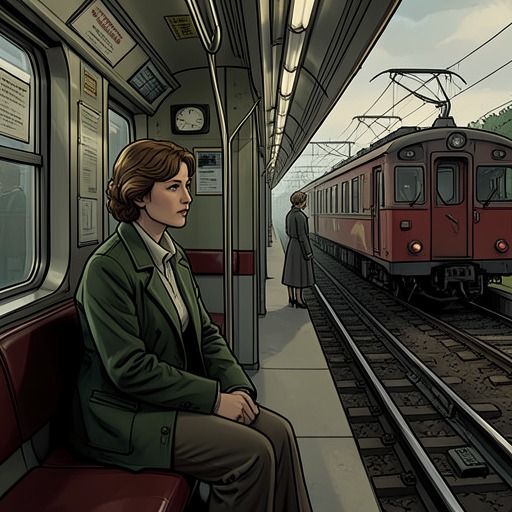
Rachel and Anna Expose Tom and Hear His Confession
The Girl on the TrainRachel and Anna Expose Tom and Hear His Confession is the turning point in which Rachel Watson’s recovered memory and Anna Watson’s evidence break through Tom Watson’s control of the story. Rachel identifies Tom as the man who attacked her in the underpass, Anna reveals that she remembers Megan Hipwell getting into his car, and the phone Anna found makes his denial of an affair untenable. Tom’s account then supplies the circumstances of Megan’s death and burial, even as he repeatedly tries to recast violence and murder as other people’s fault or as an accident.
Memory Returns and the First Disclosure
Rachel’s recognition comes after a long period in which Tom has made her distrust her own recollections. When she was drinking, he told her what she had supposedly done and said; she learned to stop asking for details and to apologize instead. He also threatened to record her, though he never played her a recording. That history gives his manipulation a practical hold over her: her own uncertainty becomes a reason to accept his version of events.
The reversal begins when Rachel remembers that Tom really did strike her and leave her injured in the underpass. What she had treated as a half-dream, with a threatening figure approaching and hitting her, resolves into a memory rather than an imagined scene. The golf club and the hole in the plaster also acquire a different meaning: Rachel now knows she was not the person swinging the club. The recovered memory does not immediately give her confidence about what to do. She starts to call the police and Detective Sergeant Riley, hangs up both times, and goes to the station, where the Sunday service means the first train is still half an hour away.
When Rachel tells Anna that she remembers seeing Megan get into a car with Tom that night, Anna initially resists what the admission would mean. Rachel explains that she had first mistaken the woman for Anna, but now remembers the sight clearly. The recollection links Megan’s disappearance to Tom’s movements and changes Rachel’s role: she is no longer only a witness unsure of her own memory, but someone asking Anna to act on what they know. Rachel urges Anna to speak to the police and not to remain with Tom.
The Confrontation at the House
On the afternoon of Sunday, 18 August 2013, Anna runs into the house when Tom arrives. Rachel follows, stopping outside the sliding doors. Inside, Tom embraces Anna, with Evie between them; Anna’s shoulders shake, while Tom looks at Rachel. His light manner and joking suggestion that he has found the women gossiping do not reassure Rachel. She recognizes that his apparent ease is a performance, but she also knows that her phone is still in her pocket and regrets not having called the police before he came home.
Rachel finally tells Tom that she saw him after he hit her and that he left her in the underpass. Speaking the accusation brings her a brief rush of elation. Tom laughs, but Rachel sees panic in his eyes and watches him glance toward Anna. His attempt to discredit Rachel follows the pattern that has kept her silent: he suggests she is making things up and assures Anna that he will prevent Rachel from bothering them again. For a moment, Anna appears to search Tom’s face for the truth, and Rachel has to call her back to what she knows.
The decisive change comes when Anna says she found the phone and asks Tom not to lie. That admission connects Rachel’s recovered memory to evidence Anna has kept, and Tom’s response shifts from dismissive reassurance to questions about where the phone is and whether Rachel has it. He takes Evie from Anna and rocks her by the window while Anna bows her head over the kitchen table. The domestic gestures do not settle the confrontation; against the phone and Anna’s disclosure, they make visible the family Tom is trying to protect alongside the violence he has concealed.
Tom’s Account of Megan’s Death
Later, with Rachel and Anna present, Tom explains that he and Megan had begun with sex, but that Megan later wanted them to leave their partners and start again together. He says she became angry when he was unavailable and threatened to tell Anna about their affair. He had been relieved when contact stopped, but Megan called again on the Saturday, saying she had something important to discuss. Tom ignored her, and she renewed her threats to come to the house.
Tom says Anna had planned to go out to dinner with friends while he stayed home to look after Evie. Instead, Anna returned shortly after seeing Rachel drunk outside the station and worrying that Rachel might come to the house. Tom claims he went out to deal with Rachel rather than meet Megan. He describes taking Rachel to the underpass to keep her from making a scene in the street, hitting her when she cried, and wanting both her and Megan to stay away from his family. His account confirms the assault Rachel has just remembered, but he frames it as an angry response to an inconvenience rather than a choice for which he is responsible.
After leaving Rachel, Tom encountered Megan as she headed toward Blenheim Road. He says he persuaded her to go with him to Corly Wood, a place where they had sometimes gone to have sex in the car. There, Megan told him about her pregnancy and the possibility that he was the father. Tom describes rejecting any involvement with the baby. As Megan shouted that she would tell Anna and would not let her child be neglected, he picked up a rock and struck her. He says the blow was not intended to kill her, but also admits that, after she was badly injured and tried to crawl away, he decided he had to finish it.
Burial, Blame, and the Limits of His Confession
Tom says he put Megan in the boot of his car and drove farther into the wood, away from the road. He dug her grave with his bare hands because he was afraid someone would arrive; the work took time and tore his fingernails. He stopped to phone Anna, telling her he was out looking for Rachel. The grave was not as deep as he wanted, and he imagined he might return later to move Megan somewhere better. Rain followed, and he never did. These details give his confession a material sequence—car, isolated ground, hands in the soil—while his explanation continues to center his fear and predicament.
He also admits that he thought the police might suspect Scott, whom Megan had described as jealous and watchful. Tom says he considered putting Megan’s phone in Scott’s house, though he insists he had no settled plan and calls the killing a terrible accident. His account therefore reveals both the intended direction of suspicion and the effort to minimize his own agency. The confession is not a simple acceptance of guilt: he repeatedly presents Megan as demanding, Rachel as disruptive, and his violence as something provoked or unavoidable.
That strategy reaches its clearest expression when Tom later blames Rachel for the chain of events, arguing that if she had not appeared drunk near the station, Anna would have gone to dinner and he might have dealt with Megan differently. Rachel recognizes the familiar maneuver: he makes her feel that everything is her fault. The confrontation’s importance lies not only in the facts Tom discloses, but in the contrast between those facts and the story he tells about them. Rachel’s recovered memory and Anna’s discovery of the phone give the women grounds to challenge his version; his confession confirms the attack, the murder, the burial, and his thought of framing Scott, even as he tries to distribute responsibility everywhere but himself.