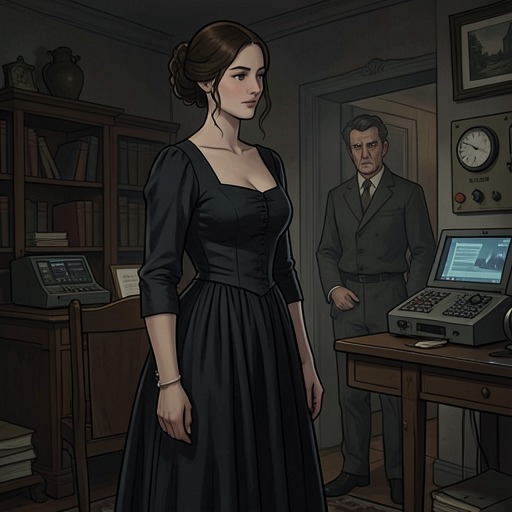
Rachel tells Scott about the Kamal lead
The Girl on the TrainRachel tells Scott Hipwell about the man she saw with Megan Hipwell, but the disclosure is a carefully managed half-truth: she confirms the likely identity of the man while hiding that she has already given his name to police. The scene turns an uncertain sighting into a concrete lead on Kamal Abdic, and gives Scott a new explanation for Megan’s apparent improvement before her disappearance.
The Oblique Approach
Rachel’s visit is shaped by what she cannot safely admit. She knows she has already identified the man to the police, but believes they did not take her account seriously; if she tells Scott this, she fears his trust in her will disappear. When he asks whether she could recognize the man again, she answers that she might, then steers the conversation toward a newspaper quotation from Megan’s friend Rajesh. Her suggestion is not a straightforward report of what she knows, but a way of prompting Scott to search for a name without disclosing how much she has already done.
The strain of the exchange registers physically. In the room, the heat seems to build, the antiseptic smell becomes overpowering, and Rachel feels faint. Framed photographs show Megan alone: smiling on a beach in a sundress, or in close-up with striking blue eyes. Scott’s hand on Rachel’s wrist as she tries to leave makes the conversation feel uncomfortably like restraint; she withdraws her hand but stays when he asks her to. The photographs, and the absence of pictures of Scott and Megan together, furnish the room with Megan’s image while Scott tries to reconstruct the life he shared with her.
From Rajesh to Kamal
Scott initially rejects Rajesh Gujral as the man Rachel saw. He knows Rajesh as an artist who exhibited at the gallery, describes him as married with children, and goes upstairs to find a picture. The leaflet he brings back advertises a gallery show and shows Rajesh beside a colorful abstract painting. The pictured man is older, short, stocky, and bearded; Rachel says he is not the person she saw. Scott abruptly leaves the room again, this time returning with a laptop.
As Scott searches, he recalls that Megan had been seeing a therapist named Kamal Abdic. He describes Abdic as dark-skinned and says that, from a distance, he could be mistaken for an Indian man; he believes Abdic came from Serbia or Bosnia, though he is unsure which. Scott turns the laptop toward Rachel and shows her a photograph on a website. She recognizes the man immediately. The identification resolves the question raised by her sighting, but it also makes the therapist—not the gallery artist—the focus of Scott’s attention.
Scott then closes the laptop and sits with his elbows on the table, his forehead against his fingertips. His arms tremble, and he remains silent for a long time. He explains that Megan had suffered anxiety attacks and trouble sleeping beginning sometime the previous year. He had encouraged her to seek medical help because he felt unable to help her himself; a doctor recommended Abdic. Scott says therapy seemed to be helping and Megan had become happier. In light of the identification, that improvement acquires a troubling new meaning for him, though the scene establishes suspicion rather than proving what happened between Megan and her therapist.
A Lead Passed to the Police
The exchange has consequences beyond Scott’s discovery. In a later phone call, Scott tells Rachel that the family liaison officer, Detective Sergeant Riley, visited that afternoon. He says he mentioned Kamal Abdic as someone worth speaking to, but deliberately does not tell Riley that Rachel prompted the lead. Instead, he claims he had been trying to think of anything significant and had remembered Megan’s therapist himself. He also tells Riley that he had past concerns about their relationship.
Scott reports that the police had already spoken to Abdic and would speak to him again. Riley asks why Scott had not raised him earlier. Scott distrusts her, feeling that although she is supposed to be on his side, she is snooping and trying to trip him up. His account confirms that the name has entered the investigation while preserving the concealment at the heart of Rachel’s approach: the police receive a lead, but not its true route to them.
Significance of the Disclosure
The scene advances the investigation through a chain of partial disclosures rather than a clean confession. Rachel withholds her prior contact with the police; Scott tests one possible identity before recalling another; the photograph converts his suspicion into a recognition Rachel can confirm. Each step narrows the uncertainty, yet leaves the characters’ motives and the nature of Megan’s relationship with Abdic unresolved. The event therefore supplies an investigative direction without settling the case.
It also changes Scott’s understanding of Megan’s final period. He had encouraged her to seek treatment because her anxiety and sleeplessness seemed beyond his ability to relieve, and he had taken her later happiness as evidence that the therapy was working. Once Abdic is identified as the man Rachel saw, that same improvement can be read differently. Scott’s grief, his trembling silence, and his decision to take the name to Detective Sergeant Riley show the personal cost of the new suspicion; his concealment of Rachel’s part shows how the lead is carried forward under conditions of distrust.